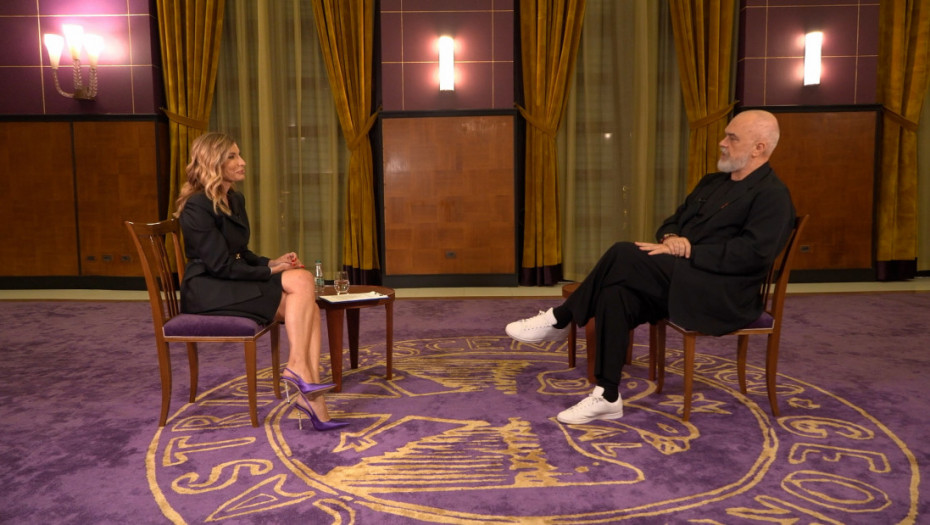
Recorded in Tirana. Broadcast on Euronews Serbia, 14 July 2026.
Editor’s note: This interview was recorded in Tirana days after the NATO summit in Ankara (7 and 8 July 2026) and broadcast on Euronews Serbia’s programme Direktno sa Minjom Miletić. The conversation was conducted in English and aired in Serbian translation; the transcript below is an English rendering of the Serbian broadcast text, so phrasing may differ in places from the Prime Minister’s original words. Obvious transcription artifacts in the source have been corrected against context, and speaker attributions in a few rapid exchanges reflect editorial judgment.
Minja Miletić: You are watching a special edition of Direktno sa Minjom Miletić, exclusively from Tirana. I am speaking with the Prime Minister of Albania, Edi Rama. Prime Minister, thank you for making time for this exclusive interview for Euronews Serbia.
Four years ago we spoke in Belgrade, and I think the world has changed dramatically since then. The war in Ukraine goes on, the conflicts in the Middle East continue, and at the same time European Union enlargement has returned to the top of the European agenda. We are speaking only days after the summit in Ankara, and I would like to ask you: what was the main political and security message that Tirana sent to its NATO allies?
Edi Rama: Look, we are far too small a country to be sending messages to allies in NATO. For us it is a great privilege to be part of that family where all the big, smart and strong boys are gathered. We contribute our share, of course, but we are fully aware that we cannot change the fate of the world. Sometimes that is bad, and sometimes it is very good.
Miletić: But next year Tirana will host the NATO summit?
Rama: Yes. The date has not yet been officially confirmed, but it is confirmed that we will be the hosts of the next summit. And when it comes to hospitality, we are better at it than many others. I am certain we can organize a truly excellent summit, one that will be remembered for a long time.
Miletić: Do you believe we are entering a long period of global instability?
Rama: It is not a question of whether I believe it. It is a fact. NATO has decided that member states will set aside more money for defense.
Miletić: Does that mean security now takes precedence over economic development?
Rama: I believe that Europe in particular is trying to turn this circumstance into an opportunity, to build an industry that will contribute at the same time to growth and to economic development. That is what they believe in and what they are working on right now.
Miletić: And what about small states? Will they, in these very challenging times, be forced to choose between the United States, China and Europe?
Rama: [laughs] It is not easy to be a small state at a moment like this. But when it comes to Albania, because of our history, we find ourselves in a somewhat more comfortable position. We have no relations with Russia. I mean, diplomatic relations exist, but practically nothing else. Since 1960 we have not had a single high level visit to Moscow, nor have we hosted any senior Russian official. And we do not miss it at all. With China the situation is different, but we do not have particularly close relations with China either. Perhaps in your country’s case it is different, and other states have different relations. For them it is more complicated. For us it is easier, because we are, in a way, Western Taliban. We go in one direction only, and we are happy about it. We do not miss the rest.
Miletić: What is, in your view, the greatest challenge for the European Union today? Is it Russia, the United States, or its own internal political problems?
Rama: Look, I think democracies as a whole are going through a very difficult and challenging period. At the same time, while we strengthen our capacity to protect ourselves and invest more and more in defense, we are completely exposed to an enemy within. And that is social media. Their ability to negatively influence the way people think is an enormous problem. But that is not the only problem.
Miletić: How do you protect yourself from that?
Rama: Social media have also become a tool that allows all our enemies, adversaries, or whatever you want to call them, to turn our discontent, our hopes and our bitterness into an instrument for interfering in our internal affairs. That is what makes the situation so complex.
Miletić: But social media are not the only problem?
Rama: Look, we may have many problems, but I think social media are our biggest unresolved problem.
Miletić: When you say “we,” you mean democratic countries in general?
Rama: Democratic countries. Democratic countries have confused freedom of speech with freedom of reach. The fact that today anyone can reach any brain in our society, influence it, and plant every kind of madness in it, is an enormous problem for us.
Miletić: Why are you laughing?
Rama: Because you said crazy shit. I said crazy shit. I do not know how to say it in Serbian, but in English it is crazy shit.
Miletić: We will come back to social media later, but I want to ask you how these geopolitical developments will affect the Western Balkans. Is the region acquiring new strategic importance today, or do you think that is not the case? I ask because I mentioned at the beginning that EU enlargement is once again high on the European agenda.
Rama: I believe that despite all these upheavals, the European Western Balkans is holding up rather well today. If we look at where we were a few years ago, we are in a much better situation today. Of course, we could do more. Of course, we could do much more together. But I think that today Europe needs the Western Balkans as much as we need Europe. Perhaps even more.
Miletić: Why?
Rama: Because we are an important piece of the puzzle that is missing from the European mosaic. Europe can hardly function if it leaves us outside its house and away from the table where decisions are made.
Miletić: German Chancellor Friedrich Merz recently spoke about accelerating the EU enlargement process. Do you think that political decision is final, or do you expect the rules could change once again?
Rama: You are asking me to predict what the European Union will do. That is impossible. But I can tell you that more and more often I hear an awareness that something must change. That the current way of functioning is no longer sustainable. And that the countries of the Western Balkans must be closer to the European Union. Will it really happen? I do not know. But I know that we must do everything we can to push things in that direction. And before we start talking about chapters, criteria and standards, or in parallel with all of that, they should gather us around the same table. Politically speaking, this family should be together.
Miletić: Is there a risk that, because of Ukraine, the Western Balkans will once again fall into the background?
Rama: I do not think so. On the contrary. I think it would be good for Ukraine to be part of this, let us say, new political era of greater closeness. The seven countries currently in active negotiations with the European Union, I call them Ursula’s seven children, because Ursula has seven children: Albania, Montenegro, Serbia, North Macedonia, Bosnia and Herzegovina, Ukraine and Moldova. They should all sit at the same table. And then I hope Kosovo will join them.
Miletić: You mean you would support Ukraine entering before us?
Rama: No. It should apply to all of us, but I am not talking now about membership itself at all. Membership will be based on merit, as they like to say, and each country will go through that process individually. Politically, however, all of us should already be sitting at the same table, as a family. In every family you have grandparents. Those are Germany and France. You have parents, aunts and uncles. Those are Italy, Denmark, Slovakia, Slovenia and the others. And then you have the children. And those children should sit at the same table. Because if you tell them to stay out in the neighborhood until they grow up, one day they may never come back to the family table. One daughter will fall in love with a Russian gangster, one son will become addicted to Chinese toys, a third will simply go astray. So it is better for the children to be at the table, exactly as Ursula has done. She is a great mother. She does not let her children out of her sight.
Miletić: Lately the question is often raised of which country will enter the European Union first. Will it be Albania or Montenegro?
Rama: I do not like that way of thinking. I remember the time when I was leading Albania and Serbia was the main favorite. Now they tell us that we are the favorite and Serbia is behind us. In the meantime, Montenegro has become the favorite ahead of all favorites.
Miletić: If, for example, Montenegro became an EU member first, would you see that as a failure of Albania’s European policy?
Rama: No, no. Montenegro is a wonderful country. It would be nice for the EU to gain another beautiful coastline, but the point is something else. This must be a broader process. Montenegro truly deserves credit. Montenegro managed to go from a country known for smuggling to a country everyone gladly accepts today. Well done to them. I genuinely respect them. They have made incredible progress. But that is not enough. More needs to be done. That is why I keep repeating that we should all sit at the same table.
Miletić: When we spoke four years ago, you said the EU must be braver toward the Western Balkans. Four years later, are you more of an optimist today, or more disappointed?
Rama: The European Union became braver thanks to Putin. In a way, he woke them up. Until then they were sleepwalking, repeating the same sentences over and over, living in the conviction that everything was perfectly fine. Then they suddenly realized it was not. They realized they had to get serious. So Putin, paradoxically, helped the European Union become braver and NATO become stronger. In that sense, he helped them a great deal. Now I think they have entered a new phase. I see things changing. The only question I ask myself is whether they will move quickly, or whether they will wait for some of them to lose elections and then everything starts over from the beginning. That I do not know.
Miletić: I would now like to talk about the political relations between Belgrade and Tirana. Over the years you have built a very specific political relationship with the President of Serbia, Aleksandar Vučić. How would you describe that relationship today?
Rama: I am convinced that in the Western Balkans we could have done more. And I am convinced it would have been useful for everyone. But we had our own difficulties. We stumbled. Along the way, new questions kept opening up. Still, regardless of everything, one thing is certain. No one is going to disappear from this space. We are all staying here. So the choice is very simple. Do we want to keep clashing and creating new problems for ourselves, or do we want to find a way to cooperate? What matters most in our relationship is that we have agreed to disagree on the question that is a red line for both sides. For us, Kosovo is an independent state. History determined it that way, and we believe it should be recognized as such. For you it is different.
Miletić: We do not recognize Kosovo as a state.
Rama: Yes, but that should not prevent us from finding the things we can cooperate on. The more we cooperate, the better it will be for everyone. And it will also be easier to resolve that question one day. That is how I look at it.
Miletić: How often do you speak with President Vučić today? Do you still have direct communication?
Rama: When there is a need, we communicate. What is good in our relationship is that it is very open. Each of us says exactly what he thinks. Sometimes that is not pleasant. Sometimes it can be hard. But that is exactly how relationships survive the test of time. There are good periods and there are bad periods. We have had disagreements, but yes, we still communicate. And communication is the most important thing.
Miletić: Can the Western Balkans be stable without any relationship with Russia?
Rama: Look, I have already told you, we have no relations with Russia. And we do not doubt for a second that Russia is the aggressor and that Ukraine is the victim of aggression. We are not trying to win any favor with Russia. But I have always said it is stupid not to talk to Putin. Europe and America should talk to Putin. Dialogue must exist. Dialogue does not say who the other side is. Dialogue says who you are. That is why it is important to talk.
Miletić: Yes, I agree. Absolutely. When we last spoke, you were one of the loudest advocates of the Open Balkan initiative. Do you think today that it was a good idea, or did politics in the end defeat economics?
Rama: You know, it was a bad idea for one reason only. Because Vučić and I stood behind it. If you removed our names and put two other names in their place, any two, everyone would say it was an excellent idea. The essence is that if the same idea had come from someone else, everyone would have called it excellent. And it actually is excellent. Because it is exactly what we will be doing one day when we become EU members. But it ran into resistance. And that is fine. It is part of the process. I hold nothing against anyone because of it. I think the initiative played its role. It was useful. It pushed things forward.
Miletić: Is the region’s biggest problem today that there is not enough trust among political leaders, or that there is no political will to resolve the open political questions?
Rama: Look, I will say it again: I do not believe in trust. I do not believe that anyone is good or evil by nature. I think every human being is a complex creature, and every situation is complex. I believe in what people and states want to be. So again, it all comes down to who you are and what you want to be on the international stage. It is not a question of how much you trust someone or not. It is a question of who you are. It is a question of your country’s interests. It is a question of finding pragmatic ways to protect your country and help it move forward.
Miletić: When it comes to open questions, we cannot avoid Kosovo. You know very well that Kosovo is the most sensitive political and national question for Serbia. You also know that the Belgrade and Pristina dialogue is practically standing still. Who, in your view, bears the greatest responsibility for the current situation?
Rama: Serbia.
Miletić: Why?
Rama: Because it does. Because Serbia is not ready to accept reality. And reality has changed. There is no longer any such thing as “Kosovo and Metohija.” There is the Republic of Kosova.
Miletić: I cannot agree with you, because, for example, five member states of the European Union do not recognize Kosovo. Under our constitution, Kosovo is part of Serbia.
Rama: I know. But I also know that even though you are not a mathematics professor, you know very well that five out of twenty seven is a small number.
Miletić: Fine, but it is still a number. It means that an overwhelming majority… We are not weak on this. It does not mean we cannot fight for our own country.
Rama: This is not about weakness. It is about accepting the fact that reality has changed. Just as all the other peoples of the former Yugoslavia found their path and became independent, so the Albanians had the right to self-determination. With good cooperation and a harmonious relationship with the minority, of course. Today Albanians are no longer a minority in Serbia. Serbs are a minority in Kosovo.
Miletić: Fine, but there is the Brussels Agreement. Under that agreement, Albin Kurti is supposed to form the Association of Serb Majority Municipalities, and he refuses to do so. You cannot apply the Brussels Agreement selectively. I hope you agree with me. And on the other hand…
Rama: Just a moment, please.
Miletić: I want to ask you one more thing. On the other hand, we very often see unilateral moves in the north of Kosovo. Serbs are being arrested almost daily. How do you view such a policy?
Rama: I understand what you want to say, but I do not want to enter that debate, because on one side you can claim that certain moves exist, while on the other side someone will say that terror was carried out there against people by terrorist groups coming from Serbia. But allow me to tell you something. I have one rule that I always keep. I never speak in a foreign language about the political opposition in Albania. So do not ask me to say, on your television and in a foreign language, things that concern Albin Kurti and my brothers and sisters in Kosovo. Let us agree on this. I will say only the following. The essence is that Serbia is the largest country in this region. It has its role. It has its history, which it must face. In my view, and I said this when I first visited Belgrade, the sooner Serbia faces reality and accepts that Kosovo is gone and that a new reality exists, the better it will be for Serbia itself. That is my view. But you know best what is good for you.
Miletić: All right. Albania signed an agreement on military cooperation together with Croatia and Kosovo. Why did Albania need such an agreement with Croatia and Kosovo, given that both Albania and Croatia are part of NATO?
Rama: I have heard that many times already. Your president is very fond of returning to that topic. Check it. You are a journalist. Check the agreement Serbia has with Croatia. The military agreement between Serbia and Croatia. Then compare it with this one. If it is a question of anyone needing to be afraid, then the military agreement between Serbia and Croatia is far more frightening. Check it.
Miletić: Fine, but explain to me: what is the concrete aim of that agreement?
Rama: Nowhere, in no part of it, in no form, is there any aim connected to Serbia. Not everything revolves around you. It can be about other things too. So do not think that everything is about you.
Miletić: Did you want to send a political message to Serbia with that agreement?
Rama: Look, we are a member of NATO. Croatia is a member of NATO. Kosovo wants to become a member of NATO one day. How, then, could we view anything separately from the military alliance and from the way the Alliance views the world? It is simply not possible. Even if we were stupid, and perhaps we are not especially smart, we are not that stupid.
Miletić: But you have not answered my question. What is the concrete aim of that agreement?
Rama: It is a cooperation agreement. Very simple. There are many such agreements. Again, I remind you: Serbia and Croatia have a very important agreement in that field. Should we now be the ones who are afraid?
Miletić: No, you tell me. If Serbia has no reason to see this agreement as a threat, why did you not speak with Belgrade before signing it? And why, for instance, did you not invite the other countries of the region to join it?
Rama: Has Belgrade, or Aleksandar, ever considered that he should speak with me, or with Tirana, when he concludes agreements with Putin, with Xi Jinping, or with Iran?
Miletić: That is not the same.
Rama: Yes. That is his business. We may be children in Brussels, but in the Balkans we are grown up. Everyone does what they consider necessary. And that is entirely normal.
Miletić: But I want to say that Serbia does not recognize Kosovo as an independent state, and that is why it sees this agreement as a very sensitive security question and a potential threat.
Rama: Yes. But that oversensitivity of yours is precisely what you must overcome. It is not good for you. You are a big country. You are a serious state. In the past ten years you have made enormous progress. For years you have been a leading destination for foreign direct investment. So you should not be so oversensitive. You should have more self-confidence. And you should let Kosovo go.
Miletić: We do not want to let Kosovo go.
Rama: That is because you are still a little childish when it comes to that question.
Miletić: Do such initiatives contribute to building trust in the Western Balkans, or is there a danger of triggering a new arms race in the region?
Rama: There is no arms race in the Western Balkans. There is no arms race of any kind in the Western Balkans. Let us be serious. These are three NATO member states.
Miletić: Kosovo is not a NATO member.
Rama: I mean Montenegro. Do not forget Montenegro, North Macedonia, us. Three NATO members. What arms race? What war? Enough already. Wars belong to the past. We must go toward the future, obsessed with peace and cooperation. What arms race?
Miletić: But I still do not understand why you signed that military agreement.
Rama: That is exactly why you do not understand it. You are oversensitive. I will not say jealous, because you have no reason for jealousy. We were not jealous when Croatia signed an agreement with you before that.
Miletić: Maybe the problem is not Croatia. Maybe the problem is Kosovo.
Rama: No. Then that is your problem. That is why I always say, when it comes to Serbia and Kosovo, it is your problem. It is not the world’s problem. It is not our problem.
Miletić: What is, in your view, the greatest threat to the region’s stability today? Is it the unresolved political disputes, economic stagnation, or the influence of the great world powers?
Rama: The greatest threat is us, to ourselves. I mean our past, our oversensitivity, the fact that we sometimes behave childishly and sometimes fail to grasp that the world has changed and that we, too, must keep pace with those changes.
Miletić: Let us move on to the situation in Albania. As Prime Minister, you have faced protests against the project of Jared Kushner’s company. Critics question the choice of location and the transparency of the project, and they claim it could endanger the environment. How do you answer the accusation that the interests of investors have been placed above the interests of Albania’s citizens?
Rama: Look, this is a very important moment in our history. And it goes beyond the topic of the project, because the project is actually not what matters most here. The protest goes beyond the question of the project. This is not just about the flamingos. It is about something much bigger. It is a sign that the country has moved to a higher level of development. That development has become the new benchmark. That people are no longer willing to tolerate what is missing. Or rather, they are willing to tolerate it far less than before. People want more. And they want it now. And you cannot blame them for that. That is the price of our success. We achieved enormous success by changing the course of history. We turned Albania from a country that was the black sheep of Europe into a country that twelve million tourists visited last year. In Tirana we built a city whose airport is bigger than Belgrade’s, which was historically the main airport in the region. I could list much more. But people have understood that change is possible. That success is possible. And now that is no longer enough for them. Once it was enough to build one school. Today you can build a hundred schools. And we have built them. But that is no longer the point. What matters is what happens inside that school. How good the education is. How satisfied the parents and the children are. Once it was enough to build a park. Today everyone wants a park in their own neighborhood.
Miletić: Are you saying this is a consequence of a higher standard of living?
Rama: Yes. These are rising expectations. In my view, these are protests of rising expectations. And we must face that. We must understand people.
Miletić: But what does that mean concretely? Are you prepared to reconsider the project, or are you determined to continue with its realization?
Rama: It is not about the project. The project was only the drop that made the glass overflow. There are many different reasons here. It would be naive to believe that it is all only because of that project. Of course, the project is one part of the whole story. And that is why we must explain, inform, and fight against an enormous quantity of disinformation. As I have already said, social media are the enemy within when it comes to the battle between truth and lies. And today lies are defeating truth. Because truth is boring, and lies are entertaining. But at the end of the day, this is not about the project. It is about rising expectations.
Miletić: I have read that this is spoken of as the Flamingo Revolution, that hybrid war is mentioned, and so on. On what basis are such claims made? On what evidence? Do you mean the activity of foreign intelligence services, the influence of social media, your opposition, or all of that together?
Rama: Those things should not be mixed up. It was not foreign interference that brought people onto the streets. People came out on their own. Foreign interference always tries to exploit such a situation, to make it its own cause and to extract benefit from it. That is entirely obvious. But I am in no way underestimating what people feel. On the contrary, it is very important that we understand it.
Miletić: How, then, do you explain the opposition’s claims that Albania has never been more politically divided? Are you still a factor of stability, or have you become part of the problem?
Rama: Albania has always been deeply politically divided. So divided that members of the opposition were killed, imprisoned, and sent straight to hell. Thank God that is no longer the case. But this is no longer only Albania. Tell me, in which democratic country today are there no divisions, conflicts and political quarrels? We used to be regarded as the problematic Balkanites who needed to become Europeans, and in the meantime the Europeans themselves have become increasingly Balkanized. Today you have the Balkanization of politics from the United States through Great Britain and France and onward. Now we are, so to speak, in good company.
Miletić: Where is the line between legitimate democratic protest on one side and an attempt to destabilize the state on the other?
Rama: As long as a protest is peaceful, it is legitimate. Not only legitimate, it is also a very important source of information, because it shows you where you stand when you are in power. When a protest becomes violent, that is an entirely different story. But thank God, apart from a few minor incidents, these have been largely peaceful protests.
Miletić: How, then, do you define this protest in Albania?
Rama: As a great celebration of democracy.
Miletić: Good, all right. Of course, we are a democratic country, and that is wonderful. Can it be said that your government also bears part of the responsibility, or do you not accept that?
Rama: Look, I think we are now paying the price of our own success, and that is at once good and bad. Because people are now inclined to see only what does not work. And they are right. In a democracy, the people are always right.
Miletić: How will you deal with this situation?
Rama: We will try to do everything we can to fix what we can fix. And then one day the elections will come, and the citizens will decide.
Miletić: Preparing for this interview, I was thinking about the fact that you are at once a politician and an artist. Has art helped you understand politics better, or has politics suppressed the artist in you?
Rama: Art does not help you understand politics better, but it helps you not to go completely mad.
Miletić: That is a good answer. What is harder today: running a state, or keeping the trust of the citizens?
Rama: The most important thing, when you are in a leading position, is to be a leader and not a follower. To be guided by conviction, to do what is right for the people. Sometimes what is right is recognized and rewarded. Sometimes precisely what is right looks like the worst thing that could befall a country. But you have to do it. And that is that. In this case, however, it is far more important to understand how we move to the next level, because these protests are confirmation that we have completed the first level. We are no longer a poor country. We are no longer a country where people celebrate the opening of the first park in town. We are no longer a country where people celebrate having water fifteen hours a day. Now the people want water twenty four hours a day. And they are right. The people are always right. As I told you, we are no longer a country where people say: fine, build a school and we are satisfied. No. People do not want only a school. They do not want only smart classrooms. They do not want only a gym where their children will train. They want to know what is happening with their children. And they are right. The situation is similar in Serbia.
Miletić: I know.
Rama: And I think that whatever people call it, and however harsh they are toward you, in the end the reason is the same. It is because they live better. And when people live better, it is entirely natural that they want much more. Poor societies have a very high threshold of tolerance for what they lack. Developed societies, and developing societies, have a much lower threshold of tolerance for what they consider acceptable. They want what they lack. Yes, when people have more, they want more and more. Because we ourselves change. Poor people tend to say: it could be worse. People who are no longer poor always say: but it could be much better. And they are right. It can be much better. The only problem is not to believe the wrong story. Because then everything can become much worse.
Miletić: Before we move on to the quick questions: if you could send a message to the Edi Rama of the time when we spoke in Belgrade, what would you tell him? What do you know today that you did not know four years ago?
Rama: I did not know that I would cross sixty. That I did not know. And I was not prepared for sixty being such a terrifying number.
Miletić: All right, I understand you.
Rama: I mean, you do not know sixty yet. You think you understand.
Miletić: Quick questions. The European Union in ten years: stronger or weaker?
Rama: I do not know. You know, I have always said there are three things you cannot predict. God, sex, and the European Union. Those are three things where you never know where they will end up, what they will do, and how it will all unfold. But we must believe that everything will be fine. Of course. We will always believe that God will be good to us, that there will always be sex, and that the European Union will surely be stronger. Whether it will really happen, I do not know. When you cross sixty, you become a little skeptical.
Miletić: Aleksandar Vučić: a difficult partner or a predictable partner?
Rama: Always difficult.
Miletić: Who is the more important partner for the Western Balkans today, Washington or Brussels?
Rama: This is like a wife and a mother-in-law. You have to live with both. The wife is the most important, but the mother-in-law must always have the impression that she is more important.
Miletić: Open Balkan: on hold, or a finished story?
Rama: Open Balkan is simply another name for the European coexistence of the Balkan boys.
Miletić: One word that best describes the Western Balkans today?
Rama: Today? We have become too soft.
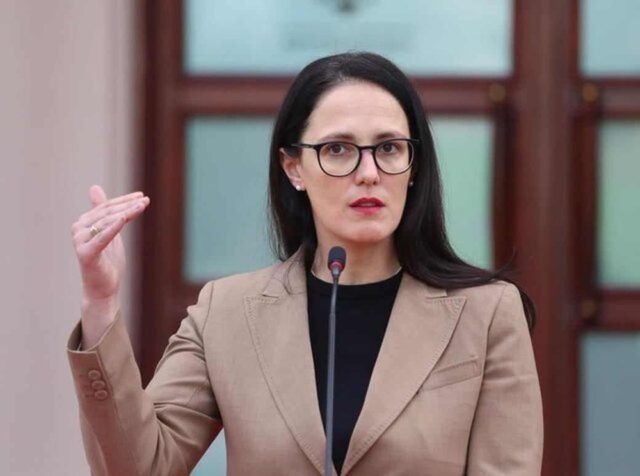
Miletić: Are you satisfied with your minister Diella? Is she the only one who obeys you without objection? [Diella is the artificial intelligence minister in Rama’s cabinet.]
Rama: She is the only one who never asks for a holiday. She never asks for anything except more work. That is why she is the best.
Miletić: I hope we will see each other again soon in Belgrade. Thank you for this exclusive interview for Euronews Serbia.
Rama: Thank you.
Miletić: Exclusively from Tirana, we spoke with the Prime Minister of Albania, Edi Rama. Stay with Euronews Serbia.
[End of transcript]