The western Balkans’ first hypersonic-capable military power acquired its weapons in plain sight. The silence that followed is not an oversight — it is a choice.
By Drizan Shala (Pristina)
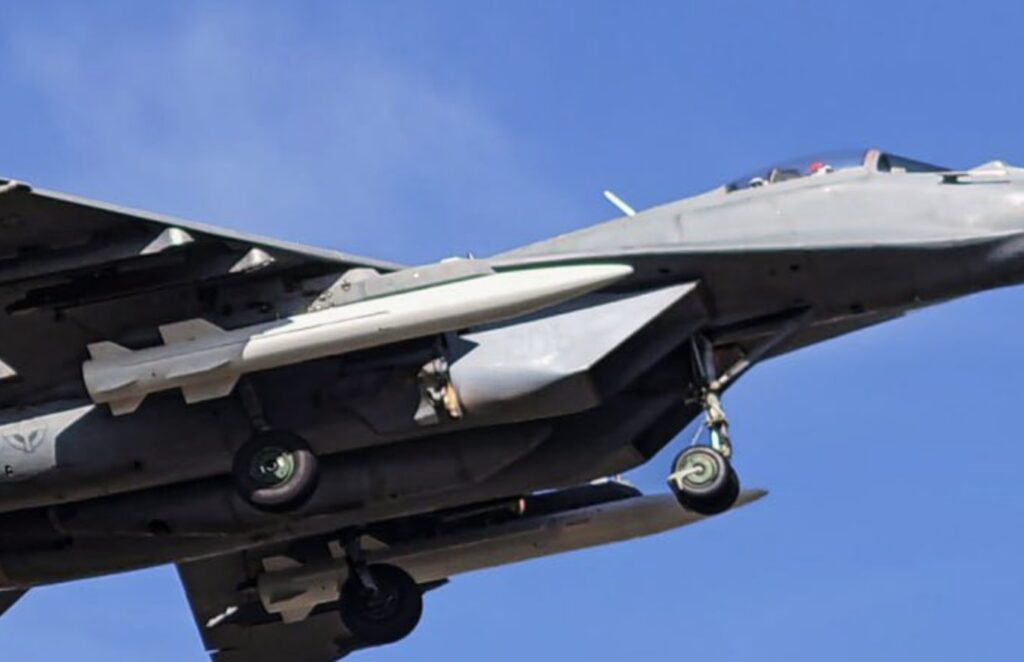
Photographs circulating this week show a Serbian Air Force MiG-29 carrying two Chinese CM-400AKG ballistic missiles — a weapon classified as hypersonic-capable, with a reported range of 200 to 400 kilometers and a terminal velocity that renders standard air defense systems largely ineffective. According to the American specialist publication Military Watch, Serbia has become the second foreign operator of this system globally, and the first in Europe.
The Serbian government has not confirmed the acquisition. It has not denied it either.
The CM-400AKG was designed as an anti-ship and anti-infrastructure weapon. Integrated onto a MiG-29 platform — an aircraft whose other capabilities are aging — it functions as a long-range precision strike asset of a kind Serbia has not previously possessed. The range envelope covers not only Kosovo but most of the western Balkans. Zagreb, Sarajevo, Pristina, Tirana: all fall within it.
A Pattern, Not an Incident
This is not an isolated data point, and treating it as one would be a mistake.
Over the past four years, Serbia has pursued one of the most deliberate and diversified military buildups in post-Cold War European history relative to its size. The Chinese FK-3 air defense system — a medium-to-long range surface-to-air platform comparable in some respects to the S-300 — was delivered in 2022, transported by Russian cargo aircraft in a move that drew immediate concern from NATO members. Armed drone acquisitions followed, including Chinese CH-92A systems now observed in Serbian Air Force inventories. Serbia’s defense budget has roughly doubled as a share of GDP over the same period, a trajectory that outpaces most European NATO members who spent years being admonished by Washington for underinvestment.
The composition of these acquisitions matters as much as their scale. Serbia is not buying interoperable NATO equipment. It is not positioning itself for collective defense. The FK-3 is incompatible with NATO integrated air defense architecture. The CM-400AKG has no conceivable application in a collective security scenario involving eastern threats. The drone platforms acquired mirror those used in regional conflicts, not in expeditionary operations far from the Balkans. Each procurement decision, taken individually, might be explained as a sovereign state hedging its options. Taken together, they describe a military being configured for a specific operational environment — the western Balkans — against specific categories of adversary.
The core issue is not the acquisition of specific weapons platforms in isolation, but the gradual formation of dependency chains that sit outside EU and NATO transparency norms. Such arrangements reduce strategic autonomy over time, embed foreign technological ecosystems into national defense, and complicate future political reversibility. The risk is not immediate escalation. It is structural lock-in — and structural lock-in, by design, is hard to reverse once it has advanced far enough.
Belgrade has a word for this posture: military neutrality. What military neutrality means in practice is the freedom to arm without the accountability that alliance membership imposes. Serbia faces no NATO interoperability requirements, no alliance vetting of procurement decisions, no collective defense obligations that might give its neighbors standing to raise concerns through institutional channels. It sits at the center of a region where four of its neighbors — Kosovo, Bosnia, Croatia, Montenegro — either are NATO members or seek to be, and where its relationships with all four carry unresolved historical and territorial dimensions. Its neutrality is not Switzerland’s neutrality. It is the neutrality of a state that has preserved maximum freedom of action in a neighborhood it has not fully reconciled with.
What Belgrade’s Logic Actually Is
The more coherent explanation for Belgrade’s strategic logic does not require speculation. Serbia’s primary unresolved dispute is Kosovo. Its secondary unresolved tensions involve Bosnia’s Republika Srpska and Croatia’s Serb minority areas — issues that have faded from acute crisis but have not been politically settled. In all three cases, the relevant adversaries in any future escalation scenario would be Kosovo Security Force-descended institutions, the Bosnia-Herzegovina Armed Forces, and Croatian military assets. The weapons Serbia is acquiring are well-suited to striking infrastructure, air defense nodes, and command facilities in exactly these environments. The FK-3 provides area denial. The CM-400AKG provides deep strike. Armed drones provide persistent surveillance and tactical strike. Together they describe a layered offensive and defensive architecture. Not a peacekeeping toolkit.
Belgrade-Zagreb tensions, once confined to anniversary commemorations of 1990s-era atrocities, have become a feature of routine political life. Croatia is a NATO member — but NATO membership does not automatically neutralize the psychological and political effect of a neighbor acquiring hypersonic-capable strike assets. An arms race logic is beginning to assert itself in a subregion that had persuaded itself, perhaps prematurely, that it was past such things.
None of this requires assuming Belgrade has made a decision to use force. It does require acknowledging that Belgrade has made a decision to be capable of using force in ways it previously was not, and that the capability gap between Serbia and its neighbors — particularly Kosovo — is widening rather than narrowing.
The Western Non-Response
European capitals have said little. Washington has said less.
The explicable part: Washington is currently absorbed in a wholesale reassessment of its European commitments and its posture toward a range of bilateral relationships that the current administration has chosen to reprice. Belgrade has been a beneficiary of this moment of American distraction — or, more precisely, has timed some of its signaling to coincide with a period when the cost of doing so is demonstrably lower than usual.
The European part is harder to excuse. The EU has been Serbia’s primary interlocutor on normalization, the broker of the Franco-German framework, the institution that has most consistently argued that engagement and the accession process are the appropriate mechanisms for moderating Serbian behavior. That argument has always rested on leverage — on the idea that the prospect of European integration constrains what Belgrade will do. The FK-3 acquisition tested that leverage in 2022 and found it wanting: there were statements of concern, there were no consequences. The CM-400AKG acquisition, if confirmed, tests it again. If the response is again limited to statements of concern, the conclusion available to Belgrade’s planners — as much as to anyone else — is that the leverage is largely notional.
There is also a specific NATO dimension that has received insufficient attention. KFOR operates without a mandate calibrated to hypersonic-capable threats from a neighboring state. Its deterrent function has always rested on the assumption that Serbian military action against Kosovo would be conventional, detectable in its preparation, and subject to the kind of escalation management that NATO’s presence enables. A strike capability that is fast, precise, and difficult to intercept changes that calculus in ways the alliance has not publicly addressed. Whether KFOR needs to be redesigned, reinforced, or whether the political decision has simply been made to tolerate this capability gap is a question alliance members have so far declined to ask aloud.
Kosovo’s Exposure
Kosovo’s security architecture rests on three pillars: KFOR’s deterrent presence, the Kosovo Security Force’s gradual development into a credible light military, and the political guarantee implicit in American and European support for Kosovo’s statehood. All three were conceived in a threat environment that did not include a neighbor with hypersonic-capable strike assets.
The KSF has made genuine progress. Kosovo’s defense industry has begun to develop — modestly but meaningfully. But institutional development takes time, and capability gaps of this magnitude are not closed by incremental procurement. Kosovo cannot acquire a meaningful counter to the CM-400AKG in any realistic near-term timeframe. Its air defense architecture is minimal. Its critical infrastructure — the power grid, road networks, the main corridors connecting Pristina to the north and south — is exposed in ways that a precision deep-strike capability can exploit without warning.
This is not an argument for panic. It is an argument for clear-eyed assessment. Kosovo’s government and its international partners need to be asking, with some urgency, what this acquisition means for KFOR’s force posture, for Kosovo’s own defense planning, and for the political assumptions underlying the normalization process. The assumption that Serbia’s military modernization is essentially decorative — a domestic political signal, not an operational reality — has worn dangerously thin.
What Is Being Ignored
The region’s security calculus has shifted. It has shifted because Belgrade made deliberate choices to shift it, over several years, in plain sight. The photographs of the MiG-29 with CM-400AKG missiles are not a revelation — they are a confirmation of a trajectory that was legible to anyone paying attention.
What makes the current moment notable is not the acquisition itself but the silence surrounding it. A European state has acquired hypersonic-capable strike weapons from China, integrated them onto combat aircraft, and photographed them. Its neighbors, several of whom are NATO members, have registered polite concern. The alliance whose presence in the region is explicitly tied to preventing exactly the kind of coercive military imbalance this acquisition represents has not publicly responded. The European Union, which has spent two years trying to broker a normalization agreement between Belgrade and Pristina, has not addressed what this means for the security assumptions underlying that process.
That silence is a policy choice. It may reflect a calculation that saying nothing is less destabilizing than saying something. It may reflect fatigue, or the priority of other crises. What these calculations collectively produce, however, is a region in which one state is systematically widening its military advantage over its neighbors without cost, consequence, or even acknowledgment — and in which the institutions nominally responsible for regional security have decided, for now, to look away.
If this corridor continues to normalize, its effects will not remain confined to Serbia’s internal defense posture. Kosovo and Bosnia remain the most exposed spaces for the consequences: altered deterrence calculations, the quiet recalibration of regional power balances, and the steady erosion of the assumption that the postwar settlement in this region is durable. That assumption has been wrong before. The western Balkans has a way of reminding the world of that at moments when the world has stopped paying attention.
About the author:
Drizan Shala is a Kosovo-based security expert and political analyst specializing in national security, defense policy, hybrid threats, and regional geopolitics in the Western Balkans. He is a PhD candidate in Security Studies (Homeland Security) at the University of Sarajevo’s Faculty of Criminalistics, Criminology, and Security Studies. Shala serves as Executive Director of the Association of Criminal Law, Criminologists, and Victimologists of Kosovo and as Director of the Kosovo branch of the SIRAS Academy. His work focuses on security normalization, deterrence dynamics, and the integration of Western Balkan states into Euro-Atlantic security frameworks. He regularly contributes analysis to regional and international media and has published on NATO intelligence doctrine and contemporary defense cooperation models.