A week of the Veliaj–Rama story, sorted into what is on paper, what one side says, what was said by people who were not in the room, and the one fact that never came up.
The Newsroom
On 28 October the mayor of Tirana was moved from Durrës to Fier under an order that nobody outside the prison service has read. On 30 October, at an hour the minister has not disputed, the Minister of Justice sat with him in the office of the Fier prison director. On 2 November the two men published statements that cannot both be true. That is the entire documentary record of the biggest political story in Albania this week. The rest was supplied. The trial of the same man on thirteen counts of corruption, the second biggest story in the country, did not come up at all.
Tirana is a capital of rumours. It is a city where hearsay and assumption carry the force of fact, where a detail spoken with enough confidence on the right programme at nine in the evening is, by morning, something everyone knows. The Veliaj affair is a clean specimen of how that works, because for once the hard record is so short that it can be written out in full and set beside everything that was added to it.
What the week looked like from the outside
On 26 October, from his cell, Erion Veliaj congratulated Serbia’s students on bringing down “the Machiavellian and populist of Belgrade” (“makiavelistit dhe populistit të Beogradit”) and wrote that student movements are “not the end of the world but the end of a world” (“nuk janë ‘fundi i botës’, por fundi i ‘një bote’”). He did not name Edi Rama. Within hours the post was being reported as a coded message to Rama, and by the end of the week that reading had become the story’s accepted starting point.
Two days later the Prisons Police moved him to Fier. He said that afternoon that he had been shown no act and no reasons, and called it a “police abduction” (“rrëmbim policor”). That night, in a letter his lawyer read out, he said he had been put in isolation for ten days, without water or a window, without medical care, on a corridor with three men serving life. The General Directorate of Prisons answered with an unusual press statement: the transfer was for security reasons (“për arsye sigurie”), the order was classified “state secret” (“sekret shtetëror”), the prosecution had been notified, and 24 other transfers had been carried out between 16 and 27 October. That statement is the only thing the state has put in writing about why the mayor of the capital changed prisons.
Then the room began to fill. A television reporter said two Socialist MPs had confronted the minister in a closed party meeting. A portal said the prime minister had called Veliaj a coup plotter in front of his ministers. A journalist said the transfer had come from above the Directorate. A presenter said the Directorate’s head had resigned, returned and signed. None of these people was in any of those rooms. All of it was repeated as if they had been.
On 30 October four things happened on paper: the President decreed local elections for 9 May 2027; Veliaj dismissed two of his deputy mayors from his cell and appointed a third; the Albanian Helsinki Committee went to Fier and looked; and the Minister of Justice signed a written reply to two Socialist committee chairmen, Bledi Çuçi and Fatmir Xhafaj, who had formally asked him how the transfer was done. His reply said an inspection of 24 transfers had been ordered and that responsibility for such decisions lies with the Directorate. That evening, at a time Veliaj’s handwritten note puts at 22:30, the same minister arrived in Fier.
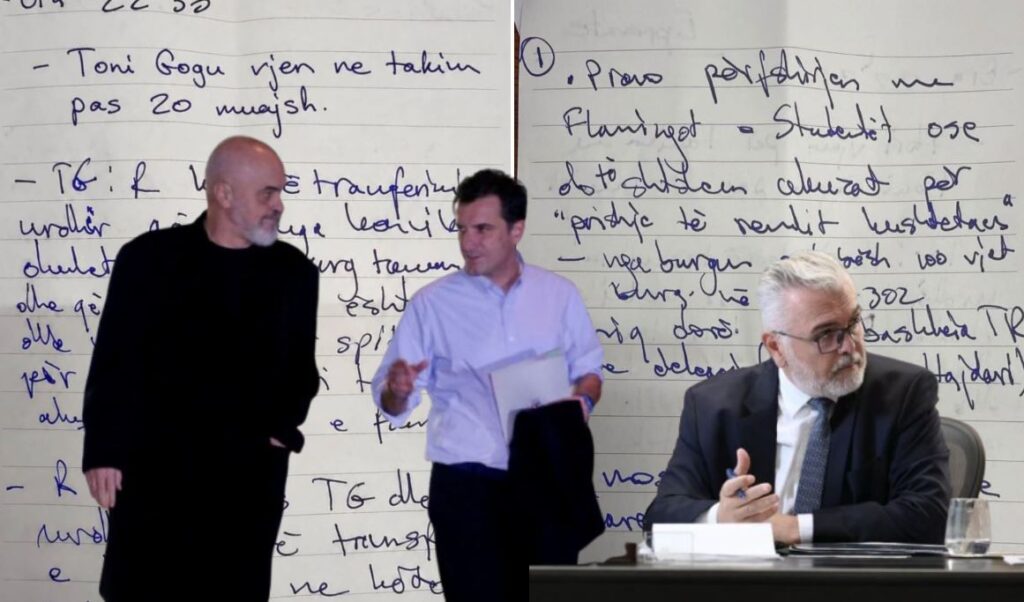
On 2 November the portal Hashtag.al published what it said Gogu had told Veliaj, in the first person and in full. Gogu answered that he had indeed met Veliaj on Friday, in exercise of his responsibilities, to see his conditions and hear the complaints his lawyer had made publicly, and that he would never utter the words put in his mouth “in this world or the next”. Veliaj answered with a note in his own hand, two pages, and the line that will outlive the week: “Otherwise, leave!” (“Ndryshe ik!”). By nightfall the lawyer was on one channel, an analyst was on another describing the sofa, and the two accounts of the same evening had four different durations.
What is on paper
Veliaj’s 26 October post. His 28 October statement and his first letter from Fier. The Prisons Directorate’s statement. The 30 October decree on elections. The withdrawal, in mid-September, of the powers Veliaj had delegated to his deputy in February 2025, and the dismissal of two deputies on 30 October. The Çuçi–Xhafaj letter and Gogu’s signed reply. Gogu’s 2 November statement confirming the visit and denying its reported content. Veliaj’s note and his covering statement. Arbër Hajdari’s denial that he has anything to do with “this penal-political story”. The Helsinki Committee’s findings, published on 2 November: the detainee was not given the order; the monitor saw it briefly; its motive was stated only as “security reasons”; its classification was “restricted” (“i kufizuar”) for up to two years, which is not what the Directorate had called it; a cell with a non-working window; for two days no telephone to his family. The Committee’s one sentence of judgement: the security of a prison and national security “are not necessarily equivalent concepts”. Veliaj’s absence from his own trial on 3 November, and a letter to the panel whose text has not been published. And a banner carried by students on the boulevard that morning: “Russia or Veliaj didn’t bring us, Albania called us.”
On the other side of the ledger, also on paper, is Edi Rama’s own record on this prisoner. In February 2025 he said the mayor had been “taken from his office and put in a cell without trial”, called the file “a 400-page novel without evidence”, and said he was not leaving because he had “a war to finish”. In November 2025, after the Constitutional Court restored Veliaj, he said Veliaj would be mayor until 2027, and, asked whether he had a political son who might kill him, answered: not for the moment, where is he? In June this year, before the Tirana socialists, he called the detention unjust. Whatever he said in a closed room last week, this is what he said in the open.
That is all. It is thin, it is almost entirely procedural, and the only substantive items in it are a handful of posts, one written reply and one NGO report.
The fact nobody mentions
Erion Veliaj is in Fier because he is a defendant. That sentence has not been spoken on any panel this week.
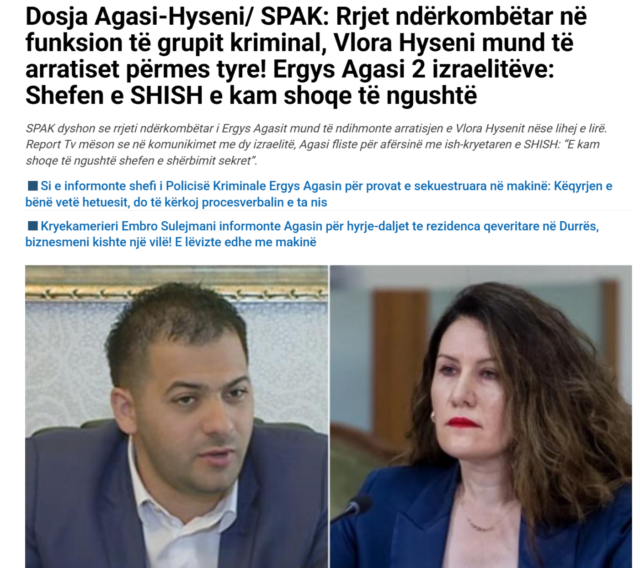
He was arrested on 10 February 2025 by order of the Special Prosecution. SPAK closed its investigation in September 2025 and sent him to trial on thirteen counts: passive corruption by a senior official or elected local official in nine separate cases, laundering the proceeds of crime, failure to declare assets, abuse of office, and bringing prohibited items into prison. His wife, Ajola Xoxa, faces twelve counts of her own, including the same nine corruption cases, money laundering and concealment of income. A group of businessmen are charged with active corruption for allegedly paying them. The file names thirty defendants, including companies and non-profits, and a former Socialist MP charged with obstructing the truth. SPAK’s case is that companies which received building permits and public money from Tirana municipality paid for them in cash and real estate, routed through the wife’s organisations, about 1.1 million euros by the prosecution’s estimate at the time of arrest. The file runs to some 60,000 pages, 1,078 items of evidence and 190 witnesses, by the defence’s own count.
On 9 February 2026 the Special Court sent the case to trial. The trial on the merits opened on 9 March. His detention has been reviewed and kept by the Special Court, by its appeal chamber, by the Supreme Court in May this year, and the Constitutional Court declined in July to take up his complaint against it. He is presumed innocent. He has also, for most of the process, not been in the courtroom: he refuses to sit in the glass cage, his lawyers have boycotted hearings and been fined for it, the court has had to appoint him counsel of its own, and on Tuesday, the morning after his letter, he stayed in Fier and sent the panel a page about Rama instead.
None of this is secret. All of it was absent from the week. The lawyer spoke of persecution; the columnists spoke of motive and ambition; the analysts spoke of sofas and pastors; the opposition, which spent two years demanding his arrest and calling him the head of a criminal group, demanded an urgent investigation into threats against him; and a prime minister who once called the file “a 400-page novel without evidence” is now accused of orchestrating it. In six days a man awaiting judgement on nine counts of bribery became, in the public conversation, a political prisoner, and nobody had to argue the point. The transfer did it, the visit did it, and the silence of the people with the documents did the rest.
That is the measure of what a rumour can do in this city. It was SPAK that put Veliaj in prison, on 10 February 2025, and four courts that have kept him there; the government moved him between two of them. Whatever was said on a sofa in Fier at half past ten on a Friday night has no bearing on a single one of the 1,078 items in the file. His rights as a detainee are real, and the Helsinki Committee was right to go and check them; his grievance against the government may be real as well. A political prisoner is a man jailed for his politics. This one was jailed on a charge sheet, by a prosecution his own prime minister attacked, and kept there by four courts. The debate forgot this because in Tirana the newest story always displaces the oldest fact, and the oldest fact here is a charge sheet.
What one side says and the other has not denied
The meeting took place in Fier on Friday. Gogu had not visited in twenty months; he speaks of “a very old friendship”, and does not contest the gap. Veliaj and his lawyer have not been given the transfer decision; the Helsinki Committee confirms it. Veliaj, by his lawyer’s account, did not object to being moved as such, only to being moved without an act. Veliaj remains, by the Constitutional Court’s decision of a year ago, the mayor of Tirana.
What one person says
The content of the conversation rests on Veliaj alone. His note has the minister reporting that “R” ordered the transfer and personally dealt with hospital and visiting permits, and then three demands: admit involvement with the Flamingos or face “constitutional order” charges and “100 years in 313 and 302”; give up the municipality and delegate it to Arbër Hajdari; stop consulting Plarent Ndreca. Gogu denies all of it.
The duration, the setting and the aftermath rest on Ndreca, who was not there either. He says the meeting lasted about an hour and a half, alone, in the director’s office; that Veliaj wrote the notes as soon as he was back in his room; that he himself was not allowed in on Saturday; that there are witnesses to the Hajdari demand, whom he does not name; that Rama telephoned him on Monday with insults and the accusation “you pushed Veliaj’s independence from me”; and that he holds “communications with the Prime Minister” that support the note. Asked on Opinion whether Veliaj believes Rama was behind his arrest in February 2025, he answered “Yes”. That is a larger charge than anything in Veliaj’s own note, which stops at the transfer. Asked by Koha Jonë about Hashtag’s quite different text, with its few minutes and its unlogged entry, he said everything published remains true. The contradiction between the two versions sits inside his own camp.
Gogu, for his part, says the circumstances of his visit are “documented and verifiable”. He has not produced the documents. A Euronews reporter says Gogu had written permission from SPAK prosecutors to make the visit and that the prison arranged the director’s office for him. Nobody from SPAK or the prison has said so.
What was said by people who were not in the room
Hashtag.al’s version, the one that opened the week, had Gogu arrive urgently, enter without being logged, and stay a few minutes. Its text of the message included a line about addressing Veliaj “for the last time as your political father” and a threat to “orient SPAK”. Neither the line nor the threat, in that form, appears in Veliaj’s own note. Another portal added that the minister wore sportswear and a cap.
Lapsi’s version of the ministers’ meeting, three days earlier, had Rama branding Veliaj a coup plotter who financed violent protests, and saying he did not want to hear any more about Veliaj’s rights. One source, unnamed, one room, closed.
Arjan Curri’s version, delivered on Top Story on Monday night, was the most detailed of all: more than two hours, a brown corner sofa, Veliaj on the library side and Gogu on the director’s side, the director coming and going, a conversation that began with the mayor’s broken leg and ended in politics, and “the conversation is all recorded”. He then performed the conversation himself: “my son, you are not Trotsky”, followed by “this is no longer Toni Gogu, this is my conversation”. A man who said on air that he was inventing the dialogue also said, in the same breath, that a recording of it exists. No one asked him who has it.
An analyst said Rama had asked Veliaj a month ago to hand the municipality to someone else and been refused. Another said the mayor had not been paid for eighteen months. A third said the transfer “exceeded” the Directorate. A reporter said the Directorate’s head had resigned and been brought back to sign. A journalist said Veliaj had been removing Rama’s people from the municipality since September, which is true, and that this is why he was moved, which is his guess. A party deputy leader said the blackmail “has its origin in the President’s decree”. By Tuesday morning two columnists in the same newspaper were writing thoughtful pieces about Veliaj’s motives, one calling the letter a campaign, the other asking whether it was miscalculation or enmity. Both were careful; both were building on a floor made of the paragraphs above.
What nobody has produced
The transfer order, and the name on it. The Fier logbook for the evening of 30 October. SPAK’s permission for the visit, if it exists. Any recording. Ndreca’s communications with the Prime Minister. The names of the witnesses to the Hajdari demand. Gogu’s “documented and verifiable” circumstances. The results of the Ministry’s review of 24 transfers. The Ombudsman’s findings from the first night. A single piece of evidence that Veliaj financed anything. The text of Veliaj’s letter to the court. A word from SPAK on the one allegation that concerns it. A word from Edi Rama.
How a rumour becomes a fact
The rumours did not spread because Albanians are credulous. They spread because the people who hold the documents refused to produce them, and a city cannot leave a hole that size unfilled. The Directorate classified a one-page order as a state secret and the monitor who saw it read a lower stamp. The minister told parliament the decision was the Directorate’s, then went to the prison himself at half past ten at night. The Ministry announced a review and has reported nothing. The minister said his visit was documented and showed no document. The Prime Minister, whose name is on every page of the story, has said nothing at all. Into that silence walked a lawyer with a client’s notes, a portal with a source, and an analyst with a sofa, and each of them was more specific than the state. In Tirana, specificity wins. The sofa had the same standing on television by Monday night as the decree.
Two institutions went to Fier. The Ombudsman went on the first night and has said nothing since. The Helsinki Committee went on the third day, wrote down what it saw, and wrote down what it was not shown. Its report is the single document in this affair that distinguishes between the two.
The paper sits in a handful of offices, and the questions belong there. To the General Directorate of Prisons: who signed the 28 October order, what is its real classification, and what are the concrete security grounds behind the two words it contains. To the Ministry of Justice: what did the review of 24 transfers find, and when will it be published. To Toni Gogu: at what time did you enter Fier prison on 30 October, at what time did you leave, was the visit logged, and under whose authorisation. To the Ombudsman: what did you find on 28 October. To SPAK: did you authorise the visit, did you know its purpose, and has anyone in government spoken to you about new charges against the mayor of Tirana. To Plarent Ndreca: produce the communications. To Arjan Curri: who told you there is a recording. To Edi Rama: did you, through anyone, ask the mayor of Tirana to hand over the municipality.
The sofa, the pastor and the political father have had more airtime this week than the thirteen counts. Two sheets of paper would end this: a logbook page and a transfer order. That nobody has asked for them in those terms, while everyone has an opinion on the sofa, is the capital of rumours at work.