Strapline: The EU ambassador handed the Commission’s 2026 Albania Report to the President, the Prime Minister and the Speaker on Thursday. Rama called it the best report the country has ever received.
By the Newsroom (Tirana)
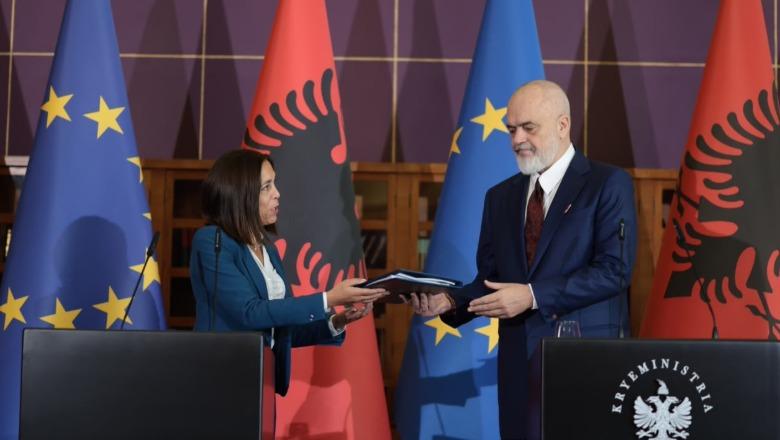
The European Union’s ambassador to Albania, Sofia Moreira de Sousa, delivered the European Commission’s 2026 progress report on Albania to Prime Minister Edi Rama on Thursday, 5 November, summing up its message in Albanian: “Albania has moved forward” [“Shqipëria ka ecur përpara”]. Rama described the document as “the best progress report Albania has ever held in its hands” [“Raporti më i mirë i progresit që Shqipëria ka marrë në dorë ndonjëherë”].
The report was adopted by the Commission on Wednesday, 4 November. The ambassador delivered it in a round of three meetings in Tirana. She was received by President Bajram Begaj in the morning, handed the document to Rama shortly before noon, after which the two held a joint press conference, and in the afternoon delivered it to Speaker of Parliament Niko Peleshi at the Speaker’s office.
What the report says
The Commission finds that Albania has made progress in the large majority of the chapters it is negotiating. Six clusters covering 33 chapters have been opened and four chapters have been provisionally closed. The report also records Albania’s full alignment with the EU’s common foreign and security policy and the financial support received under the Growth Plan for the Western Balkans. The document foresees the closure of the 31 remaining chapters by the end of 2027 and asks the Council of the EU to begin drafting the accession treaty next year.
Rama said that, compared with a year ago, Albania’s level of preparedness has risen markedly in at least 20 chapters, with progress recorded in the economy, digital transformation, energy, education and the alignment of legislation with EU standards.
The new element this year is an indicative roadmap. Rama said the Commission has, for the first time, presented such a roadmap for the four countries furthest advanced in negotiations, and that Albania’s version sets out the stages and targets for the year ahead. He said the Commission considers the end-2027 target for concluding negotiations “ambitious but achievable” [“ambicioz, por të arritshëm”], and that the roadmap does not set a date for membership, since it cannot predetermine the outcome of the negotiations.
The ambassador said the roadmap contains no further deadlines of its own but takes into account the goal and the calendar that Albania has set itself. Asked whether Albania could be a member of the European Union in 2029, she answered that it is possible but very demanding work. “Albania has so far shown it is able to meet these challenges, so I have no reason to doubt,” she said, adding that everything will depend on the pace at which the reforms are adopted and the manner in which they are implemented.
The criticisms
Both speakers addressed the critical findings. Rama said the report assesses delays in the courts and the issue of corruption, raises “serious concerns” about the functioning of democratic institutions, media freedom and the protection of the environment, and deals with the recent protests, putting its finger, in his words, on the wounds of violence. The report presents dialogue as the solution, he said, and no finding in it can be set aside.
The ambassador said the report notes good work on justice and corruption but that corruption remains a real challenge and the efforts must continue. On democracy, she said the report notes a polarised climate and that the reform requires compliance with OSCE/ODIHR [“Reforma kërkon përmbushjen e OSBE/ODIHR”]. On fundamental rights she spoke of genuinely positive steps. On media freedom she said defamation has been decriminalised but media financing remains non-transparent, and that the use of police force against journalists must be investigated.
On the environment, she said the report finds that the 2024 amendments to the law on protected areas and the repeated extensions of the law on strategic investments have worsened the protection of nature. Provisions that conflict with one another should be repealed, she said, and major projects, including the one planned at Zvërnec, will be assessed against EU standards. “Grievances must be resolved through genuine dialogue,” she said. On the protests, she said violence has no place in democratic life.
She also called for political consensus and open parliamentary debate on the integration reforms, calling that the responsibility of all political forces. “These reforms do not aim to please Brussels, but to build a strong and democratic Albania, ready to become part of the EU,” she said. “Albania has moved forward, but we have not yet reached the end of this journey.”
Rama: the last kilometre
Rama said the report changes the story of Albania’s European path. For a long time, he said, that story was defined by what Albania was waiting for: candidate status, “yes, no, when?”; the opening of negotiations, “yes, no, when?”; the approval of interim benchmarks, “yes, no, when?”. The report published on Wednesday, he said, sets out a new narrative, no longer about what Albania expects to happen but about the steps it must take.
“Albania’s European fate is today entirely in our hands. That is the main news of the report,” he said [“Fati europian i Shqipërisë është sot i gjithi në duart tona. Ky është lajmi kryesor i raportit”]. Albania, he said, is entering the last kilometre of the membership negotiations, and that kilometre has a thousand metres to cover, each with a hundred centimetres to get past.
Time, he said, now gains importance by the day, and that has to be understood by those on the front line of the process: Parliament, the government, the judiciary, and above all the governing majority. The chance to conclude the negotiations is unique and historic and is not a fixed given once and for all, he said. History would never forgive Albanians if the opportunity were lost through their own fault. He said he would do everything to ensure the opposite of the misfortune that has struck the country whenever it had the chance to rise, and that no one and nothing would put this historic chance in question “për mustaqet e asnjë ‘Çeloje’”.
Rama also framed the process in terms of emigration. Albanians, he said, have lived for years in a great contrast between the opportunities available abroad and those at home; for many families, emigration has been the road to a better life, better services and a more secure relationship with the state. Integration, he said, is not for Brussels, Paris or Berlin but for building a European state in Albania, with institutions, economic opportunity, legal certainty and conditions for raising children as in Europe. He called the report “a very objective report card of Albania’s great progress.”
On the protests, Rama said the report asks for dialogue and that it is the government’s duty to guarantee it. In remarks to Report TV he said his resignation would not be imposed from the street, and he announced that an online dialogue window would open from Friday.
Begaj and Peleshi
President Begaj, receiving the ambassador earlier in the day, called the report evidence of the country’s advance in the integration process and an important step toward membership. He thanked the Commission for its continued support for Albania and for the enlargement policy in the Western Balkans, and reaffirmed Albania’s commitment to concluding the accession negotiations by 2027 and joining the EU in 2030. The discussion covered the rule of law, the fight against corruption and organised crime, and media freedom. Begaj said respect for the rule of law, the functioning of institutions and democratic dialogue remain essential to the integration objective.
Speaker Peleshi, who received the report in the afternoon, said Parliament would examine its assessments and recommendations responsibly, continuing the approximation of Albanian legislation with European standards and strengthening parliamentary oversight.
Opposition reaction
The Democratic Party read the report as a black mark for the government. Its leader, Sali Berisha, said the report brands Rama and that he should go, and described Deputy Prime Minister Belinda Balluku as an impassable wall on the road to the EU. Democratic Party MP Jorida Tabaku said there would be no EU funds without institutions and EU values, and called the Audiovisual Media Authority a tool of the government.