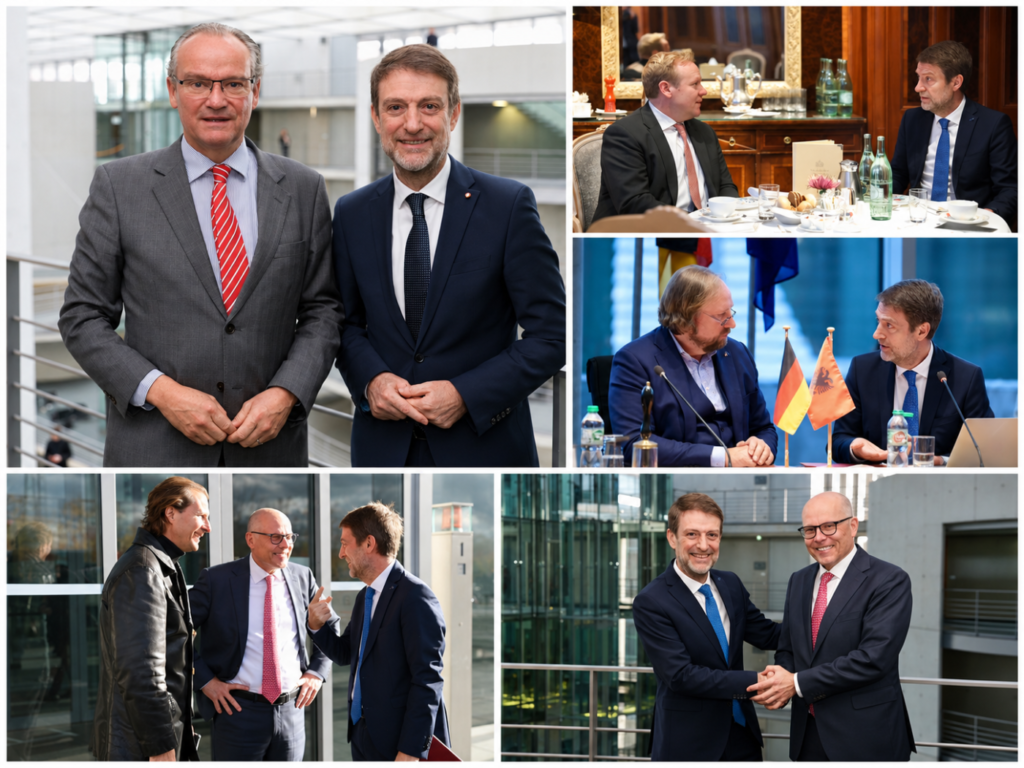
Albania’s foreign minister met the Minister of State for Europe, members of two Bundestag committees and a think-tank audience on 3 and 4 November, and posted six readouts. His German hosts posted none. Every word of friendship between the two countries that week was written in Tirana.
Tirana Examiner Newsroom
Ferit Hoxha arrived in Berlin on 3 November and met Gunther Krichbaum, Minister of State for Europe at the Federal Foreign Office. His readout called it “a frank and constructive exchange” on Albania’s accession path, Germany’s support for enlargement and “a credible, merit-based accession process that translates reform and tangible progress into concrete steps towards full EU membership”. Germany, he wrote, “is a key partner and a strong supporter of Albania’s European journey”.
On 4 November he spoke at the German Council on Foreign Relations (DGAP) conference “EU Enlargement: Assessing New Concepts and Outlook for 2027”. His post from the conference set out the position he repeated through the day: enlargement has become “a strategic and security imperative for Europe”, reforms “remain as necessary as ever”, and Albania asks for no shortcuts. “EU membership is earned, not granted as an act of solidarity,” he wrote. “When candidate countries deliver, Europe must respond.”
The same morning he had breakfast with Tilman Kuban, the CDU/CSU parliamentary group’s spokesman on European affairs, in what he described as “an open and frank conversation” on Albania’s European path, “the current developments in Albania and the region”, and the future of the enlargement process.
He then joined a panel, “Growing Europe: A Case for Enlargement”, with Krichbaum, Kosovo’s chief negotiator Jeton Zulfaj and DGAP senior fellow Milan Nič. His account of the panel described Berlin as a city “once divided by a wall” and claimed for Albania “an overwhelming national consensus on EU membership” that “no benchmark can fully measure”. He named three principles for enlargement, credibility, fairness and tangible progress, and defined the third as “progressively bringing candidate countries into the European space even before formal membership”.
In the evening he met Peter Beyer, CDU member of the Bundestag’s Foreign Affairs Committee, whom he called “a longstanding friend of Albania”. The readout listed bilateral relations, “recent developments in Albania”, the accession path, and “recent elections in Serbia and their implications for regional stability and European integration”. The two also discussed “the need for an even stronger German engagement in the Western Balkans”.
His last readout, posted on the morning of 5 November, covered a meeting with the Bundestag’s Committee on European Union Affairs, chaired by Anton Hofreiter of the Greens, which Hoxha called “a key highlight” of the visit. He presented Albania’s progress “as reflected in today’s European Commission Progress Report” and the aim to conclude negotiations by the end of 2027, “an objective now reflected in the European Commission’s roadmap”. Albania, he wrote, asks “no shortcuts and no favours” and wants to be judged “on our merits, our reforms and our results”. He thanked “Chair Hofreiter” for the warm welcome.
Five of the six posts carried the hashtag #Albania2030. The Beyer post carried #Together. The word “frank” appears in three of them.
The readouts refer twice to “recent developments in Albania”, in the Kuban and Beyer posts, without naming them. None of the six mentions the October protests in Tirana or the German embassy.
As of the morning of 5 November, neither Krichbaum, Kuban, Beyer nor Hofreiter had posted a word about their meetings with the Albanian minister. Every account of those meetings that exists was written in Tirana.
None of it changes what this publication wrote on 2 November. Berlin opened every door to Hoxha and said nothing through any of them, which is how it has dealt with Tirana all autumn: an ambassador who lent his name to a dialogue platform while the boulevard burned, a Chancellor who congratulated Belgrade’s new majority before reading its programme, a committee chair who grades Albania’s institutions on camera and had nothing to say after receiving its minister. Germany is a partner, and a useful one, and the minister treated it as one. It is not an ally. An ally would have said in Berlin what Hoxha said for it. Two days of frank exchanges produced Tirana’s account and Berlin’s silence, and of the two, the silence is the honest one.