Marta Kos cited a final judgment. Vučić called her explanation stupid and answered as if Serbia still gets to decide what The Hague already did.
Ngadhnjim Brovina (Regional Affairs desk)
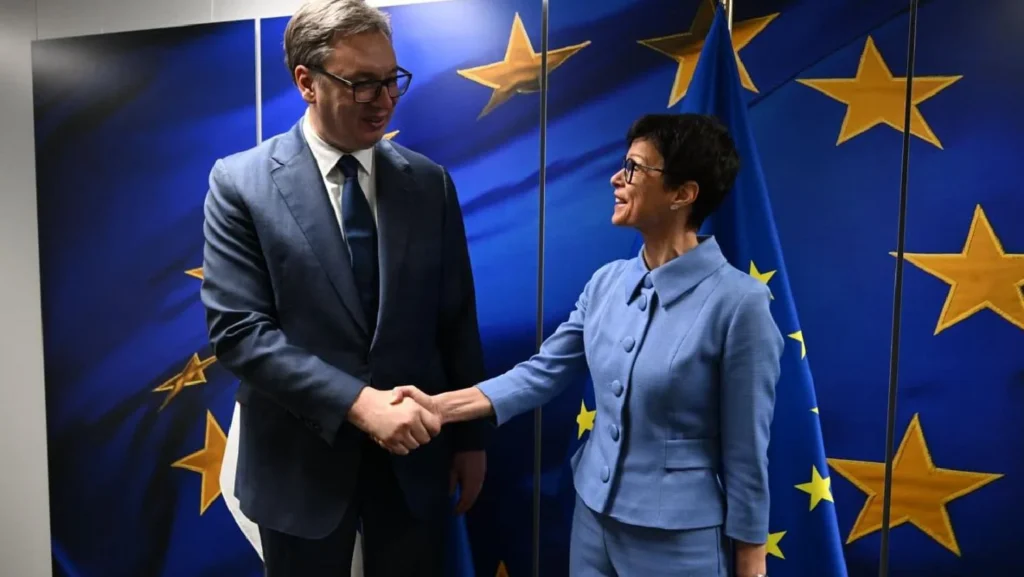
Aleksandar Vučić called Marta Kos’s explanation stupid. Not Kos; the explanation. “The explanation was extremely short, but stupid, as usual,” he told reporters on the afternoon of Friday, 4 September, hours after the Commissioner for Enlargement wrote on X that the glorification surrounding Ratko Mladić’s death was incompatible with the values on which the EU path is built, and that she would not be travelling to Belgrade as planned. Danas and N1 carried the wording. Let him have it. Presidents have called worse things worse names, and a commissioner who cancels a visit over the political glorification surrounding a funeral has priced in the adjective.
The sentence that matters came a few breaths later.
“I fight for history, for my Serbia, and Marta Kos will not lecture me on who the criminals are and who are not.”
She was not lecturing him
Marta Kos did not decide that Ratko Mladić was a criminal. Neither did the Commission, nor Zagreb, nor Sarajevo, nor Prishtina, nor any of the capitals Vučić has in mind when he says “they”. A court did. The Trial Chamber of the International Criminal Tribunal for the former Yugoslavia convicted Mladić on 22 November 2017 of genocide at Srebrenica, of persecution, extermination, murder, deportation and forcible transfer, of terror against the civilian population of Sarajevo, of unlawful attacks on civilians and of the taking of UN hostages, and sentenced him to life. He appealed. On 8 June 2021 the Appeals Chamber of the Residual Mechanism affirmed the convictions and the sentence. Mladić had counsel throughout, challenged the evidence, called his witnesses, and lost.
Serbia knows this better than most, because Serbia delivered him. Serbian authorities arrested Mladić in Lazarevo on 26 May 2011 under the country’s own Law on Cooperation with the Tribunal and transferred him to the Tribunal’s custody on 31 May. Whatever quarrel Vučić now has over who the criminals are, his quarrel is with a final judgment that his own state’s authorities made possible, and the Commissioner is simply the nearest person standing in its light. Serbia executed the arrest and the transfer that put Mladić before the Tribunal. It cannot now reduce the resulting final judgment to one foreign opinion among others and reserve for itself the authority to decide what the judgment means.
That is the whole of the answer to “who will lecture me”. Nobody was lecturing. A conviction was being cited.
What “my Serbia” defends
“I fight for history, for my Serbia” sounds like patriotism until one asks what the fight is over. It cannot be a fight over whether Mladić was criminally responsible for the crimes of which he was finally convicted. That question is closed, after years of trial, thousands of exhibits, hundreds of witnesses and an appellate review that Mladić’s own lawyers argued. In this argument, “fighting for history” is no longer a fight over Mladić’s criminal responsibility. It is a fight over what Serbia is required to do with that adjudicated fact.
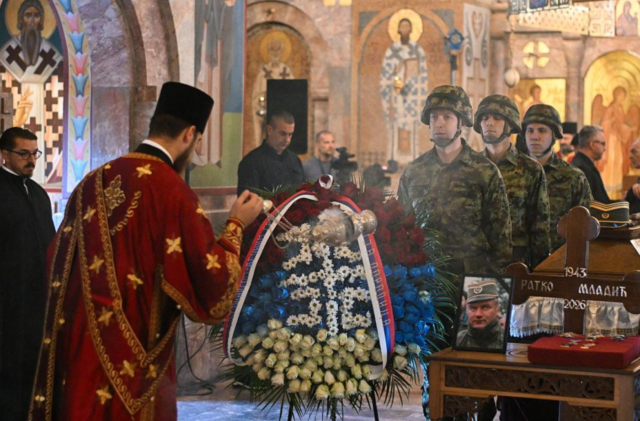
Look at what was never in dispute. Serbia’s right to bury a Serbian citizen: nobody denied it. His family’s right to mourn him: nobody denied it. The right of people to stand in the street and watch a hearse pass: nobody denied that either, and Vučić’s line about how Brussels presumably wanted him to “ban people from turning up, ban the funeral, build dog cemeteries” answers an objection nobody made.
What Vučić is actually defending is narrower and larger at once. It is the claim that the Serbian state may reopen the moral standing of a man whose legal standing is closed, and may treat any objection to that reopening as an insult to the nation. “I won’t let you humiliate our country, and don’t lie,” he said, to a commissioner who had written four sentences about a convicted man. The move is visible in the grammar of his own answer, in the order N1 recorded it: first the “lecture”, then “my Serbia”, then the humiliation. Mladić becomes Serbia. Criticism of Mladić’s glorification becomes humiliation of Serbia. And a judgment rendered after a decade of proceedings becomes, in the president’s mouth, somebody else’s “lecture”, to be set against “some other places” where “Za dom spremni” is tolerated, as if a chant in Zagreb could reduce a sentence in The Hague.
Saturday
On Saturday, at noon, the fight for history was conducted in public, and it looked like this.
In Dom Vojske, off Trg Republike, Živomir Ninković, the first wartime commander of the VRS air force, told a hall so full that people were turned away into the park: “On the day when we have a little song about Ratko Mladić on the first page of the primer, only then will we be a free people. If we don’t have that, others will write our history for us.” He placed Mladić, “by his deeds”, in the company of Karađorđe. He said he had never seen a written order to kill anyone, and that the Srebrenica genocide was “a plan agreed in advance to impose on the Serbian people the mortgage of genocidal guilt”. Radan Ostojić, Republika Srpska’s minister of labour and veterans’ affairs, ran the line from the Nemanjići and Saint Sava through Lazar and Karađorđe to the coffin, and said of 1992 that Mladić “stood at the head of the Serbian people” on “the road of Christ, of Golgotha and of suffering”. Jelena Guskova of the Russian Academy of Sciences spoke. Branko Krga, once chief of the Yugoslav general staff, spoke.
Dom Vojske is the building in which the Serbian defence ministry houses Medija centar “Odbrana”, a specialised military institution of the ministry’s Public Relations Directorate. The ministry also rents its halls for outside events, and Darko Mladić has said that the Club of Generals and Admirals helped organise the day. So the address belonged to the Serbian defence establishment, whatever name appeared on the booking form.
And in the audience sat Nenad Vujić, Serbia’s minister of justice, the only member of the Belgrade government named among those present, confirmed by N1, Radio Free Europe and FoNet.
He was not a passer-by, and he had not arrived at the story on Saturday. On Thursday, 3 September, Vujić was aboard the Serbian government aircraft that carried the coffin from The Hague; when it landed in Belgrade, soldiers of the Serbian Army received the coffin and carried it from the plane. On Friday at noon he sat beside Darko Mladić at the Journalists’ Association press conference on the burial arrangements; the association lists him among the speakers. Kos cancelled that afternoon. Vučić demanded to know who had glorified anything a few hours later, by which time his own justice minister had spent the previous twenty-four hours making himself part of the story.
Here a distinction has to be held, because it protects the argument. Accompanying a citizen’s remains home, or discussing funeral logistics with the family, is not in itself glorification, and a Serbian government may argue it owed the first to any citizen. Saturday is where the evidence changes character. Sitting through the primer, Karađorđe and Golgotha, in a defence ministry building, is not logistics. Saturday is the point at which his presence stops being explainable as funeral logistics and begins lending the authority of his office to an event whose content was unmistakably glorification. He did not say Mladić was Karađorđe. Serbia’s justice minister chose to sit in a room where it was said. That is enough to answer Vučić’s question.
And the minister in question is the minister whose ministry carries Serbia’s Chapter 23 work on judiciary and fundamental rights, the chapter through which war-crimes accountability is measured. The War Crimes Prosecutor does not answer to him. But the ministry he leads is one of the institutions through which Serbia delivers its Chapter 23 commitments.
That is what “who the criminals are” looks like once the state gets to decide. Not a rebuttal of the judgment, which nobody in the hall attempted, but a proposal for what to do with the convicted man now that the judgment is inconvenient: the primer, Karađorđe, Golgotha. On Friday Serbia’s president announced that no commissioner would tell Serbia who its criminals were. On Saturday, in a defence ministry building, with the justice minister in the room, Serbia showed what it intended to do with the answer a court had already given.
Who is being treated as stupid
The title is Vučić’s word, and it deserves a second reading. He used it because Kos supposedly failed to understand Serbia. The question underneath is who, in this sequence, is expected not to understand. The judges, whose findings are to be received as one more foreign opinion; the Commission, expected to accept that Serbia can hold its Chapter 23 dossier in one hand and the coffin in the other; and above all the reader, asked to believe at the same time that Serbia respects international judgments and that its president alone decides who counts as a criminal.
Kos’s post cost Belgrade very little; a postponed visit is one of the least costly instruments available to the Commission, and Vučić’s “it doesn’t bother me that she won’t come” may well be true. But her post did not need Saturday to be reasonable. Saturday did something to Vučić’s reply instead. It turned an objection into a hostage to evidence, and the evidence was his own minister.
He said Marta Kos could not tell him who the criminals were.
Correct. She cannot.
She did not have to. That question was answered in The Hague, on the evidence, with Serbian cooperation, and the answer became final in June 2021. What remained open was only what Serbia would do with it. On Saturday, Serbia gave an answer.