Gogu signals the criminal amnesty, which would affect roughly 12,000 people, will move once the European Commission delivers its Fundamentals assessment. The minister defends judges over the live-broadcast question and promises rehabilitation at Shënkoll on the same day the Ombudsman calls for five prisons to be shut down.
News Desk
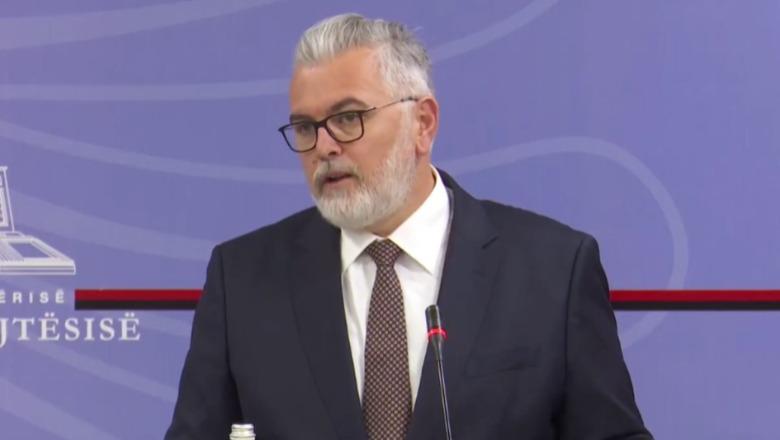
TIRANA. Justice Minister Toni Gogu used a press conference on Tuesday to set out an agenda built around three connected tasks: clearing the case backlog choking the courts, moving the long-delayed criminal amnesty through parliament once Brussels delivers its verdict on the Fundamentals cluster, and rehabilitating a prison system that the Ombudsman, on the same day, described as failing in five facilities.
The minister presented the package as the operational consequence of Albania’s position in the accession process. With Chapter 23 in view, he said the ministry had coordinated more than 70 institutions and over 190 experts, and had submitted in excess of 8,000 pages of documentation to the European Commission. The justice system, he argued, had moved past its institution-building decade and into a new phase.
“After a decade of institutional construction, justice must be felt by the citizen: in the timely reasoned decision, in access to legal aid, in the contract that is enforced, and in a state that functions equally for everyone,” Gogu said.
The backlog: 137,101 cases and a High Court template
The figure Gogu put on the record was 137,101 pending cases across the system. He framed it as a stock now shrinking rather than a static crisis, citing the High Court’s 60 percent reduction over five years as the in-house template. The approach there, he said, combined more personnel with legislative changes, and he indicated the same logic would be extended to the lower courts: filling vacancies, increasing the number of legal advisers at all levels, and expanding physical capacity.
The minister also opened the door to a revision of the judicial map, noting that the law itself mandates a review at the start of next year. He stopped short of committing to redraw it, saying the current map should first be allowed to operate with all its intended components in place: full judicial complements, available courtrooms, and a functioning case management system. Only then, he indicated, would the ministry have the grounds to decide whether the architecture itself needs adjustment.
What he was not asked to explain was why, after years of reform, the backlog still stands above 137,000.
Amnesty: 12,000 people, held back by Brussels timing
Roughly 12,000 people stand to be affected by the criminal amnesty awaiting parliamentary discussion: several hundred prisoners awaiting release, around 1,000 awaiting sentence reductions, thousands awaiting release from probation supervision, and others whose criminal prosecutions would be extinguished. The bill is in parliament. Discussion has not begun.
Gogu was unambiguous that it will. “It will happen, without question,” he said. The reason it has not yet moved, in his account, is sequencing rather than substance: the government has chosen to wait until the European Commission completes its assessment on the Fundamentals cluster before opening the floor debate. Once that assessment is in hand, he said, discussion will begin within days, and approval is expected within the current parliamentary session.
The sequencing carries an institutional logic the minister did not spell out but which sits behind the entire calendar. Chapter 23 monitoring tracks prison overcrowding and human-rights compliance as accession markers; a large amnesty, moved before Brussels delivers its verdict, would inject a politically charged penal-policy decision into the assessment window. Holding it back removes that variable. It also concentrates the government’s near-term political risk on a single file, the Fundamentals evaluation, rather than two running in parallel.
Gogu framed the amnesty itself as an instrument designed to address prison overcrowding and reinforce human-rights guarantees, the same two pressures that Brussels monitors directly. The two files are therefore not separable, even if they are being moved one at a time.
Prisons: Shënkoll under reconstruction, five facilities flagged for closure on the same day
The Ombudsman recommended on Tuesday that five facilities be closed for failing to meet conditions: Burrel, Kosovë-Lushnjë, Kukës, “Mine Peza” (302), and “Jordan Misja” (313). The minister’s press conference was the government’s first response, delivered within hours of the recommendation.
Gogu did not address each facility by name. He signalled that the ministry’s most advanced rehabilitation work is at Shënkoll in Lezhë, where inmates under compulsory medical treatment for mental illness are held in conditions the minister himself described as intolerable.
“We cannot continue to provide that service as we have done until now,” Gogu said.
The solution he outlined involves dividing institutional responsibility: the Ministry of Health would take over the clinical service, while the Ministry of Justice would retain custody and security. Discussions on that division, he said, are at an advanced stage. Concrete results at Shënkoll, in his phrasing, are imminent. He did not address the other four facilities the Ombudsman named.
Criminal Code: awaiting the final draft
A new Criminal Code is in late drafting, with the working group expected to deliver its final text to the ministry shortly. From there, Gogu said, the draft will be put to international experts for consultation. The substantive priorities he identified are economic crime, money laundering, penal proportionality, and the protection of human rights.
Asked about criticism that the draft is too severe, the minister declined to engage with that charge directly until the final version is on the table. The test he set out was whether the Code, as finalised, corresponds to the country’s actual legal and institutional reality.
Live broadcasting: deference to the bench
The minister was asked about the courts’ refusal to permit live transmission of hearings in several high-profile cases, including those involving Ilir Meta, Erion Veliaj, and Ilir Beqaj, where cameras have been admitted only for the opening minutes. Gogu declined to comment on the merits, saying he had not sought clarification from the courts and would not, because the decision is entirely within judicial competence. He expressed confidence in the prudence and professionalism of Albanian judges to balance the public-hearing principle against the integrity of proceedings, and drew an explicit distinction between live broadcasting and the physical presence of journalists in the courtroom.
A crime strategy in coordination with SPAK
A new anti-crime strategy is ready at the ministry and is being discussed with the Prosecutor General and the head of SPAK. The priorities Gogu named are the financial investigation of structured criminal groups in parallel with criminal proceedings, the protection of journalists against SLAPP suits, and road safety.
Access to justice: mediation and expanded legal aid
The minister closed with two access-to-justice measures: a push to expand mediation as a mechanism for resolving disputes outside the courts, and an expansion of the categories eligible for free legal aid. The new beneficiary list will include persons with disabilities, victims of domestic violence, victims of discrimination, and asylum seekers.
Human rights guarantees, citizen access, and system efficiency, Gogu argued throughout, are the conditions on which Albania’s EU membership will be assessed. The Fundamentals verdict will indicate how Brussels reads the same conditions.