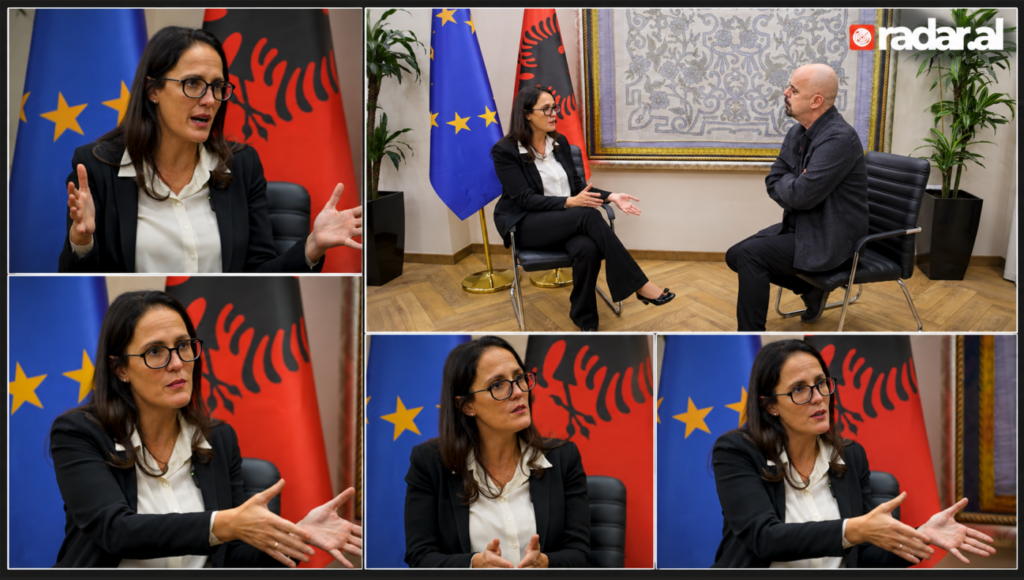
Minister of Economy and Innovation Delina Ibrahimaj was the guest of the second episode of Hard Talk, the Radar podcast hosted by Albatros Rexhaj, main political commentator of this publication. The conversation began with her modest way of dressing and moved quickly to the burned ministry, the attacked banks and the accusation that has followed this government for years: the narco-state.
Ibrahimaj says the attack on the banks was meant to cause panic and a mass withdrawal of deposits, and that the students were not the ones behind it. On Tirana’s towers, she says there is not a single fact showing they are being built with dirty money. She recalls that Albania has left the grey list and that a new Moneyval assessment is expected within the year. She concedes that more than eighty per cent of hotel bookings in Tirana were cancelled after the protests, and that businesses have most likely kept for themselves the gain from the stronger lek. She promises that the 12.8 billion lek from the VAT cut on basic foods will reach families, with inspections and fines for those who do not apply it.
On Edi Rama she has a short answer: arrogant no, authoritarian certainly. And on savings, a piece of advice one does not expect from a former Finance Minister in a country that has always saved in euros.
The full transcript of the interview follows.
REXHAJ: Hello everyone. This is the second episode of Hard Talk, here on Radar, the most innovative platform on the Albanian internet. The last interview, with Defence Minister Ermal Nufi, was widely watched and drew endless comments. We hope the same holds for this second interview, with my friend, I take the liberty of calling you a friend, the Minister of Economy and Innovation, earlier Minister of Taxation, of Entrepreneurship, of Finance…
IBRAHIMAJ: Minister of Finance. I also had the Tax Directorate under me, so both are valid.
REXHAJ: Why I mention it: I have watched you over time in various interviews and public appearances, and what has caught my eye is your modest style of dress. I am used to seeing Albanian government officials, it might be a director somewhere, but she has the handbag, my God, a handbag I would have to work some five years for, as you can imagine. Max Mara clothes, and some brands whose names I do not even dare to pronounce. With you this has stood out, always a modest, formal style. Someone once even said: she is the nun of the government, not in the bad sense, but in the sense of self-restraint. Why this style?
IBRAHIMAJ: I did not choose it, I was raised with it. I have never dressed up more than necessary, not when I was younger either, at high school, as a student. I was a sportier type. For work I dress as simply as possible so that I am comfortable, because the working hours are very long. It is not as if we only have public appearances, those are only one part of the job.
REXHAJ: But here people tend, when they take up an official post, to make an impression through looks, appearance, expensive things. This inclination to modesty, take Mother Teresa, a person who conquered the world with her work, she was modest. Modesty is a value too. Have you never felt uncomfortable in front of your colleagues?
IBRAHIMAJ: No, on the contrary. I think people want to see in government figures they value for their minds, not for appearance, not for clothes. Clothing should follow comfort. I do not judge those colleagues, women or men, who like to dress up, because they enjoy it, it is a matter of character. For me what matters is that people remember me not for what I wore, but for what I say and for the way I communicate the work we do.
REXHAJ: But until recently a female who, in an official post…
IBRAHIMAJ: I am very particular about the word “female”. It is girl or woman.
REXHAJ: Girl or woman. A woman in an official position, in this Albanian environment, who does not invest in her appearance, is she not prejudged?
IBRAHIMAJ: No, on the contrary. I do not think a person, especially in the positions we hold, should be prejudged for the way they dress. They should be judged for what they say and what they do. I have never felt prejudice because of clothing. I have always dressed in a way that is comfortable for me. I like myself dressed simply.
REXHAJ: The reason I asked these questions is that for me this is a compliment to you. I think this is the right model to pass on to people. In the end, as a minister you are a public servant. I think some of your colleagues across the administration, and I mean ministers, deputy ministers, directors and others, sometimes forget that. What is it like to be a public servant in a high position such as yours, at this moment Albania finds itself in? Besides being a minister you are also a private citizen, which means a private life: you go out shopping, to buy something, to have lunch somewhere, to have coffee with a friend, with family. What does this moment feel like today, given the office you hold?
IBRAHIMAJ: To be honest, first as a citizen and then as a minister: I come from a generation that carries its own traumas from protests and conflicts, because Albania has had major conflicts, which we lived through. Perhaps part of the generation now out on the boulevard did not live through them, does not remember them, may have read about them or heard about them from their parents. But hearing is one thing and living it is another. I lived through them in adolescence, at high school, at university, at ages similar to those of the students who have gone out to protest, and not only theirs.
So the violent situation affects me a great deal, as an individual and as a citizen. I cannot separate the citizen from the minister, because in the end I am a human being. It is very hard to watch a step backwards, in a situation we worked very hard for, and when I say we, I mean our government, but also the emancipation of our society in general. It is very sad to see the situation thrown back and such extraordinary violence.
What struck me in the days of the violent protests was that it was not only the boulevard being destroyed, public and private property being destroyed with no right whatsoever. There was the whole rest of the city, which did not go out to protest and stayed at home, glued to the television. In the past, in other protests, the boulevard would fill up, whether in the June and July protests or the earlier political ones. Meanwhile, right next to the boulevard, in Blloku, people carried on with their lives, drank coffee, had lunch, had dinner. Over the years protest never disturbed the life of the city. This time it was entirely different.
REXHAJ: Those who took to the streets in this latest episode think the fault lies with you as a government. They have reached the point where the cup overflows, and they frame it like this: this display of the anger we feel is legitimate. Do you feel that pressure on yourself, as part of the government?
IBRAHIMAJ: To be honest, I do not find it legitimate at all for property to be attacked, public or private.
REXHAJ: But nobody has distanced themselves from it. Not the media, not civil society. The European Union barely managed to put out a statement against the violence, and I have not seen anyone in the civil society that takes EU funds echo it. In public discourse in Tirana, the violence is considered legitimate.
IBRAHIMAJ: I do not think so. If public discourse sees it as legitimate, that means there are not enough voices representing the real citizens of Tirana. In my private conversations, and not only there, I have heard people deeply worried on exactly this point, that we cannot allow and tolerate violence. Do people have the right to go out and protest? Without question, everyone has their own thoughts and opinions. If you do not support a leader or a political force, if you think they are to blame for a situation of yours, personal or collective, of course you have the right to go out and raise your voice in various forms. But not by tearing up the boulevard’s paving stones.
REXHAJ: On this point you and I agree completely. I am among the few voices who have said that violence in this form is unacceptable. But let us state the reality: in public discourse we are a minority. Most of the people who appear on television, most of those who speak on social media with videos, reels and the rest, journalists who write, commentators who take positions, are on the other side, who in one form or another justify the violence or find a way to legitimise it. Now I am crossing to their camp, I am playing devil’s advocate. They say: we are going out and we have to smash the banks, we have to smash these private business institutions, because they are in the hands of a minority. That is the argument used, for example, by one of the opposition’s main voices, Jorida Tabaku. Albania had a first phase of transition, which ends in 2005, the second phase begins after 2005, and now, it seems, we are entering another phase of transition. Where is the mistake of this government, and of the one before it, in this perception that a minority holds all the resources?
IBRAHIMAJ: First, I hope we do not move into another phase of transition. We have entered a phase of stability, and we must all work together to continue in a phase of stability and growth, because constant transitions leave you behind.
REXHAJ: That is not in our hands.
IBRAHIMAJ: It is, because a government comes in and is mandated for a purpose.
REXHAJ: Yes, but those who take to the streets, and the public opinion that backs them, I mean the people who appear on television, I am not talking about the silent majority, think otherwise. They say there has been plunder here, that everything is in the hands of a minority, including the banks, and here we enter your field.
IBRAHIMAJ: First, I cannot accept, the banking system was hit the hardest, I cannot accept that those who go out and protest believe the banks are in the hands of a minority. Not at all. We have legislation that licenses banks and we have a sufficient number of banks. In fact from time to time the IMF says we should be careful with the number of licences we issue, because it is a small market. Who owns the banks in Albania? There are bank owners who are Albanian, and there are banks that are branches of foreign companies.
REXHAJ: Concretely, then: BKT is a Turkish bank.
IBRAHIMAJ: Yes. Raiffeisen is Austrian. OTP is foreign, ProCredit is foreign, Intesa is foreign. So most of the banks are foreign.
REXHAJ: And these hold most of the capital?
IBRAHIMAJ: Certainly. Albanian banks have a much smaller portfolio, and every kind of bank was hit. So the argument that the financial business was hit because it is controlled by a minority does not stand. Small shops were hit on Durrës Street, on Kavaja Street, shops there was no reason whatsoever to hit. For what? I heard arguments like “we are against you because you did not join us in the protest”. That is psychological violence. Why should I join the protest? I have my own opinion and I decide not to join. Just as you have the freedom to go out and protest, I have the freedom not to. How it is then used politically is another matter, but the argument that we protest because a minority profits and a majority does not simply does not stand.
REXHAJ: As an expert in the field, I think the reason the banks were attacked has to do with the aim of pushing Albanians into withdrawing their deposits. That is where it was heading. There were even calls on social media: take your money out. Has that happened?
IBRAHIMAJ: It has not happened. And let me turn a question back to you: do you think some students, and in that protest there were children of fourteen, fifteen, sixteen, understand the workings of the economy so clearly that they would think of attacking banks so that deposits are withdrawn and a financial crisis is triggered? I do not. The aim was without question this: to cause panic among consumers, among individuals with deposits in the banks, as they watched the banks being attacked, and to bring about a mass withdrawal of deposits that would have led to financial instability, and would certainly have prolonged the instability in public order too.
Fortunately this did not happen, and I see no risk that it will. I am very glad that citizens read it correctly. We of course tried, through communication and information, to prevent panic. But that is the aim, and it certainly was not the students’. It belonged to certain forces that have an interest in instability here.
REXHAJ: Driven, I think, by various conspiracy theories as well. The main conspiracy theory circulating everywhere in the world, and in Albania too, is that the banking sector is controlled by Jews. This is a global myth. In certain countries it may be true, we do not know, but in Albania…
IBRAHIMAJ: If we look at the statistics of the largest banks, those with the biggest loan portfolios, the biggest deposit portfolios, the most capital, that is not the situation at all. Not at all. Is there an interest in spreading this opinion? It has happened to me several times that even friends of mine, simply from this public discourse of those who go out and talk, were convinced that it is as you say. But it is not.
REXHAJ: You have them on national television, on Top Channel for instance, in prime time, throwing out these conspiracy theories entirely unchallenged. Naturally, when people see a national broadcaster like Top Channel promoting such ideas, that Israeli Masons control the banking system in Albania, and nobody challenges it, an ordinary citizen believes it. For me the fault lies with the government, which has not come out to say: hold on, these are the facts. Whether through a campaign against disinformation or otherwise. But that is a long conversation.
Let us go further into the conspiracies. Albanians are mad about conspiracies. The main theory is that the Albanian economy is based on drug trafficking, that we are a narco-state, that the construction going on is a result of the drug trade and so on. I was born in the former Yugoslavia. I know that in organised crime in the region the Albanians are latecomers. The Montenegrin mafia controlled the former Yugoslavia, controlled a large part of the trafficking that passes through this part of the world, and continues to do so. According to confirmed statistics, the Montenegrin mafia, specifically the Kotor clan, has around seventy victims, people it killed for the interests of its informal economy. But nobody deals with that, because in Montenegro people do not deal in gossip and conspiracy theories. This is the reality we live in. These towers going up: is it true, as Jorida Tabaku and some others say, that they are the result of money laundering?
IBRAHIMAJ: We have discussed this together before. There is not a single fact showing that this is the case. Is there money laundering in the construction sector in Albania? As in every other country in the world, it is a vulnerable sector in this respect, where room for money laundering can open up. But that is not only in Albania, it is in every country in the world. For this reason the institutions that deal with preventing money laundering keep the construction sector in focus, treat it as a high-risk sector, and monitor all activity in it very carefully. But what happens in the construction sector in Albania is what happens in every other country in the world.
Now, are the towers being built with dirty money? First, some towers are being built, not all the towers that received permits have started construction. It is a narrative that has begun to be inflated and over-inflated. There is also the narrative that the Albanian economy is driven by the construction sector. That is not true, because when we talk about construction we are not talking only about towers. We are also talking about road infrastructure, infrastructure in general, tourism, industrial development. Every building that goes up, whether a warehouse, hotel, residence, apartment block or a tower in the capital for commercial purposes, falls within the construction sector. So when we see growth in construction, it means we have growth in investment in general, not only in housing or towers.
REXHAJ: Now let us explain it to people simply, as in primary school. To build a house, I have to apply for a loan. To buy a house, I have to apply for a loan. You get the funds from the bank, you invest in the house. The things being built in Albania, hotels or towers, do they go through the same channel?
IBRAHIMAJ: Yes, certainly.
REXHAJ: Do you have statistics, figures?
IBRAHIMAJ: We have statistics. They are published by the Authority for the Prevention of Money Laundering, which carries out an annual analysis of the construction sector: what percentage of the sector is financed by loans, what percentage of purchases are financed by loans. The statistics show that more apartments are sold on credit than for cash. And, more interesting still, I am speaking of housing, a large share is bought by non-residents. In recent years we have had very high demand from foreigners or Albanians with foreign passports, who have bought, and without question all transactions go through the banks, because it is also a legal requirement, the transaction is made before a notary.
REXHAJ: That is the buyer. And the one who builds? Are you absolutely certain that this construction rests mainly on a relationship the builder has with the bank?
IBRAHIMAJ: I am absolutely certain that the larger part goes through the bank. Part of construction is of course also financed through barter. For many years in Albania builders have made arrangements with whoever does the windows, whoever does the façade and so on. I am not an expert on the construction sector and subcontractors, but in the main it works like this: there is an investor who subcontracts various works, and pays the subcontractors partly in apartments, that is, in property.
REXHAJ: Are all these links monitored?
IBRAHIMAJ: All of them are monitored. Part is financed by loans, because in any case, to begin works, you have to pay the taxes, you have to pay…
REXHAJ: It is not that you fix the paperwork for someone?
IBRAHIMAJ: How could we fix the paperwork?
REXHAJ: Who monitors the government on this? Does the EU deal with it? The World Bank? Who does?
IBRAHIMAJ: The EU does not monitor construction companies. Not the EU, but other entities monitor the Authority for the Prevention of Money Laundering. Of course they have reporting. We are assessed, and we will now be assessed again.
REXHAJ: You fix their paperwork too.
IBRAHIMAJ: How on earth would we fix their paperwork? That makes no sense. We are now waiting for the new Moneyval assessment, which comes out at the end of the year. Three years ago we left the grey list, and the fact that we left the grey list of FATF and Moneyval is because we created all the mechanisms to monitor and prevent money laundering. This needs explaining. We were on the grey list. We passed all the legislation, built the institutions, set up the mechanisms in line with all the recommendations given to us by the two institutions that deal with preventing money laundering, and we came off the grey list. We expect an assessment which, according to the signals, will again be positive, by the end of the year. And we are accused of being a country whose entire economy is a narco-economy.
This term narco-economy is the opposition leader’s term. Every person is a narco-director, a narco-minister, this is a narco-state, narco this, narco that, and for every word “narco” he utters he has an embrace.
REXHAJ: We need to treat this as in primary school. I am going to be ironic, so bear with me. That is: the builder fixes it with the bank, they sort out the paperwork, as if they were taking a loan. Now the government receives this paperwork. The two of them fix it with the government’s agencies so that they sort out the paperwork as well. Then the three of you together fix it with these European agencies, so that they sort out the paperwork. And finally you fix it with those others somewhere else, so they give you a positive assessment.
IBRAHIMAJ: Yes, yes, the Council of Europe too. We have fixed it with everyone…
REXHAJ: You have corrupted them all.
IBRAHIMAJ: (ironically) All of them, all of them. All the way up.
REXHAJ: The reason I put it ironically is that Albania has received an assessment on this. If that assessment exists, why does this war go on in the studios, everywhere, that everything we see in the Albanian economy is dirty money?
IBRAHIMAJ: This war is a political war. It takes hold, and people like to hear talk and gossip.
REXHAJ: But the media are not political parties. It cannot be news if the facts say something else.
IBRAHIMAJ: But that is exactly what is being done. Yesterday I was in a parliamentary committee, I had opposite me…
REXHAJ: Where are your directors? Where are this government’s directors, where are your other colleagues? If the facts are on your side, and the others say something and nobody challenges them, where is the problem?
IBRAHIMAJ: With the mechanisms at my disposal, I go out, I speak, I explain. When the economy grows, of course the public does not grasp what it means that the economy grew by 3.6 or 3.8 per cent. I go out, I speak, I explain when we receive the international assessment. I speak and explain when we undertake policies for citizens.
REXHAJ: When I see someone from the government speaking, I change the channel immediately. In a second. That is the problem. I think the problem on this point lies with the government.
IBRAHIMAJ: The government does not know how to communicate properly? How is that possible, when since before I was part of the government, the thing we have been attacked for most by everyone is that we communicate more than we should, that we talk about what we do more than we should? Meanwhile the result you are describing to me is that nobody listens to us.
REXHAJ: I think you are at the point where people are not listening to what you tell them.
IBRAHIMAJ: But we agree that we have been attacked a great deal over communication.
REXHAJ: Or the facts do not support what you say. Because for this not to be true, the chain has to be: the builder fixed it with the bank, the bank with the government, the government with the EU, the EU with those others, and the Albanians have corrupted them all. That deserves an Oscar, a Nobel Prize, something. So the facts prove you right. But at the same time nobody wants to hear about the facts. I think you as a government have a problem here, and it is not solved simply with PR. It requires an entirely new approach, but that is another subject.
IBRAHIMAJ: What is needed, and what we are doing, is to try to translate these growth numbers into a positive effect on citizens’ pockets. Otherwise, on this insinuation about the narco-state and money laundering, however many facts you give, we have talked about this, people no longer want to hear facts. People are influenced by what they hear, by what they like to hear, by what sells more and makes more news.
REXHAJ: Or it is the opposite: you and your cabinet colleagues have now settled into the role of the victim. “We have the facts, nobody is listening to us.” You have dozed off comfortably in it. While the others, Jorida Tabaku comes out every day, she was out again today: it’s this, it’s that. You look as though you have surrendered.
IBRAHIMAJ: No, we have not surrendered. We explain what we do. The work done in the ministries, not only by me but by the whole government, is extraordinary work, which of course cannot be perceived every day by citizens or businesses. Today alone, before you came here, four new laws passed through my hands. The intensity at which we are working is extraordinary.
Now, what is needed: this economic growth, this stability I told you about, to translate it into citizens’ pockets. In the end all citizens want to live better, want more welfare, more services. That is what we are trying to do: to move the additional revenue this economic stability generates for us, let us say, from the gains of businesses to the gains of citizens. This has happened also through the fact that wages have risen, and now we have presented the fiscal package, where we propose to tax capital more than labour. We do this because economic development now allows us to.
It is certainly very easy, when you are in opposition and bear no responsibility for governing, to come out and say that pensions must be raised, taxes must be cut, business must be helped, wages must be raised as well, and then end up with an unaffordable budget. Perhaps at times we have not carried out these left-wing policies you speak of, but we have shown that we preserved economic stability, and I am not the one saying so. The IMF says so, the World Bank says so, Moody’s says so, S&P says so, Fitch says so, agencies that are there to assess the country’s economic situation. Can it be that we have corrupted the IMF, and the World Bank, and the rating agencies, in addition to the Council of Europe and all the other entities, and of course business here, because we have everything in hand? These things do not stand.
Of course, when the opposition comes out and says these people are a narco-state, they help launder money, they run the trafficking, that takes up more space than what I say. But what I say is based on facts, and this is not my assessment, nor the opposition’s, it is the assessment of the internationals. How can it be communicated better? Only if people feel better off. Only if they have more money at the end of the month, more opportunities to do business, more opportunities for housing. Only that way can we convince them that we are pursuing the right policies for their welfare, and that is what we are trying to do. Is it easy? No, it is not. Perhaps there are people who say: you have been in power so many years, how have you not done all these things yet? It has been thirteen years, why are you telling us now that this or that held you back? But that is how the situation was. The crises, as we know.
REXHAJ: I have to congratulate you, because you may be the first government official in the history of Albanian media who has had the chance to speak about these things with such passion, and that was why I did not interrupt you. But I think you need to rediscover the passion. The reason the government has come to this low point of trust, I think, is that people no longer see you as passionate. The moment they see no passion in the eyes of an official to whom they gave their trust with their vote, they say: this one is looking after his own interest, he is no longer looking after mine. So accept my compliments on this point.
Let us move on to the next point. What do we do, Minister, about the fact that Albanians, not only Albanians, in my view this is a problem of the white race, want to get money without working? Second, if they work, they want to work in services, not in production. The strength of Europe and North America for a long time was being the industrial base of the globe. Today the industrial base is leaving, it is going to Asia. Europe, of which we are part, and North America want an economy based mainly on services, and when people get an education, they are educated to perform services. Can an economy based entirely on services survive? Where does Albania stand on this?
IBRAHIMAJ: There are economies that are concentrated mainly on services. America is concentrated on services, on financial services, of course there is production as well. England too is an economy where, not that there is no industry, of course there is, but over the years the larger share of the economy is produced by services and intermediation services rather than by real production. Should production be strengthened? Certainly. I think an economy should always be diversified, because every sector has its own cycles.
REXHAJ: Production in Albania is disappearing.
IBRAHIMAJ: Production in Albania is not disappearing. Without question it must grow. In recent years we have paid a lot of attention to services, mainly the tourism sector, which has had attention in fiscal policy too, and which has without question brought benefits to our economy. But meanwhile we also have policies to stimulate production. For example, we are working to stimulate production in heavy industry. These are investments that require a lot of money, a lot of financing, but they are important, both for the national economy, by using the natural resources we have, and for the value chains of the European economy, because raw materials are ever more in demand. The supply of raw materials in Europe was tied to certain states with which Europe has now cut its ties. So we have potential there.
REXHAJ: Who will work in that heavy industry? Will we bring in people from the third world?
IBRAHIMAJ: There is still room and willingness to work. Of course there is not when easier and better-paid work is on offer, without question. I too, if I can choose, go to work in a job that pays better and is easier for me. In the end labour is a price. As long as the price of labour in production is lower than the price of labour in services, citizens will have more interest in working in services. It is supply and demand. So the market has to be adjusted so that those jobs are better paid. I believe that with investment and with an investment strategy in those fields there will be interest, because they are mainly in more remote areas, where there is no large supply of jobs. But without question imported labour is not ruled out for domestic production either.
Now, the opposition comes out and says there is no production any more, and ties it mainly to the textile industry, which used to be large. That was not a manufacturing industry where all production took place in Albania. It was an operation under the fason system, cut-and-sew work to order, which was practically slavery: you received only a minimum for the production you carried out and you were totally dependent on the orders coming from abroad, and on the raw material coming from abroad too. So you did only a fraction of the work you invoiced. Albania can no longer be a state that produces on fason. It must be a state that produces domestic output, with a closed cycle, so that the added value stays here and does not go to other countries.
We no longer have the luxury of a model in which the interest in investing comes from cheap labour. Apart from the whole debate about the euro… We no longer have the luxury of a company coming to Albania because labour costs are cheap, because we have Europe very close. We also have the alternative of emigration, and an individual has no reason to work in Albania for a very low minimum wage when they can go and work for a much higher minimum wage in another European country, and are free to do so. So we cannot encourage investment, even in production, that keeps Albania at low labour costs, because, as we said, we have to work so that growth is tied to the welfare of citizens. And citizens are not only the middle class, there is also the lower class, which we must think about more and more.
REXHAJ: Minister, the tourism industry is booming in Albania. Some years ago, when I went on holiday to Turkey, I would get into conversations with hotel owners. They told me that the hotel is only the top of a chain. They said: the beer you drink here is produced in Turkey, the tomato you eat here is produced in Turkey, the flour used is produced in Turkey, the meat you consume is produced in Turkey. Only the very expensive spirits were imported. Why is this not happening in Albania?
IBRAHIMAJ: First, because Albania, compared to Turkey, is a much smaller country with much smaller production capacities. And increasingly, both through the agreements we made many years ago with the World Trade Organization and those we are making for the European integration process, we are not allowed to favour domestic production through various policies. So there are two elements: one, that we cannot be specialised in producing everything, and two, that we cannot stimulate domestic production through fiscal policy, because we have international rules that forbid it, and our will is to join the European Union, that is, to accept their rules.
Then, in Turkey you have economies of scale, it is a very large country. So you are competing with much larger producers, at much lower cost. You have that competitive disadvantage as well. Meanwhile, without question production has to reach standards, so it needs investment. That is why we are pursuing some policies to stimulate the financing of these products, and we are preparing a law, which I believe will be approved very soon, in the first months of next year, the law on “Made in Albania” products, where we have provided for some incentives aimed at promoting “Made in Albania” products.
In any case we will remain a country that continues to import products, because we cannot produce all domestic demand at home. We would then have to specialise all production in the food industry alone, whereas the structure of the economy is diversified, there is production in several different sectors, and the whole labour force cannot be concentrated in the food industry alone.
REXHAJ: The diaspora. For every country it is a headache, but also an asset. Every state goes through this. The diaspora is more nationalist, more emotional, we are not the only ones. But at the same time the diaspora is an asset. We have seen the diaspora work wonders in Croatia, in Montenegro. We are seeing a trend in Kosovo too. How does this trend stand in Albania? Are there Albanians who emigrated and come back, not to stay, but to invest?
IBRAHIMAJ: Without question there is such a trend. On construction I said it a moment ago: there are many Albanians, they may hold foreign passports, who come and buy second homes in the country. Meanwhile I have seen very great interest across the whole world of startups, of innovation. They are interested not only in coming to invest in Albania, but also simply in mentoring, offering ideas and becoming part of the initiatives we run.
So the interest exists. In other countries, Ireland for example, which has a very large diaspora, there has been structured financing dedicated to the diaspora. Or Israel, since we mentioned it a moment ago. They have structures where you can invest through shares, through financial instruments. We do not yet have a well-structured capital market, where an Albanian from the diaspora can come and buy shares in company X or company Y. So the opportunities for investment are harder: it is very difficult for someone from the diaspora to come and open a business here from scratch. They need a local partner, someone to run the business. The greatest opportunity is through the sale of shares, which we have not yet developed.
REXHAJ: That brings me to the next question, which is tied to the protests and to what we saw throughout this year. One of people’s complaints, which in my view is legitimate, is that the lower you go, minister, deputy minister, director, agency head, down to the clerk at the bottom, the more complicated things get. We have a rise in arrogance. I call them people who think they are pashas, each with his own palace: this is my thing, let the minister talk on television, ministers come and go, we are here. This is a real problem, the arrogance of power. When people talk about the arrogance of power, they do not have Delina Ibrahimaj in mind, because they never meet Delina Ibrahimaj. Perhaps a neighbour meets her, or a friend. Citizens do not meet her, but they do meet Delina Ibrahimaj’s subordinates, and the subordinates of your colleagues. You also take part in this experiment of Edi Rama’s, Prania besnike (Faithful Presence), a very interesting, very valuable experiment, because it makes you listen, and I think that there you hear endless stories of people complaining about arrogance. So I do not accept the answer “there is no arrogance”, because Edi Rama has said: there is arrogance. He was the first to say: we will have an administration that listens, not an administration that talks. How is this problem of officials’ arrogance solved? Because the lower you go, the worse it gets.
IBRAHIMAJ: I say there is only one solution. People’s work culture is hard to change. The only solution is for those officials to have no contact with individuals.
REXHAJ: We cannot do everything online, Minister.
IBRAHIMAJ: Why not? Why not? Is it not simpler to use artificial intelligence? Is it not simpler to get an analysis from an artificial intelligence system than this confrontation you are talking about?
REXHAJ: Are you the one putting these ideas about online services into Edi Rama’s head?
IBRAHIMAJ: Not only me! Of course it is simpler through technological tools. It is simpler to build an AI agent than to change the culture of an administration. Without question the culture of arrogance has to be fought. But it is hard to follow the chain to the end and understand which link needs fixing. You may have a great many employees who are not arrogant, and one arrogant one is enough to ruin the image for all the others. It is like the army: when one makes a mistake, the whole battalion pays. In service delivery and in public administration there may be a great many who are good, dedicated, not arrogant, who come and do their duty very seriously. Then one comes along who behaves badly, and he ruins the whole perception of everything.
REXHAJ: But in the end the fault lies with the superior.
IBRAHIMAJ: In the end the fault lies with the superior. The fish always rots from the head, without question. I never blame my staff when something was not done. The fault is mine, for not following it up properly, certainly.
REXHAJ: That is very nice, but I have tested this system, with the idea: I am going, I am complaining on behalf of someone I heard has a problem, and I told him, all right, I will represent you. In my past I was a trade union chairman for thirteen years, in the organisation where I worked. We fought with great passion and ended up in court, so representation is close to my heart. But what happened to me is this: someone goes and raises a problem. The first reaction of the administration, of the superior at a lower level, is to give you a hostile reception. They do not even want to listen. They treat you with: how dare you complain? Why? We cannot behave as if everything is in order. This country has problems. I think this is a very serious matter that has to be addressed: when I complain, I should not be afraid that I am complaining. All right, you are meeting people there at Prania besnike. But a person must feel entirely free to come to the state administration and say: this and this is my problem, without fearing that his life will be made complicated.
IBRAHIMAJ: That is very true, and that is why I say electronic tools are much easier both for complaints and for follow-up, because you do not have that official in front of you.
REXHAJ: But someone reads your name there. You do not have him in front of you, but: “so-and-so has complained, has he”. How does the system guarantee so-and-so that his life will not be made complicated? These are the challenges people face today. Since we are at the Ministry of Innovation.
IBRAHIMAJ: Agreed. I think the only way to avoid this personal relationship is the system. Whether you can get the solution from the system or not is another link, on which we are working and will work: to improve services, to listen to complaints more, to understand them more. Thousands upon thousands of services are delivered every day by the institutions. Not every service gets stuck, not every service has a complaint, not every official holds a grudge because Delina complained. It does not happen every time. The system is what will work.
There are services that are not delivered online. You go to the doctor, the doctor cannot do it online, because you have to show up and be examined. For those too there must be feedback. The trouble is that if the feedback does not reach the top, we cannot get to the bottom of it and solve it where the problem lies. Sometimes there are blockages that are solved very easily, and there are blockages that are cultural, that make the individual go straight on the defensive and get upset, because it seems to him that his performance looks worse if someone complains. That is a cultural matter, hard to fix. I am not like that. When someone raises a concern with me, I think about how to solve it, because there is a blockage there, and there is a way for his problem to be solved without coming to the minister, as it should be.
REXHAJ: But people did storm into the ministry.
IBRAHIMAJ: That is another matter.
REXHAJ: The enraged people got into the ministry, and according to commentators in the media they were right. Fortunately you were not in the office. How did you feel that day when you saw the ministry burned like that?
IBRAHIMAJ: Violated. I felt personally violated, I felt violated as a minister and I felt violated as a citizen. Violated in every direction. I am sorry that, after all the work we have done, each of us in our own way, we reach the point of a degradation of this level, where you enter an institution, burn, tear things apart. To see the photos of the rooms downstairs, with doors ripped off, windows smashed, things burned. But why?
REXHAJ: Because you have to be removed. If we remove you, things get better. That is what they say.
IBRAHIMAJ: There are forms and ways of protesting. What they think, I have no problem with. They think we should go, someone else thinks we should stay. The vote shows that, and so far we have won the votes. We will see how it goes in future. But violence against institutions, which are not mine, are not Edi Rama’s, are the state’s, are public institutions, a public good, that I cannot tolerate. I felt violated from all four sides. I felt sorry that my children have to live in a city where there are such displays of violence, when until a few months ago they lived in a city where you had no worry walking in the street, and now you might be hit by a stone, or I do not know what, while walking.
REXHAJ: Did this have an effect on the capital’s economy?
IBRAHIMAJ: It did, without question. The effect is not yet measurable, but it will be very high. Certainly this quarter will be slower than the others. Leaving aside all the businesses that were damaged and are now closed, that have people employed, that are paying loans, that do that work to keep their families and businesses alive, you had more than eighty per cent of hotel bookings in Tirana cancelled. That then affects the whole chain, because it is not only the hotels that did not get what they should have.
REXHAJ: But what business do we have with these foreigners who come here? These foreigners have pushed our prices up.
IBRAHIMAJ: Many people, including some of those who go out to protest, are people who, for example, have rented out their own home, they let it on Airbnb. Now nobody goes to Airbnb any more, because demand has fallen. And they begin to feel that we need these foreigners, because they generate economy, generate consumption, drive the whole value chain. One lek spent in tourism…
REXHAJ: Albania for the Albanians. We do not need foreigners, Minister.
IBRAHIMAJ: We are back at this point. The country that fought to open its borders will now be closed. Either we want to be in Europe and have no borders, or we want to keep Albania for the Albanians. We cannot hold this idea of a small, closed country, because this idea, of the small, closed country, was the dictatorship’s. If we like that economic ideology…
REXHAJ: We are nearing the end: the euro. The euro is falling. Have you now fixed it with the World Bank and the Monetary Fund as well?
IBRAHIMAJ: (ironically) With everyone.
REXHAJ: Currency, whether national or whichever is in use, is monitored by institutions such as the International Monetary Fund and the World Bank, if I am not mistaken. Are we correct?
IBRAHIMAJ: Currency, like everything else, is a price. Labour is a price. Currency is a price. It is the same as a commodity.
REXHAJ: But I do not believe you on prices. Who is monitoring you?
IBRAHIMAJ: On the euro’s performance there are certainly analyses by the Monetary Fund and the World Bank, carried out on the movement of the exchange rate. They say what we say. There are analyses and studies.
REXHAJ: So you have fixed it with them too.
IBRAHIMAJ: (ironically) Yes, yes, with everyone.
REXHAJ: You have fixed it with the European Union, with everyone. All right, Jorida Tabaku, I am sorry we keep mentioning her, but she should not mind, because she is the only one who speaks, I congratulate her on her passion, she speaks and promotes her ideas, says today that the euro is falling because of this and this and this. What does the Monetary Fund say? Let us explain it as in primary school.
IBRAHIMAJ: It says what I say: the exchange rate is a price. When there is large supply and small demand, the price falls. When there is a lot of demand and supply is smaller, the price rises. It is like having a lot of apples and one buyer.
REXHAJ: Do we have a lot of demand for lek?
IBRAHIMAJ: Demand for euros has not risen. We have had a lot of euros entering the economy, because of tourism, because of foreign direct investment. We have had large euro inflows, while demand for euros in the economy has not grown along with supply. If today we have overproduction of olive oil, there are years of olive overproduction, the price of oil falls, because there is a lot of supply. In a bad year production is lower and the price rises. The exchange rate is the same, it is set by supply and demand.
REXHAJ: Does it affect the small economy?
IBRAHIMAJ: It has positive and negative effects, you can look at it from both sides. Whoever imports raw materials sees positive effects, because the cost of the imported product is cheaper than it would be if the euro were higher.
REXHAJ: Edi Rama has come out with the Price Mirror (Pasqyra e Çmimeve). At last Edi Rama is dealing with prices, and we congratulate him on this great courage. I too think what you say, that imports come out cheaper, but the price is not changing. Do you think businesses in Albania operate with a very high profit margin?
IBRAHIMAJ: Yes, there are grounds to think so, and that is why we made the Price Mirror. One, to bring transparency to prices, so the citizen can see where the product is cheapest and go and buy it there. Second, so that we begin to monitor profit margins across the whole value chain, at wholesalers, importers and producers alike. Meanwhile we are working to build a mechanism so that the policy we undertook, the reduction of VAT on basic foods from twenty per cent to six per cent, is passed on to citizens. So that what happened with the euro does not happen, where the strengthening of the lek was not absorbed as a benefit for citizens, but must have been absorbed into companies’ profit margins. I cannot say this with complete certainty, because when you sit down with them, they say: our costs have gone up here and there, and that is why it was not reflected. These are matters that will be monitored and analysed. Very soon we will come out with a legal act that will allow us to carry out monitoring, inspections and penalties in cases where it is not applied.
REXHAJ: Minister, let us take an example people understand. A top at Zara. Zara is where most people buy things. In Albania, let us suppose, it costs 3,999 new lek. The same top in Kosovo costs 29.99 euros, which in lek comes to around 2,600 at today’s rate. The same top in Macedonia costs 1,899 denars, which comes to around thirty-one euros. The same top in Thessaloniki costs what it does in Kosovo. It is a big difference.
IBRAHIMAJ: Without question it is a big difference. Here that chain I mentioned comes into it a great deal: costs, duties and taxes. It depends on how each country has set up its tax system.
REXHAJ: It is imported from the EU, meaning there is no customs duty there, nothing.
IBRAHIMAJ: There is no customs duty. But there may be a reduced VAT somewhere, so it depends on the structure of how the price is formed.
REXHAJ: The difference cannot be fourteen euros.
IBRAHIMAJ: That is why transparency is important. We had a similar case, not with Zara, with another chain of shops. The moment this became transparent, when it was said that this product costs this much in Albania, this much in Kosovo, this much there, the chain itself lowered its prices. Because there is positive pressure to lower profit margins.
REXHAJ: Another example, with food: Conad. Near my home in Pristina I have a Conad, and there are some things I like to buy, here as well as there. In Pristina it costs one euro forty. The same thing in Tirana costs around 260, 270 lek. The same company, the same product.
IBRAHIMAJ: Kosovo has reduced VAT. That is exactly where we are.
REXHAJ: But the difference cannot be almost double. I am saying that businesses here are simply ripping people off. And they say: it is a market economy, we set the prices. How much does that answer interest the citizen?
IBRAHIMAJ: Not at all.
REXHAJ: I agree, not at all. He wants it to be cheaper. How will we solve it?
IBRAHIMAJ: This is solved only through positive pressure. In other countries that had this problem, transparency puts traders in competition with one another. When they see that one lowers the price of a product, all the others lower it too, because they know purchasing power will leave and move to where the price is cheaper. That is why transparency is very important.
REXHAJ: Do you intend to see this through to the end?
IBRAHIMAJ: Yes, certainly. This will be a year in which we concentrate on reducing the cost of living, which is why we undertook this initiative. It is 12.8 billion lek that the state budget will forgo from the VAT reduction on basic foods alone, and these 12.8 billion lek must without fail be passed on as lower costs for Albanian families. Otherwise what is the point of undertaking this policy? We will make sure to follow it step by step, so that it translates into lower prices for citizens. This is the only means we have for basic foods, for those categories that spend the larger part of their budget on basic foods.
REXHAJ: Are you serious about this?
IBRAHIMAJ: Yes, certainly.
REXHAJ: All right. We will believe it when it happens. I am a supporter of what is called affordability, meaning that the cost of living should be lower for people. It should be an imperative for every government, including today’s. I am glad there is such reflection. Do you think Edi Rama has really reflected? Because this word reflection is very pretty. Or is he acting, since he is a bit of an artist? Have you seen him when he goes live, he knows the whole world is watching, he picks up his coffee and drinks it like that, dramatically? Is Edi Rama not a bit of an actor? Let us state the reality. Leaders are neither black nor white, they are complicated. Is he sincere about this? You work with him.
IBRAHIMAJ: There are several initiatives that began before the protests. For example the one I am describing, the Price Mirror, is an initiative we began to design back in December of last year.
REXHAJ: The protest made it necessary?
IBRAHIMAJ: The protest hastened it.
REXHAJ: It made it necessary.
IBRAHIMAJ: It made it necessary. Housing is another element we already had in the governing programme. In the programme we have a pillar on housing, where we promise that in this four-year term, in this mandate, we will pursue housing policies for affordable housing, not only for social housing, and that is what is happening. The protest brought it out even more. So there are several initiatives we had thought of beforehand and are now implementing with more speed. Without question the protests have made us think about what more we can do and what we can do better. In the end that is the purpose of protests too, to improve governance.
I think that if the policies we are undertaking now go in the direction of reducing the cost of living, raising incomes, greater security for young men and women, but also for Albanian citizens in general, to live in Albania, lower housing costs, that is, stability, the chance to open a business and a better life in Albania, then we will have had a positive result, both from our policies and from what, in the end, the protesters on the boulevard were asking for. Of course services are the Achilles heel, and that is why we are working to improve services for citizens and services for businesses.
REXHAJ: Minister, we have mutual friends in the business sector too. A small country, everyone knows everyone, went to school with someone, had coffee with someone. But my assessment is that these people of the business world do not have much regard for reality. They think: I know the minister, I know this director, I will get this done for myself. They are not interested in procedure, they are not interested in why it cannot be done. How do we discipline these people?
IBRAHIMAJ: Perception and reality are two entirely different things. All businesses, large and small, must have the same procedures, and they do, because no institution of the public administration takes it upon itself to skip procedures for this person or that one, because one is my friend and the other is not. The procedures are what they are. The perception that someone has it easier than someone else is a perception that is not necessarily true.
REXHAJ: It is not only perception. It is also my assessment from contact with these people: they have no regard for the state. Not all businessmen, but I think it is a reflex from the past, found mainly in the older generation. They have this reflex of “get it done for me”. The state is not there to get things done for someone.
IBRAHIMAJ: Certainly not. The state is there to get things done for everyone, it is there to apply procedures equally for all. Do some big businesses have it easier in one respect? Yes, because they have very good law firms, which when they file an application prepare the paperwork properly, with all the components, and the application does not get sent back. Meanwhile a small business may not have the capacity to carry out all those procedures properly, because it does not have the right legal support. So it is very important to have dialogue with business, to understand where the difficulties are, where a small business finds it hard…
REXHAJ: A concrete difficulty: he says, they leave my file at the bottom, they put the other one on top. He says: I have to go and give them money. He does not give money to the minister, he gives it to that minor official.
IBRAHIMAJ: That is why we have directed the complaints of small and medium businesses to the window that has now been created. In the Services Mirror (Pasqyra e Shërbimeve) we have entered all the services that are offered, giving the deadlines for delivering them and where these services are obtained.
REXHAJ: These are very important. I have complained, the answer: “it is in process”. The legal deadline is thirty days, we are in the sixth month, “we are in process”. How will this be solved?
IBRAHIMAJ: By making it transparent, by flagging right up to the level of the minister which procedures have got stuck, which should have been delivered in thirty days and have gone six months undelivered, without the citizen or business knowing why.
REXHAJ: “It is in process”, those are magic words.
IBRAHIMAJ: Through this Services Mirror the citizen or business will be able to monitor what point the process has reached. So it is not “in process” in general, it is in process at a particular link.
REXHAJ: If the law says thirty days, he must get an answer, yes or no.
IBRAHIMAJ: Yes, or an extension. And automatically, through this platform, he will be able to complain if the thirty-day deadline passes, or the seven-day, or five-day, or one-day deadline.
REXHAJ: The State Supreme Audit Institution (KLSH). I was glad when I saw that people are coming to understand that KLSH is a serious institution. I was glad when I saw some reports dealing with situations where a case jumped the queue.
IBRAHIMAJ: Very good, that must certainly be punished. We are working on the electronic archive, so that there are no more such jumps, and so that we as heads of institutions know the state of things. Today I am not aware of how many documents there are in the institution, how many are past the deadline and how many within it. And the documents may be from citizens, from businesses, they may be requests.
REXHAJ: Because one person is given an answer on the thirtieth day, deliberately, and another on the third. That is an injustice. For this I would go out into the street to protest.
IBRAHIMAJ: No, for this one does not go out into the street. For this, digitalisation helps. It is the key to success, to greater efficiency, to greater productivity in all sectors. Do not go out into the street, wait a little longer.
REXHAJ: What is it like to work with Edi Rama?
IBRAHIMAJ: It is an experience that has made me grow…
REXHAJ: Do not praise him to me, do not praise him.
IBRAHIMAJ: It has made me grow a great deal professionally, more than anything before this engagement.
REXHAJ: Is he arrogant?
IBRAHIMAJ: He is not arrogant.
REXHAJ: All of Albania says he is arrogant.
IBRAHIMAJ: He is authoritarian, certainly.
REXHAJ: He is an actor, you have seen how he drinks his coffee live on social media.
IBRAHIMAJ: I do not judge a leader by the way he drinks his coffee. I judge him by the way he sets the engines in motion, by his vision of things, by how he tells good from bad, right from wrong, and by how he helps me do my job.
REXHAJ: Does he get irritated by procedures?
IBRAHIMAJ: He gets irritated when procedures are not carried out.
REXHAJ: Does he understand procedures?
IBRAHIMAJ: Yes, certainly.
REXHAJ: An artist understands procedures? I asked because we are all Albanians, and we Albanians have a habit, a quirk: we approve things, we sign things without reading them. The laws that come from Europe we pass without reading.
IBRAHIMAJ: You are very wrong. There is a whole army of people working to read every centimetre of every document, every letter, every character, every comma. It is not true that they pass unread.
REXHAJ: Can the Prime Minister read all the laws?
IBRAHIMAJ: Of course not, because it is not his job to read all the laws. His job is to push the process forward and to lead the agenda the government has before it.
REXHAJ: Has there been a case when you were obliged to tell Edi Rama: this cannot be done?
IBRAHIMAJ: Many cases.
REXHAJ: How did he take it?
IBRAHIMAJ: He listened, and reflected on the basis of the arguments I gave him. Sometimes I was right, sometimes the Prime Minister was right. It depends on how things are debated and discussed, and then the decision is made for the best. He is a person who listens.
REXHAJ: In the region femicide has returned, unfortunately, and violence against females in various forms…
IBRAHIMAJ: Women, women.
REXHAJ: Against women and girls, in various forms. We say we are going to join the European Union. I will believe it the day it happens. I am a Eurosceptic, I do not believe in this fairy tale of Edi Rama’s about the European Union. I think Europe does not want us. Whatever we do, it does not want us. But at least we are working for those values, because as values they are good values. What is it like today to be a woman or girl who has a dream, has a vision, wants to build a career in Albania? I think this matters, because it is one of the links where development becomes measurable. Are there women and girls who are entrepreneurs? Do they feel sufficiently supported? Are we just a number?
IBRAHIMAJ: I do not think we are just a number. Albania has a history that has its good sides too. During the dictatorship all women and girls worked just like the men. So we do not come from a culture where the woman stayed at home and looked after the family only.
REXHAJ: But a woman head of state, prime minister, no.
IBRAHIMAJ: Head of state and prime minister not yet, but between prime minister and head of state and femicide there is a very wide range. Does Albanian society discriminate against women? Without question. I am not saying we live in a society without discrimination. I myself have never felt discriminated against in my career. But without question, mostly far from Tirana, the degree of discrimination may rise. Nevertheless we come from this culture, where the woman worked: she kept the house, but she also contributed with work. That has helped towards greater equality.
REXHAJ: Are you talking about the reality in Tirana, inside the first ring road, inside the second ring road, or outside the second ring road?
IBRAHIMAJ: Outside the ring road too. In Albania women and girls worked in the fields, in agriculture, just like the men. I am not talking about rights, without question that is a different level. But if a woman is economically empowered, then her rights are greater too, without question, the two are bound up with each other. A woman who is not economically empowered…
REXHAJ: Are there statistics on women and girls who are entrepreneurs?
IBRAHIMAJ: There are statistics, we are at European levels. It will be somewhere around thirty per cent of enterprises that are run by women or have women owners. I do not have the exact figure at the moment, but we are around there, at the level of the European statistics. I am very proud of the women and girls who are in innovation, who invest in startups, who have startups. There the statistic is forty-two per cent: in the last call we held, forty-two per cent of the ideas came from girls and women. That means the young generation has improved, because it is mainly young men and women who enter that field and dare to open a business of their own. Of course we too have encouraged it with incentive policies.
But without question, when we hear of cases like the one a few weeks ago in Kosovo, in Macedonia, they are cases that certainly make you think, reflect. We as a government, as a political force, must do more in this direction. It is not enough only to have women represented through quotas in politics, we must do more for economic empowerment. I think the key to our success will be economic empowerment in all fields, not only for women. If we have a better economy, then politically too we are more stable, we will pass through the stages of EU membership faster, we will achieve convergence, we will have better welfare for citizens. It all comes down to economic development.
REXHAJ: I have one very last question, it comes from a friend. When I told someone I was off to interview Minister Delina Ibrahimaj, he said: you must ask her one question, should we keep our savings in euros or in lek?
IBRAHIMAJ: I have always been and am pro-lek.
REXHAJ: Solve my problem, briefly. Explain it.
IBRAHIMAJ: I have always been pro-lek. Why? Because with the lek, public institutions, the policies we make, can have an effect. With the euro we are price-takers and interest-rate-takers.
REXHAJ: Where am I better off keeping my money, in our currency or in euros? Because until recently we thought it had to be euros.
IBRAHIMAJ: First, I think the best thing you can do with savings is invest them. At the stage of development we are in, do not leave them in the bank, but invest in a business, buy something. In treasury bills, not in a car, of course. That pays more, because such is the dynamic of the economy today. But if savings have to be kept somewhere, they should be kept in lek, and the reason is the one I am giving: we make policy on lek interest rates, whereas interest rates on the euro, and on euro deposits, come to us from the ECB and are not influenced by economic developments in our country.
REXHAJ: Since we mentioned the lek: new lek, old lek. How is this problem solved?
IBRAHIMAJ: A big problem. Another cultural problem.
REXHAJ: Because the Prime Minister speaks in old lek too.
IBRAHIMAJ: Not only the Prime Minister, my children, who are teenagers, speak in old lek too.
REXHAJ: What, can they not read?
IBRAHIMAJ: They can read, but that is the general culture. They go to the shop, and if the shopkeeper does not follow, then you are forced to speak in old lek. It is a big problem. It will be solved when we join the eurozone and have everything in euros, then we will no longer have new lek and old lek.
REXHAJ: Thank you very much for the conversation. I congratulate you on your transparency, your energy and your passion. Keep it up!
IBRAHIMAJ: Thank you!