An Albanian publisher of the German right tells Tirana plainly: for German politics Albania is “completely irrelevant”, “partnership” is an empty word, and the parties Albanians bet on are in retreat. Ledio Albani, in fourteen answers.
Interview by Albatros Rexhaj
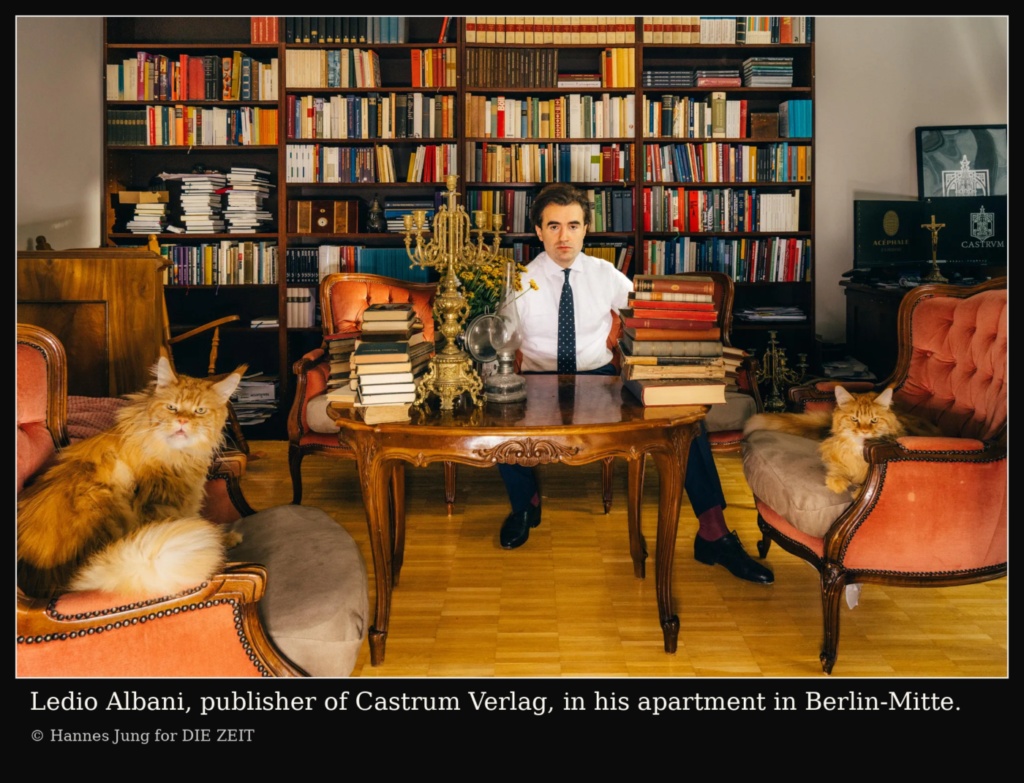
Ledio Albani named his publishing house Castrum, the Latin word for the fortified camp of the legions. He named his magazine Fiume, after the city Gabriele D’Annunzio seized with his legionaries in 1919. A man who chooses names this way does not hide his intentions.
He was born in Shkodër in 1987, grew up in Germany and has spent most of his life in Austria. He founded Castrum in Vienna in 2021 and brought it to Berlin this summer. He has translated Ezra Pound’s Personae. He publishes Maximilian Krah, a member of the Bundestag for Alternative for Germany (AfD), Hans-Thomas Tillschneider, vice-president of the Saxony-Anhalt state parliament, and Iddo Netanyahu. At the Frankfurt Book Fair, asked who the people of Castrum are, he answered: “We are the good right-wingers” [Wir sind die guten Rechten].
I sent him fourteen questions in writing. I wanted to know how official Berlin looks to an Albanian who knows the other Germany from the inside, the one that today presides over a state parliament and tomorrow may sit in government. I also wanted to know what that Germany thinks of Albanians and of Kosovo.
I publish his answers in full.
I. Between Shkodër and the German-Speaking World
AR: You were born in Shkodër in 1987 and were formed in the German-speaking world, where you also founded your publishing house, first in Vienna and now in Berlin. How Albanian and how German is your inner world? And how does the intellectual milieu in which you have established yourself see you? Are you naturally considered part of it, or does your Albanian origin always remain an element through which others define you?
LA: I believe the answer to this question touches, in a way, the very foundations of our era. I was born in Albania, grew up in Germany and have spent most of my life in Austria. My wife comes from Saint Petersburg in Russia. The children attend an English-language school. So several languages are spoken in our home, as you can imagine (laughs).
I believe firmly in identities, roots, traditions and heritage. Consequently, I naturally feel part of the Albanian world. But I also believe that we Albanians, precisely because of our historical circumstances, have this inclination to reach out towards the outside world. Biographical turns of this kind therefore come more easily to us than to other peoples. In my case this holds to a very great degree, but I believe it holds for many of my compatriots too.
II. The Writer and the Publisher
AR: You have engaged with philosophy and devoted yourself to a literary tradition that stands far from the prevailing tastes of the time. What do you look for in literature, and what do you miss in today’s German-language culture? What place does Albanian literature hold in that search? Are there Albanian authors who deserve a place in the German literary debate, and why have they not yet won it?
LA: Yes, that is entirely correct, although I should stress that almost every new project at first tries, almost as a rule, to define itself through the negation of what it finds before it, as an antithesis.
In our time, and especially in relation to German-language culture, this matters even more. For several decades there has been a tendency towards uniformity here, which only now, and slowly, is beginning to break. Perhaps we, with the Castrum publishing house, can play a role in that.
In the Albanian world this is more complicated still, because rebellion always unfolds on two levels. On the one hand we have the spirit of the age and, on the other, the incomparably larger European cultures as a counterweight. To defend yourself against them and at the same time create something authentic is extremely difficult.
Let me say it now: unfortunately, in Albania this is achieved very rarely. The desire to be included, to take part, especially in the cultural field, often produces imitations of a Western European culture that is itself already in decline. Authentic countercultures then emerge mostly outside the attention of the so-called mainstream, in Europe as in Albania.
AR: With Castrum you have built an institution with a distinctive profile. In Frankfurt you said that your path runs through the mainstream and that you aim to conquer. What do you want to conquer? Is Castrum first and foremost a literary project, a philosophical one, or a cultural project with political ambitions?
LA: I started Castrum in 2021 as a publishing project, as a publishing house. That is the core and that will remain the core. But projects of this kind are always living organisms too; not infrequently they develop unpredictably and according to their own principles.
At the latest since the founding of the magazine FIUME, the purely publishing activity and the making of books have been raised into a new, broader cultural, and even political, sphere. Perhaps in our time it cannot happen otherwise.
Even the somewhat martial word “conquest” does not concern only the publishing sphere, but implies a field that goes beyond it. Still, it is extraordinarily important to me to stress that all these things, aims or conquests, always proceed from the primacy of culture.
We do not want to deal directly with day-to-day politics, but to aim at politics from the position of a genuinely cultural sphere and, yes, gladly conquer it too.
AR: You have translated Ezra Pound and founded the magazine Fiume, whose name leads to Gabriele D’Annunzio. Both figures combine great artistic achievement with a gravely compromised political history. What draws you to them, and do you believe art can be fully separated from the political convictions of its creator?
LA: Both figures, Pound as much as D’Annunzio, need some explaining to the world in a politically very conscious age, to avoid the term “woke”. For me, both are of great interest first of all because of their uncompromising stance in art. What unites them is an almost manic fusion of the poetic stance with everyday life.
Pound makes this shine almost literally in the poetry collection Personae, which I translated (or, better said, reinterpreted) from English: a form of hyper-personalised poetry. With D’Annunzio we have a form of hyper-poeticised life.
We need more of both: to make art alive, on the one hand, and to poeticise life, on the other. That is exactly where the great fascination lies.
III. The Controversy
AR: The publication of Maximilian Krah’s novel and Castrum’s closeness to authors of the right have drawn criticism and political labels. To what extent do these books reflect your personal convictions, and to what extent do they stand for the principle that literature must also give space to authors the political consensus does not accept?
LA: First, it must be said clearly that I stand behind all the books we publish. I run Castrum almost biographically. Of course I can also carry out projects that do not fully match my worldview, but even then, ex negativo, I would believe in those projects.
Beyond that, the German cultural scene and, to an even greater degree, German politics are in a phase of transition and transformation. What is considered consensus and political mainstream today is changing at great speed. Look, for example, at the polls; the shifts become visible there.
Certain political labels come naturally when you publish books by well-known figures from political life such as Maximilian Krah (an AfD member of the German Bundestag), Hans-Thomas Tillschneider (vice-president of the state parliament of Saxony-Anhalt) or indeed Iddo Netanyahu (brother of the Israeli prime minister). But in this respect I am fearless. I believe in my cause, I believe in the books we publish.
AR: At the Frankfurt Book Fair, asked by Tichys Einblick how you define Castrum, you answered: “We are the good right-wingers, I would say” [Wir sind die guten Rechten, würde ich sagen]. The sentence came as a reaction to a comment on a report in Die Zeit and can be read as irony. We take it seriously: what, in your view, makes a right-winger a good one? Where do you yourself draw the line against ethnic nationalism, xenophobia and authoritarianism, and which author would you not publish?
LA: Haha. All of that was something of a retort to certain right-wing currents that attribute to us too great a closeness to the so-called “mainstream”, and even accuse us of something like desertion from the right.
That is of course absurd. In this respect we represent very authentic and historically well-founded right-wing positions, as represented by the authors of the Conservative Revolution in twentieth-century Germany.
However, the line of conflict within the right in Germany, as in other European countries, runs along the question of nationalist isolation and of economic regression built on the nation. Both positions are, for me, incompatible with a genuine right.
So I will not name specific authors now whom we would or would not publish. But what is entirely foreign to me, in any case, are the forms of an outdated nationalism, economic statism, antisemitism and fantasies of state isolation.
IV. The Albanians and Official Berlin
AR: In German society, Albanians often face stereotypes linked to crime, migration and integration. Have you personally experienced such prejudice? Tell us of a case in which your Albanian origin influenced the way you were treated.
LA: Origin naturally and fundamentally determines how a person is perceived by others. This does not bother me at all; I would not want it any other way.
So it does not matter whether others attribute national traits or prejudices to us, rightly or wrongly; that will always happen and it does not affect Albanians alone. What matters is how we ourselves deal with these traits of ours and, consequently, with our self-understanding: who we are and who we want to be.
My choice has always been to meet this as far on the offensive as I can, almost impetuously. I often find it close to a pleasure to play with stereotypes, to turn them into something productive.
AR: Albanian representatives say that in talks with German officials, the bad reputation of Albanians is raised as an obstacle to relations and business between the two countries. When a people is judged by its collective reputation, are we dealing with a legitimate political concern or with a form of racism that German society does not want to admit to itself?
LA: Naturally, the great nations, with a long written history, the great peoples, that is, are in their way somewhat arrogant. I believe most smaller nations accept this quite well. There is a kind of tacit understanding in the mutual relationship within this imbalance of power.
The Albanians are a rare exception here, one of the few among the small nations. We are a small nation with the bearing and the desire of a great power that seeks to reach out to the outside world and to expand.
We have a language of our own, distinct from all others, and we form a very clearly defined cultural space that we do not share with other states. In dealings with the truly great, this can of course cause friction or wound our pride somewhat.
But here too the principle holds that we must not make our traits depend on how foreigners define us or, worse still, on the wish to please them.
Even apparently problematic things, such as a bad reputation, crime and the rest, can be met on the offensive.
So “the Albanian” has, for Europeans, a somewhat wild, dangerous ring and at times even takes on an almost menacing character. That does not bother me at all. On the contrary, I must admit I rather like it (laughs).
AR: How do the CDU and the SPD, the parties that have governed Germany, see Albanians: as partners or as a problem to be managed? Where have you experienced the difference between the official word and what is said when the microphones are off?
LA: I believe that in the circumstances of current European politics, Albania is completely irrelevant. That can always change, of course, but Albania is not a real issue for German politics.
There are some reasons for this that are not especially flattering to us, but also some that speak in our favour and in favour of Albanian policy in recent years.
On the one hand, the size of the country plays a decisive role. At the same time, Albania (especially compared with the other Balkan countries) is a rather comfortable case for the EU.
It seems quite impossible that the country should leave the European path. Support for NATO and the EU is higher in our country than anywhere else and, regardless of political camps, Albania has taken part in every European political measure over the past three decades.
The fact that the country has also achieved successive economic successes and has been politically quite stable, at least until recently, has created no need to move EU enlargement, a process not much liked in Europe, beyond formal declarations.
AR: Berlin communicates with Tirana in the language of conditions and standards, while EU membership remains a promise. Is this the language of partnership or of tutelage? And do you believe Berlin wants to keep that promise, or does it serve merely as a means of pressure?
LA: Of course these are forms of tutelage; that is more than clear. We know it and the Western Europeans know it too. The only thing that surprises me is that this regularly makes us indignant. That too is, I have to put it this harshly, something of our historical paranoia.
At state level the relatively empty word “partnership” is constantly emphasised, but when a state with many times the economic power faces another, it is not the elements of friendship that prevail, but pressure and coercion.
V. The New Right, Kosovo and the Albanians
AR: Germany’s traditional parties are losing ground to new forces, especially on the right. What have the CDU and the SPD lost in their relationship with society, and what has the New Right understood about Germans that these parties fail to understand? Do you recognise the same tone, preaching without listening, in the way Berlin communicates with countries like Albania?
LA: This development is, I believe, very complex, has many causes and affects not only Germany but other European states too. I think that, at bottom, it is also linked to the consequences of globalisation over recent decades.
The self-confident arrival of around a billion Chinese and, soon, a billion Indians on the main stage of history, with all their political, economic and other claims, has changed the role of Western states and will go on changing it fundamentally.
The European bourgeoisie was able, until the end of the twentieth century, to impose its claim to influence almost ad libitum, on the basis of economic power and material superiority.
That is changing now. It is changing economically, as the example of China shows, but also geopolitically, as former middle powers appear ever more sure of themselves and ever less willing to be influenced by Western policy.
In this sense, I believe parties like the CDU and the SPD, and the same goes for the established parties in other European countries, are being punished as the administrators of this inevitable decline.
Whether the new parties will manage to change this radically transformed situation remains doubtful.
The bourgeoisie’s fear of decline will, in the medium term, turn against every existing form of government, whether left-liberal or right-conservative, as the example of Fidesz in Hungary shows.
AR: On 11 June 2026 the Bundestag extended the German KFOR mandate by 382 votes to 192. The Left party (Die Linke) also voted against, but the AfD justified its opposition with the claim that Kosovo is regarded as a failed state and, in a 2023 motion, called Serbia Kosovo’s “mother state” [Mutterstaat]. How do you explain these positions? Is there, within the German New Right, an orientation against Albanian interests, or is this about a broader worldview on NATO, Russia and the Balkans?
LA: I would not put it in such general terms. Within the European new right there is undoubtedly strong scepticism towards Kosovo and a certain sympathy for Serbia, and for Russia too, as supposed hearths of a preserved traditionalism. This may also have to do with religious factors.
However, the opposite position also exists within the right and, as far as the AfD is concerned, I can affirm this from direct experience.
Whatever the positions and attitudes of others, we must not lose sight of our geostrategic mistakes of recent years.
Many decisions in Kosovo’s politics this decade have been taken as if there were a moral and universal law under which the West must always pursue a pro-Albanian policy. As if the 2000s, when Kosovo’s independence was widely considered necessary, would go on for ever.
It is true that nothing essential has changed in this basic stance, and nothing will change even with right-wing parties taking part in the governments of Berlin, Vienna, Paris or Rome. Nevertheless, Kosovo’s politics would do well to think, from time to time, in more realpolitik and less ideological terms.
AR: The European New Right places national sovereignty and the right of peoples to identity at its centre. How is that principle reconciled with the denial of Kosovo’s statehood? Have you observed in these circles one standard for the sovereignty of Serbs and another for that of Albanians?
LA: Here it must be borne in mind that many foreign-policy positions of the right-wing parties were born of a pronounced opposition to the established parties.
Since parties such as the CDU, the SPD and also the Greens decisively supported independence, the new political forces, as a reflex, position themselves to some extent against it.
Of course, that is only part of the answer. The other part is linked to what I said earlier. The dichotomy between realpolitik and ideology that I mentioned in the previous answer also has this driving force: the political strategy of the Albanians, and this applies to Albania as much as to Kosovo, has since the early 1990s been clearly oriented towards the political mainstream in Europe and the parties in power.
If that mainstream is now under attack and in retreat, together with all its parameters, attitudes and concepts of political order, then the former main partners risk becoming irrelevant.
In short: all this is less ideological than we think and has more to do with the logics of power, to which Albanians too should respond not ideologically but likewise with careful calculation.
AR: Let us close with your personal story. You are an Albanian who built his life, education and career in the German-speaking world. Do you believe the Germany the New Right envisions would offer an Albanian boy arriving today the same opportunities you had? And would you feel just as accepted in such a Germany?
LA: The game of “what would have happened if…” is always complicated in history. Today’s Germany is no longer that of the 1990s, but neither is Albania the Albania of that time. How things will be in a few years, or with right-wing parties in power, is less clear still.
Nevertheless, Albanians have strong reasons to represent their nationality with self-confidence, and their role among the other European nations too.
Then the question is no longer whether someone enables us to do something or not, as it once was. We are by now fully capable, perhaps more than at any other period in our history, of creating opportunities for ourselves, at state level as at the individual one, independently of others.
After the Interview
Albani has translated Personae, the book in which Pound speaks through masks. Some of his answers belong to that craft.
What mattered most was said without a mask. Berlin’s tutelage over Tirana is “more than clear”. “Partnership” is a “relatively empty” word. Albania is “completely irrelevant” to German politics, a “rather comfortable case” that never strays from the path, and precisely for that reason nobody has seen any need to move enlargement “beyond formal declarations”. These sentences come from a Berlin publisher, formed in the German-speaking world, who knows the German right from the inside. After them comes the advice: Albanians tied themselves in the early 1990s to the parties of the mainstream, that mainstream is in retreat, and so they should respond “with careful calculation”.
Calculation requires knowing the other side, and Albanians know it only by hearsay. Everything we have been told about the new right came from its rivals, the same parties that held our hand. They drew it for us as an orc: a thing that hates, that cannot be reasoned with, that a decent people keeps away from. I sent fourteen questions to a man who belongs in that drawing. No orc answered.
The one who answered believes in “identities, roots, traditions and heritage”, and finds “an outdated nationalism”, antisemitism and “fantasies of state isolation” foreign to him. One may disagree with him. I do, in places. But it is hard to read these answers and go on believing the drawing.
Take the drawing away and what is left is something Albanians should recognise. The new right is a revolt of European nations, the reflex of peoples who feel their culture and identity being erased or replaced, and who have been told it is shameful to mind. We know that reflex. We are a small nation that kept its language through five centuries of empire and its customs through nearly half a century of a state that set out to remake us. We are conservative in the old sense of the word, bound to family, to the given word, to the house, and secular as few peoples are: we have never let religion stand above the nation. Vaso Pasha wrote it nearly a century and a half ago: the faith of the Albanian is Albanianism. A people like that has more in common with a Europe that wants to remain itself than it has been told.
He calls our anger at the tutelage “our historical paranoia”. I do not have his calm. A revolt in the name of nations cannot call Serbia Kosovo’s “mother state” and keep its own principle. Albani says he knows the opposite position inside the AfD at first hand; I would like to see it in a vote. I also asked whether that Germany would give an Albanian boy arriving today the opportunities he had. He answered that Albanians now create their own. It is a fine answer to a different question. Mine stands.