The Commission’s outgoing enlargement chief praises Tirana’s progress, voices concern about the proportionality of the police response, and says the talks close only when the benchmarks in chapters 23 and 24 are met. Montenegro, he says, can finish within a month.
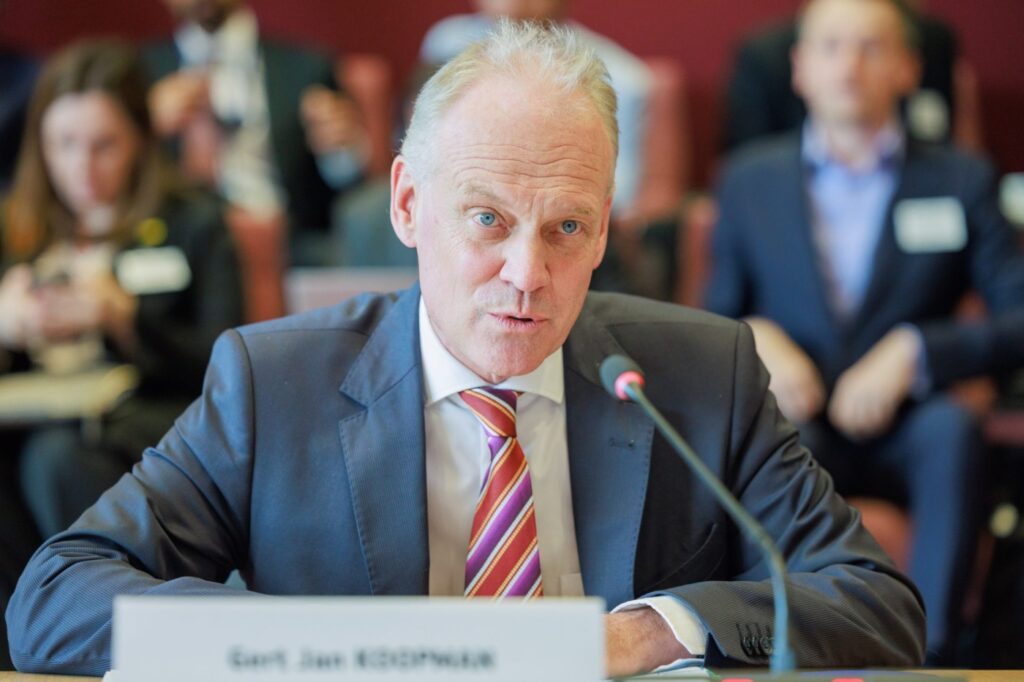
Gert Jan Koopman leaves the European Commission on 1 January. As Director-General for Enlargement and Eastern Neighbourhood he ran the department through the opening of talks with Ukraine and Moldova and to the edge of what may be the first accession treaty since Croatia’s.
In one of his last interviews in the post, he spoke to Ilva Tare of the Atlantic Council’s Balkans Debrief about the 2026 enlargement package, adopted on 4 November. He was unusually direct. Montenegro, he says, has delivered everything the Commission asked. North Macedonia is not blocked by a member state. Bosnia and Herzegovina cannot expect Brussels to settle its quarrels. Kosovo’s candidate status is feasible, on conditions it has not yet met.
What follows is a transcript of the conversation, lightly edited for clarity.
Ilva Tare: On 4 November the European Commission adopted its 2026 enlargement package. For the first time in more than a decade, it sets out indicative roadmaps for the four most advanced candidates: Montenegro, Albania, Moldova and Ukraine. Montenegro has provisionally closed 21 of its 33 chapters and work on its accession treaty is under way. But the package also draws a sharper line between candidates. It finds little progress in Bosnia and Herzegovina, North Macedonia and Kosovo, and backsliding in Georgia and Turkey. Serbia is moving closer to that group, though its new government, the Student List government, has raised hopes in Brussels of a fresh start. The gap between the candidates this year seemed bigger than ever. Does such a gap work against accelerating enlargement for all six Western Balkan countries?
Gert Jan Koopman: It is definitely true that the differentiation has increased significantly, but I would rather see the glass half full. It is the first time in 14 years that the Commission is indicating that a country is ready to finish the accession negotiations. You mentioned 21 chapters closed for Montenegro. Just a few days after the publication of the report, a further two chapters were closed. Our expectation is that it is possible to close all chapters in a month from now. That is clearly the most important news.
Albania is also making good progress. It is true that the others are not advancing so much. But getting one across the line, demonstrating that the enlargement methodology actually works, is absolutely crucial.
Tare: The roadmaps are new, and I find them very good and very creative. For the Balkan mentality, deadlines deliver better. Could they also create frustration if the targets are not met on time?
Koopman: Absolutely. The roadmaps are indicative, and they depend on the own merits of the countries. For Montenegro, the Commission has just finished its last so-called DCP, the last document that needs to be sent to the Council. As far as we are concerned in the Commission, Montenegro has delivered everything that is necessary. It is now for the member states to finish the negotiations, and we are facilitating. So I do not think there will be frustration over the roadmap for Montenegro.
For Albania, there is a full year still to go under this roadmap. Yes, it is challenging. It is ambitious. But if the country delivers, it should be feasible. If they do not deliver, that could lead to frustration. But some introspection in the Balkans is also useful from time to time.
Tare: The Commission says Montenegro could close all the remaining chapters by the end of the year, which is just over a month from now. Is that too ambitious, especially with Croatia wanting outstanding bilateral issues resolved first?
Koopman: I do not think it is too ambitious at all. Technically, the chapters are ready. Most member states would agree, and most member states want to close. It is true that there are still a number of bilateral issues with Croatia, but there is still time to solve these before the end of the year. We should all be laser-focused on achieving that.
Tare: Are you being over-optimistic or realistic?
Koopman: I think it is entirely possible. It requires tough choices to be made. But we also all know that next year is a difficult year politically. The political cycle next year is not very favourable. So there is a lot of benefit to be had in closing everything this year. I think that is the mindset of most of the leaders, and it is very much what Montenegro wants. So now it is delivery time.
Tare: How is the drafting of the accession treaty with Montenegro going so far? Are there any big challenges?
Koopman: The key element still outstanding relates to the safeguards. A month ago we published proposals for a new generation of safeguards. We have since submitted detailed legal text to the Council. Council bodies are deliberating. We will have a discussion on that next week, and based on that discussion we will translate the results into proposals for Montenegro. That, of course, will have to find its way into the accession treaty. It is the most substantive point.
Beyond that, there is a lot of technical work still needed. In the roadmap for Montenegro we have suggested that the accession treaty could be signed in June of next year. That means there is still a lot of technical work to be done. But once the chapters are closed, the drafting is more a matter of implementing pre-existing agreements.
Tare: I find that the report on Albania shows a paradox. There is good progress on the rule of law and on fighting corruption and organised crime. Yet serious problems persist with democratic institutions and their functioning. How do you reconcile the two? And with protests and political tensions in Tirana, what must Albania do in the next year to keep the end-2027 target realistic?
Koopman: The first point we need to make is that Albania has achieved enormous progress in just one year. Not only did they close the so-called interim benchmarks, which are all about the fundamentals, but beyond that they also started closing chapters. That is record fast for a country that opened negotiations in the not-so-distant past. And it is all down to the merits of the country.
What our report shows, of course, is that the country is still transitioning, as you would expect. There are still outstanding challenges that are significant. The underlying message of our report is also that this is a whole-of-society effort. We need everyone in the country pulling behind the EU agenda. That means working across the aisle with the opposition to ensure that there is support. It also means consultation, involvement of stakeholders, involvement of citizens.
In this respect, it is very important that the present protests are managed in an inclusive manner. It is not easy. There are elements in those protests that are clearly criminal and that are seeking a very different outcome from the one that the government and we ourselves want. But that should not stop the government from reaching out to the vast majority of people, students and professors, who actually want to be heard and consulted.
Tare: What would be a plausible, acceptable solution for Brussels in the way the government manages the protests by students and professors?
Koopman: This is first and foremost for the government to decide. I know that the government wants consultation. The prime minister is underlining that quite significantly. So it is also important that the offer is accepted. At the same time, of course, you want proportionality in the police reaction, and there are some concerns about this.
I really hope that from both sides we get to a place where the country refocuses on its European path. The government has been delivering, admirably so. But it is not just the government. The whole of society has been delivering. It would be extremely unfortunate if that momentum were lost. So the hope and the wish is that they return to this process, which is very beneficial.
Let me be very clear. At the heart of the EU accession process are the fundamentals. We will only close the negotiations with Albania if we are satisfied that the closing benchmarks in chapters 23 and 24 are fulfilled. These relate to many of the issues that the protesters are flagging. So the EU path is actually a path for everyone in the country to seek a resolution of the conflicts.
Tare: Let us move on to Bosnia and Herzegovina. How can the country move forward after the elections, given the problems with how its state institutions function? The Commission’s immediate priorities are functioning institutions, judicial reform and the appointment of a chief negotiator, which has been a request for years. It has also already cut the country’s Growth Plan allocation. Is more funding at risk?
Koopman: The country is complicated. We all know this. But despite the institutional complexities, back in 2023 and 2024 the country managed to pull together, to make progress and to get to the opening of the negotiations. Afterwards we had complete paralysis.
It is a little disappointing that a country cannot even appoint a technical negotiator because everyone in the country is quarrelling with everyone else. That is not something Brussels should resolve. It reflects a belief in the country that Brussels will fix its problems for accession. It does not work like that. You have your own responsibilities. It is on your own merits.
So my message is this: the elections are out of the way, new actors have been appointed, and the spirit of 2023 needs to be brought back for the country to move forward. Of course, that comes with innovation as far as the institutions are concerned. That is very clear from what the European Council has said, and from the benchmarks that were set at the time. It requires a focus by the three constituent peoples and the two entities on the EU path. It needs to be treated as a priority, not as something that sits there while domestic rivalries are fought out.
Tare: North Macedonia, once a frontrunner, has waited 17 years since the Commission first recommended opening negotiations, and it still has not opened its first cluster. Is there hope of overcoming the blockade in the Council? Is there anything the Commission can do at this point?
Koopman: Let me correct you, and I am sorry to do that. The blockade is not in the Council. The blockade is in the country. The country knows exactly what it needs to do to open the negotiations, which is, in essence, to change the constitution.
Tare: So it is the Bulgarian veto. That is why I mentioned the Council.
Koopman: It is not just a Bulgarian issue. This is an EU position. It is part of the Council conclusions. The country also needs to adopt roadmaps and an action plan on minorities. It is advanced on those, maybe not entirely there yet. But without the constitutional change the process will simply not move forward. That is really on the country itself.
The country is capable of reforms. It has made very good progress this year on its Growth Plan, which means it has undertaken many very difficult reforms. The issue now is to address the constitutional changes seriously, and for us to work with the country and with all our member states to ensure that there is comfort in the process. It is difficult. You are fully right that the country has a long history on its EU path, and there have been many bilateral issues. But we need to be very careful with the framing. It is not blocked by a member state. It is blocked because, to date, it does not want to do what it knows needs to be done. We need to be clear about that.
Tare: So you are confirming that the ball is in Skopje’s court?
Koopman: Absolutely.
Tare: And there are no ongoing negotiations to find a solution?
Koopman: We obviously talk to everyone, but fundamentally the ball is in their court. They know this. It is a political choice. It is a sovereign country. No one can force, or wants to force, the country to do something it is not prepared to do. But it is very, very clear what needs to happen.
Tare: Serbia’s report shows a lot of backsliding and no progress. Can things move now that a new government will be established in Belgrade? Could Serbia qualify for a roadmap in the 2027 package, and what would the first milestones be?
Koopman: We have a completely new landscape, a change of power of a kind we have not seen in a very long time. As I understand it, the Student List has focused very much on what we call the fundamentals, even if they do not call them the fundamentals and do not talk about the European path so much. In reality it is very much the same thing. So it offers an opportunity for them to engage on these issues, where there have been quite serious problems this year. These are the issues the Student List wants to address. So I can see a pathway towards restarting the talks on this basis.
It is early days. There is no government yet. There are issues relating to CFSP alignment. There is Kosovo. We need to look at it in the round. But if we can start with the fundamentals, if progress can be made there rapidly and confidence built, then I believe things can start moving forward.
As for North Macedonia, the availability of a roadmap depends on progress in the negotiations. There has been no progress in the negotiations with Serbia and none with North Macedonia this year. But next year could be completely different. It is entirely possible that the two countries would get roadmaps. Both have strong administrative capacity to move fast if they so wish. So it is all in play.
Tare: You mentioned Kosovo as one of Serbia’s issues. Meanwhile Kosovo’s membership application, from December 2022, is still waiting, with five member states that do not recognise Kosovo’s statehood. Is candidate status realistic for Kosovo?
Koopman: I personally believe it is really important that we start looking at their application. The five non-recognisers are reluctant. But it is not just the five non-recognisers. There have also been issues in the north of the country. And the Specialist Chambers issue has come back. I understand that the law was actually passed today. That is extremely unhelpful.
I would turn it around. Because we have a delicate institutional setting with five non-recognisers, the country needs, on all these other issues, to demonstrate its commitment to the European path fully. That means not passing the law on the Specialist Chambers and ensuring that the situation in the north of the country is managed.
If that is done, it is entirely feasible for the Council to invite the Commission to work on the application and provide an opinion, which is the next step. It is then for the Council to decide whether or not to grant candidate status. They are an enlargement partner. Their funding comes from the Instrument for Pre-Accession. So I do not think it should be too difficult for countries to grant candidate status, provided Kosovo meets all these conditions. And we are not there yet.
Tare: You have spent almost three decades in the Commission, and you have led the department through one of its most intense periods, with an ongoing war in Ukraine, from the first intergovernmental conferences with Ukraine and Moldova to what may be the first accession treaty since Croatia’s. What is next for you, and what would you most like to see achieved before you hand over these files?
Koopman: I will be handing over the file on 1 January. I will be leaving the Commission. So I very much hope that we manage to finish the negotiations with Montenegro. We have not been able to get to this point since 2011, when we completed the negotiations with Croatia, which entered in 2013.
Enlargement remains the EU’s most powerful foreign policy tool. There are a lot of people who believe that it does not work. But even if Montenegro is a small country, the work that has been done and the achievements of the Montenegrins over the past two years show that the system does deliver if the candidate country puts sufficient energy into it and the member states reciprocate. So I hope we get this done, and that it provides inspiration to everyone in the Balkans.
With the changes in Serbia, the dynamics in the Balkans will probably change. With Albania moving forward, there is a whole new landscape. My hope is that as Montenegro and Albania move forward, we will also get progress in North Macedonia and in Serbia. If that happens, I am sure the remaining two partners will follow. So I think the future is bright.
The region also needs to realise that the world is complicated, very complicated. The Balkans are very important, but there are other parts of the world that are also very important. It would be a tremendous pity if the Balkans did not seize this moment, because this moment is not going to be available indefinitely. There are other big priorities in the world. So my hope is that the region seizes the moment. That would be my two pence of wisdom, for what it is worth.
Tare: Thank you for all you have done for enlargement. I take it you will not deal with enlargement any more.
Koopman: I will not, indeed. But I will be following it, and I wish all our colleagues in the region, which I have come to like a lot, every success. The region has enormous potential. It could bring a lot to the EU. It is not just the EU helping the region. The region can help the EU, and I trust we will see that in the coming years.