Germany got through its night of masked men with no ministry burned and a sentence ready by morning. Tirana got five nights, a drone and a table it had not asked for. Before the ambassador reads this as another attack, he should read what his own interior minister said on Sunday.
By Drizan Shala (Security Desk)
The author first, since the ambassador has made him part of the story. I speak German, I have worked with Germans for most of my professional life, and I keep the contacts that come with that: in the ministries, in the Bundestag, in the services. Those contacts are how I know what Berlin thinks about Tirana before Berlin says it. On 19 October, the morning this publication printed its first account of the embassy’s conduct during the five nights, I sent that account to the Chancellery, the Federal Press Office and the Foreign Office, in German, under my own name, with an offer to answer questions. Within days of that reporting the ambassador was called to Berlin, and he has been away from his post on leave by the embassy’s account. Berlin does not pull an ambassador out of a NATO capital in the middle of that capital’s worst week in a decade for a rest. What I have learned since, from the same contacts, is what he said when he got there: that my analysis of his embassy is a series of attacks on him personally. That is his defence, and it was given in German, in the building that has my letter. Berlin has nothing to fear from this desk. I am a security analyst. I write about mechanisms: who said what, in what sequence, with what effect, and what a hostile actor gains from it. The ambassador is in the sequence because his embassy put him there. If the account is wrong, the correction is one statement long and the Auswärtiges Amt has had my address for two weeks. If it is right, the ambassador’s feelings are not the problem Berlin has.
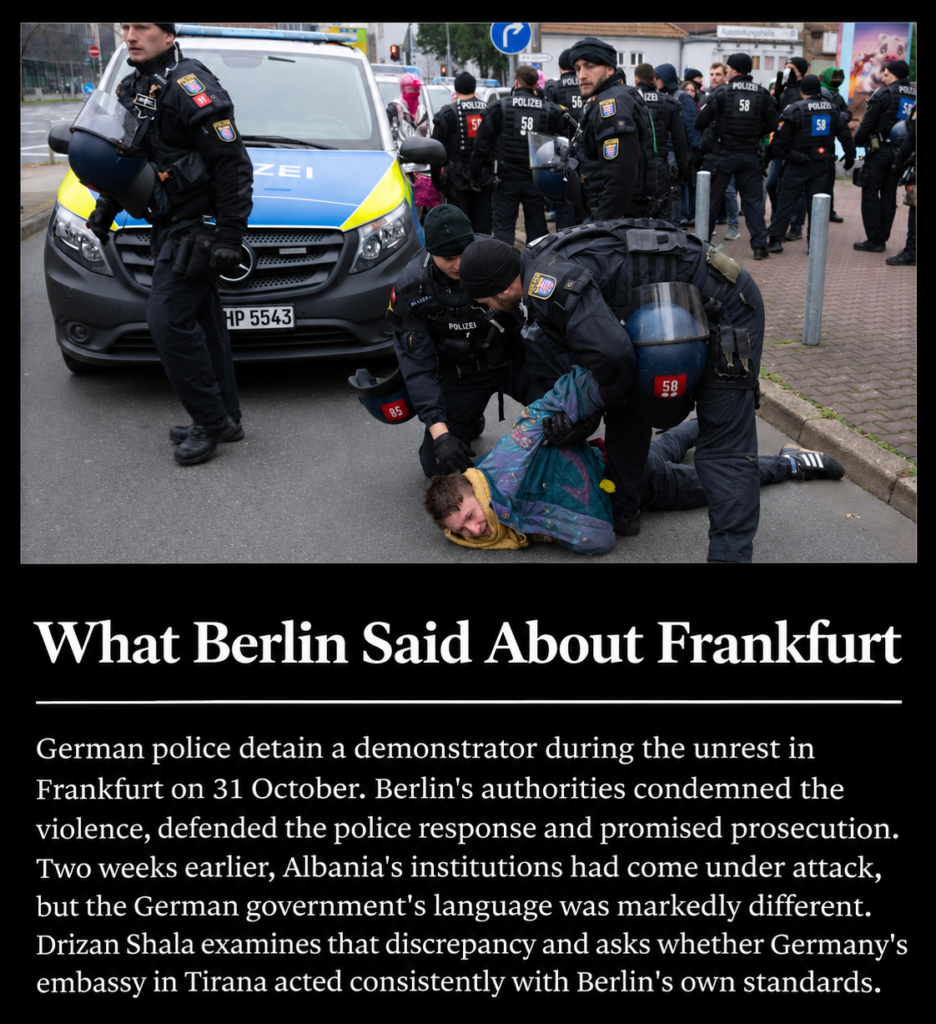
On Saturday 31 October, tens of thousands of young Germans marched in more than thirty cities under the banner of Gen Z regelt, against bad schools, high rents, cuts and the return of compulsory examination for military service. The afternoon was peaceful and the police said so. After dark, in Frankfurt, hooded men threw Molotov cocktails, stones and fireworks at officers, broke into a gun shop and carried out the weapons, and looted and wrecked shops along the Zeil. More than a hundred police officers were injured, seventeen shops damaged, five looted, fifty-four people arrested, aged between 13 and 29. There were clashes in Cologne, barricades in Hamburg and bottles in Berlin. The Frankfurt operations chief called it a new dimension of violence. By early Sunday it was over.
This publication is glad of that. Germany survived its night with broken glass and no building burned, and we hope its coming Saturdays stay that way. We are a NATO publication by conviction, and the strength of the largest European ally is Albania’s interest too.
What interests the security desk is what happened at nine o’clock on Sunday morning. The Federal Interior Minister, Alexander Dobrindt, told Bild that violent left-wing groups and troublemakers from the migrant milieu had hijacked the peaceful demonstrations, that the rioters and looters would be identified and held to account, and that excesses like those in Paris had been prevented by the police. The Hesse interior minister, Roman Poseck, said he was shocked, that there was no point in sugar-coating it, and that things could not go on like this. The Frankfurt police chief said the night’s rioters were young men known to his officers and that some of them had taken the French looting footage as their model. No federal official spoke of two sides. No one asked the Hesse police to be proportionate. No embassy in Berlin offered the Bundespräsident a table between the Chancellor and persons unknown. Germany named the perpetrators as a category before it had identified a single one of them by name, promised prosecution, credited the police, and moved on. That was the right register. It is the register of a state that knows what masked men with petrol bombs are.
Set it beside Tirana, 13 to 17 October. The rioters went for the Ministry of Education with fire on the Tuesday. The Ministry of Justice burned on the Wednesday. On the Saturday masked men attacked the High Court with Molotovs, went at the Bank of Albania with iron bars and petrol, burned a private bank and looted the boulevard. A drone carrying explosives was stopped over the Prime Minister’s Office, aimed at the timber garden in the enclosed courtyard, the one point in the complex where a small charge would have put the building alight on four sides. Thirty-seven police officers were in hospital by Sunday. The intent, from the first days, was to burn the Ministry of Education and the Kryeministria to the ground. Frankfurt’s masked men went for shops. Tirana’s went for the ministries, the court, the central bank and the seat of government, and brought a drone. Of the two nights, Germany’s was the one that did not touch the state, and Germany’s is the one that got the harder sentence.
The German embassy’s record for Tirana’s week is one repost of the EU Delegation on proportionate policing. Then, with the court still smoking, the ambassador went to the President with a dialogue platform, without the host government’s knowledge, and approached the Prime Minister only on Sunday 18 October, once the government had started asking questions. Already that weekend the louder voices in Tirana’s media were saying it plainly: by Tuesday the President, backed by the German embassy, would convene a table and press Edi Rama to resign. The embassy’s name was in the public version of its own initiative before the government had the full account of it. The embassy has heard that sentence every day since and has not said a word against it.
The ambassador has now made his defence in Berlin. One of its sentences has reached me. The others are the ones any desk officer at the Auswärtiges Amt would write for him. Each fails in Berlin’s own terms.
Es war Vermittlung in gutem Glauben. It was mediation in good faith. Article 41 of the Vienna Convention, which the Auswärtiges Amt cites to every foreign mission in Berlin, binds a diplomat to keep out of the internal affairs of the host state. Whether a government survives a riot is the most internal affair a state has. A platform to settle it, arranged without the government’s knowledge, is interference whichever organ of the state is asked to host it. And the good-faith route was open. The Prime Minister said, live from his office that Sunday morning, that he would sit at any table, anywhere, with the movement in the street the moment it named the person who speaks for it. An ambassador in good faith takes that offer to the people he believes he can reach and brings back a name. This one had taken a platform to the President instead. Good faith is a motive. Article 41 is about method, and the method was wrong before anyone asked about the motive.
Es war die Initiative des Präsidenten. It was the President’s initiative. Under the Constitution the President stands above parties and offering dialogue in a crisis is his duty, not a favour an embassy procures for him. He needs no foreign mission to carry a message between a street and a government in his own country. Bajram Begaj could offer a table, and should. What the German ambassador was doing in the arrangement is another matter. The President holds no executive power; the government does, and it was in place, with a parliamentary majority seventeen months old and a counter-terrorism unit on the boulevard that was winning. An ambassador who takes a crisis table to the head of state behind the back of the head of government has concluded that the government is no longer the address, which is to say that it is collapsing. It was not. The ministries were attacked and the state held every one of them. The only person in Tirana that week who treated Edi Rama’s government as something to be arranged around was the German ambassador. Then there is the other chair. A table needs two sides, and on the day the ambassador took it upon himself to set one and to act as the agent of those in the street, everything Albania knew about the other side was a set of masks and a burning court. The state had no name. The Prime Minister had asked for one in public and got none. Dugin had claimed the week from Moscow the night the drone was stopped. Yet the embassy went to the head of state with a platform, which means it believed it knew whom to seat. Where did the ambassador look for a counterparty that the Albanian state could not find, and what did he find there? Masked men on the Zeil get no channel from Berlin; they get identified and charged, and Germany tightened its own borders before Saturday against extremists who might exploit a youth protest. An embassy that offers a table to a street with no name is treating the mask as a political actor, which Berlin’s own counter-intelligence has spent a year explaining is the thing a hostile service wants most. Berlin can answer both questions from its own cable traffic in an afternoon: on what assessment the ambassador wrote off the government, and where he found the street. Until it does, the President’s constitutional duty explains the President and leaves the ambassador unexplained.
Gerüchte sind nur Gerüchte. Rumours are just rumours. In Germany that is true. In Tirana rumour is the fuel of political unrest, and every diplomat posted there is told so in his first week. The rumour that Berlin wants Rama gone was put to the ambassador through official channels. He did not dismiss it. In a capital where rumour moves crowds, an embassy’s silence on a rumour about itself is read as confirmation, and the men in masks have said on the boulevard that a great power stands behind them. The German government knows this mechanism intimately; it is the one its own services describe when they explain Russian influence work: a claim is planted, repeated, and left to harden because the party it names says nothing. Berlin would not accept “just a rumour” from a Russian spokesman. It cannot offer it from its own.
Ein Botschafter muss nicht zu allem Stellung nehmen. An ambassador need not comment on everything. This embassy commented on a burned villa in March, on six injured officers in March, and, in the ambassador’s own words to reporters in July, on the incompatibility of violent protest with the EU. It has a statement for every small thing in Tirana. It had none for thirty-seven injured officers, a burning court and a drone. A mission that speaks on everything and falls silent on the one week that mattered has made a choice, and the choice is visible.
Das ist eine innere Angelegenheit Albaniens. It is an internal Albanian matter. That is what the Foreign Office spokesman said in June about an earlier phase of the same protests. Berlin cannot hold both positions at once: that the crisis is internal to Albania and therefore no business of Germany’s to condemn, and that it is the business of Germany’s embassy to convene the Albanian head of state on the question of who governs Albania. One of those sentences has to go. Berlin should say which.
Deutschland hat selbst Gewalt erlebt und urteilt nicht anders. Germany had its own violence and applies no different standard. Sunday morning settled that. Dobrindt’s words for Frankfurt are the words Tirana never got from Berlin: hijacked, prosecuted, prevented. Merz’s words for Tirana, from the Budva podium, were “either side”. The German state has one vocabulary for petrol bombs in Hesse and another for petrol bombs in Albania, and the harder vocabulary went to the night in which no court burned and no drone flew.
Die Berichterstattung ist ein Angriff auf den Botschafter. The reporting is an attack on the ambassador. This is the sentence that reached me, and it is the one the ambassador chose to lead with in his own ministry. An attack would be a claim about the man. This is a record of the mission: a repost, a silence, an approach to the President, a question left unanswered, a rumour left standing. Every item is a public fact or a confirmed official interaction, and all of it was in Berlin’s hands, from me, before the ambassador was. A man attacking an ambassador does not send his text to the ambassador’s own ministry the morning it is published and offer to answer its questions. That is what an analyst does who wants Berlin to fix the problem before Tirana names it. The ambassador was asked to account for his mission’s week. He answered with a complaint about the man who wrote it down. The German government does not treat the Verfassungsschutz report as an attack on the people it describes; it treats it as a record. The same courtesy is requested here.
Berlin need not accept this publication’s reading. It owes Tirana what it gave Frankfurt on Sunday: a look at the record, a name for what it sees, and its own house in order first. The question for the Auswärtiges Amt is whether a German mission, during an attack on an allied capital, acted outside its instructions, outside the Vienna Convention and outside Germany’s own standard for political violence. Berlin has had the file, with the author’s name and address on it, since 19 October, and it has had the ambassador in the building to answer it. The question has been asked, then, in the one place where it counts. What Tirana has not heard is the answer: whether he goes back to his desk as if the week had not happened, or whether Berlin says, to Tirana and to its allies, what its mission was doing. A government that could discipline a riot in Frankfurt before breakfast can finish with a mission it has already called home.
Germany was spared the fire on Saturday. Its own ministers called what they faced by its name, promised the courts, and had shut the border to the foreign hand before the day began. That is a state that has learned what hybrid pressure looks like, and Berlin taught the rest of Europe the lesson. The same method reached Tirana two weeks earlier, with a drone, and Germany’s answer there was a table. The method does not change at the Albanian border. Only Berlin’s vocabulary does, and the people who chose the target in the courtyard were counting on exactly that.