Six demonstrators, among them a leading figure of the movement, were detained during the sharpest confrontation since the anti-government wave began, then released within hours as crowds gathered outside a Tirana commissariat.
The Newsroom
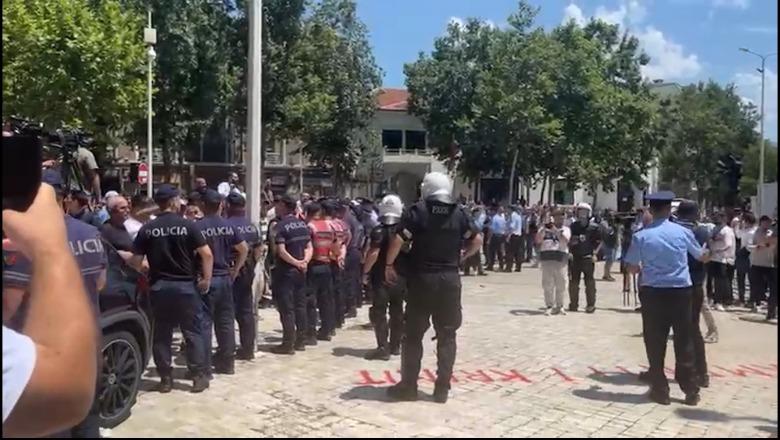
The plenary session had not yet opened when the first chants reached the deputies slipping into the building ahead of ten o’clock. By early afternoon the pavement outside Albania’s Parliament had become a running series of scuffles between demonstrators and the police cordon holding the entrance, in what participants and monitors described as the roughest day of a protest movement now in its second month.
The gathering, the thirty-first consecutive day of demonstrations in the capital, began peacefully. Protesters massed outside the Kuvendi with cries of “Your end has come” and “parliament of crime,” directing their anger not only at Prime Minister Edi Rama, whose resignation they demand, but at the parliamentary opposition, which they branded a “sold-out opposition.” At intervals the crowd chanted “Rama to prison, Berisha to prison,” yoking the Socialist premier and the Democratic Party leader Sali Berisha in a single rejection. Wary of the demonstrators, a number of legislators entered the chamber before the session opened.
The first flashpoint came with the Socialist deputy Tërmet Peçi, who found himself encircled by protesters shouting “You don’t represent us” and, as he withdrew, “Thief.” From there the confrontation sharpened. Demonstrators began pelting the cars of departing deputies with eggs, sparing neither vehicles parked in the street that had no connection to the legislators, which drew the anger of their owners. The tension peaked as eggs rained on the vehicle of Deputy Prime Minister Albana Koçiu as she left the plenary session, and on the parked car of the Socialist MP Erion Braçe, which a police officer moved clear of the crowd. Police officers themselves were then targeted, struck with eggs and water bottles; protesters knocked the cap from one of them.
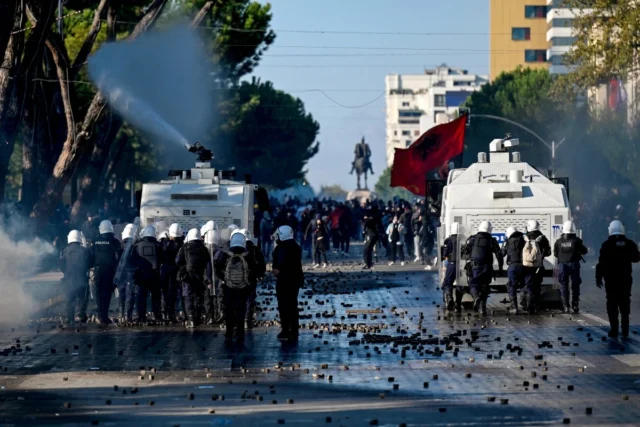
Police moved to make detentions, and for several minutes the square in front of Parliament dissolved into physical clashes between protesters and officers. Forces of the Rapid Intervention unit, the FNSH, had earlier reinforced the cordon and pushed demonstrators back from the entrance to clear passage for ministers and deputies leaving in their vehicles. Among the six people detained was Dritan Goxhaj, one of the recurring protagonists of the demonstrations. As officers led detainees away, protesters set off firecrackers and began moving toward the Tirana Police Directorate, chanting “Free our boys” and, later, “Arrest Rama.” Outside Commissariat No. 1, where the detainees were held, a fresh crowd assembled with the same demand.
The detentions proved brief. By late afternoon Goxhaj and the others were released, greeted by supporters outside the commissariat. Speaking afterward, Goxhaj said he and the others had been held on suspicion of resisting police officers and that they had not been questioned, only asked to give statements. He described the conduct of officers inside the station as correct and within the law, said detainees had been allowed to phone their families, and characterized the treatment as respectful on both sides. He added, however, that some force had been used by police against several of those detained at the moment of arrest itself.
That account was contested by others. The protesters’ lawyer, Gentian Serjani, said the six were being held unlawfully, that no charges had been brought, and that defense counsel had not been permitted to see them, though the Ombudsman and several deputies had gained access. The Democratic Party MP Ina Zhupa accused the State Police of answering “a few eggs thrown in protest” with fists, kicks and dragging, and asked what distinguished uniformed officers from the private security guards who, weeks earlier, had dragged a demonstrator at Zvërnec. That late-May episode, in which a protester opposing a coastal investment was hauled along the ground by private guards, is widely cited as the trigger of the current protest wave.
The government cast the day in sharply different terms. Deputy Prime Minister Koçiu, posting footage of the clashes, called the verbal and physical violence outside Parliament unacceptable and beyond any democratic frame, and said scenarios of destabilization and chaos were being orchestrated by a small group placing their political agendas above the national interest. She insisted the country’s public and political life would not be taken hostage by that group. The Socialist parliamentary group leader Taulant Balla published a photograph he identified as the protester Gentjan Progni striking a police officer with an egg, calling Progni a repeat lawbreaker and describing the demonstrators responsible for the tensions as a “criminal and terrorist gang” exploiting the protest for personal ends. Inside the chamber the split was equally stark: the Democratic Party demanded an end to violence against protesters, while the Socialists framed the events as an assault on police and called for Goxhaj to be investigated.
Prime Minister Rama, who earlier in the day circulated a video contrasting young people playing basketball with marching demonstrators as “a European Tirana with different tastes for leisure,” said of the confrontation that citizens, faced with a choice between peace and violence, choose development. Braçe, whose car was among those struck, called the scene not a new Albania but “the new chaos” of criminals with a megaphone and a microphone. Minister Ibrahimaj described the scenes outside Parliament as a turning point for the protests. Separately, demonstrators were reported collecting signatures to refer to the Special Prosecution, SPAK, a book promoted by Rama and titled “Albania Files.”
The demonstrators, for their part, refused to let opposition figures claim the movement. The Democratic MP Gjin Gjoni, a former judge, was pressed to resign from Parliament and from his party if he wished to join them, and told the crowd that the Democratic Party could not assume leadership of the protest; protesters replied that it never would, and pressed him on whether a moratorium on four contested laws would be secured. The Vlora-born deputy Agron Shehaj was surrounded outside the Police Directorate and told to leave, with one demonstrator declaring that Vlora “does not forget” and that there was no room for political statements at the protest.
Two institutions intervened over the course of the day. The Ombudsman, Endrit Shabani, visited the detained protesters in the afternoon and said his office had opened an inquiry into the conduct of the State Police, describing the intervention on preliminary assessment as disproportionate and warning that the constitutional right to protest could not be curtailed by an officer’s behavior or by orders from police commanders. That evening Shabani also visited officers injured during the protest at the Mother Teresa University Hospital Center, stating that the physical integrity of police on duty was inviolable and that violence, from whatever quarter, was unacceptable and had to answer before the law. The Albanian Helsinki Committee struck a similar double note, expressing concern at the use of physical force and at images showing protesters dragged along the ground during detention, which it called disproportionate, while urging organizers and participants to exercise their right peacefully and avoid any act that escalated the situation. The committee grounded its statement in Article 47 of the Constitution and Article 11 of the European Convention on Human Rights, and cited Strasbourg jurisprudence on the tolerance state authorities owe peaceful assemblies and on the dignity of the person in police custody.
By nightfall the immediate crisis had passed. The detainees were free, the square outside Parliament had emptied, and the movement, a month after the Zvërnec dragging that set it in motion, had recorded its most physical day yet.