Prime Minister puts the toll at some 200 police officers and 80 protesters injured, says masked youths were “paid and brought in from the peripheries”, and asks teachers to keep a diary of these days
TE Newsroom | Tirana
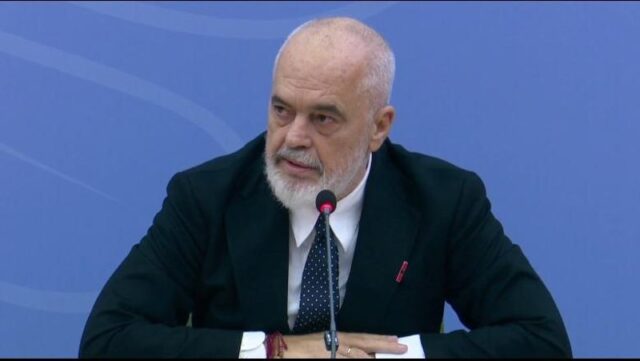
Prime Minister Edi Rama on Tuesday described the violence that has accompanied the Tirana protests for a second week as “a hybrid war”, organised by “hands trained for this work” and “fed with petrol, like an internal fire, by foreign actors”. He spoke at the Ministry of Education, in a meeting with teachers and school directors and in remarks to the press alongside Education Minister Mirela Kumbaro.
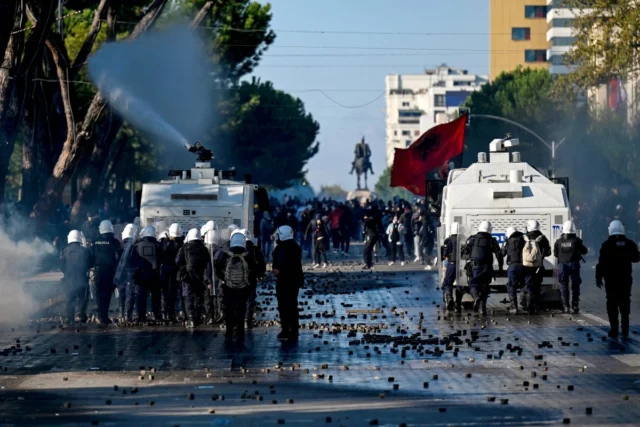
Over the past days, masked individuals have attacked police officers, institutions, banks and private businesses with stones, molotov cocktails, fireworks and hard objects, causing extensive damage in the capital. The ministry on Rruga e Durrësit was among the targets. Rama said the building had been subjected to “a real aggression with stones torn out of the pavements of Rruga e Durrësit”, and that it had been placed at the centre of attention “for one reason only, to camouflage what is really in the poisoned source of this protest”, and “to create the idea that this is a protest about education”.
Rama put the number of injured at around 200 police officers and around 80 protesters. He set the figures against numbers he attributed to protests in Spain, where he said 883 protesters and 33 police officers had received medical assistance in hospital, and in Germany, where 130 protesters and 34 police officers had received medical assistance. “This is a list of the disproportionate use of force by the police and the state in relation to the protesters,” he said of the foreign figures. He added: “The monopoly of force in a democracy belongs to the state. Only the state can exercise force, and it has the right to exercise it disproportionately” [“Monopolin e forcës në demokraci e ka shteti. Vetëm shteti mund të ushtrojë forcë dhe ka të drejtë ta ushtrojë atë në mënyrë joproporcionale”].
A part of the young people involved, he said, were not pupils or students but “masked young men, paid and brought in from the peripheries to attack the police and to create an atmosphere of terror”. Within the group, he said, “there are also students who are extremised in their views, who belong to the new currents of political extremism, but the problem is never the students who exercise the right to protest. Here we are speaking of the exercise of violence.”
Holding up one of the stones thrown at police in recent days, he said: “When you imagine the weight this takes on when it is thrown at the bodies of police officers, it is a weapon that can also cause a tragedy. This stone defines where the right to protest ends.”
On the organisation of the violence, Rama said: “Interests linked, naturally, to money, to politics, to power, in the sense of the screaming need to use this social unease and turn it into a wave of stones to bring down the government by imposing violence, which will never happen, but which weighs dramatically on the psychology of citizens. It creates the idea that the whole of Albania is burning here, whereas this is an organised attack within a well-defined perimeter, orchestrated by hands trained for this work, fed with petrol, like an internal fire, by foreign actors. This is understood, and it is now becoming a big issue across the whole of Europe. It is a hybrid war that works because it is based on real concerns, not on fantasies.” Concerns about a secure tomorrow, housing and “the possibilities to have more” were real, he said.
“This is something that was known, when under the feathers of the flamingos were hidden the hands that today have come out openly,” Rama said, referring to the flamingo emblem of the earlier protests. “On the other hand, what challenges a state only makes it stronger. The State Police deserves everyone’s respect.”
Rama asked the teachers to keep a written record of the period. “We have agreed with the minister and with some reasonable advisers the idea that each of the teachers also writes the diary of these days, in detail, with a very simple narrative, what happened, how it happened. Not in order to have a document to take to a law-enforcement body, but to have the mosaic of a story that will serve us when we read it. This will help us see where we need to intervene, both in terms of security and in terms of those individuals who have been drawn into this plague.”
He spoke of “a common front to compensate for the aggression of the images children receive from TikTok and the other platforms”, where “the algorithm chooses and targets them in the same way as the networks of drug dealers”. “Thank God, the greater part of pupils is healthy,” he said. “But the risk that this other part becomes ever larger is a real risk.” He said he was convinced that social networks should be closed to children under 16, and asked how that could be done, and how to address “this whole mass of aggressors against human life and dignity who, through social networks, threaten and take the peace away from families”.
Rama thanked the teachers for their “correct stance these days, when many waver and preach in the media, to the point of some pedagogues who compare this wave of violence with the protests of 1990”. He said he would not go into that: “With the pedagogues it is another matter, and I like to say things face to face.” Shqiptarja reported on Tuesday that around 1,000 university lecturers, out of some 10,000, have signed a petition calling for his resignation.
Kumbaro said every hour taken by violence was an hour stolen from the lives of the children, and that a team of psychologists had been set up for pupils, parents and families affected. Tirana carried the biggest problem, she said, while in all other schools lessons had continued normally, with very few episodes. The groups attempting to disturb stability, she said, “come from outside the school yards”.
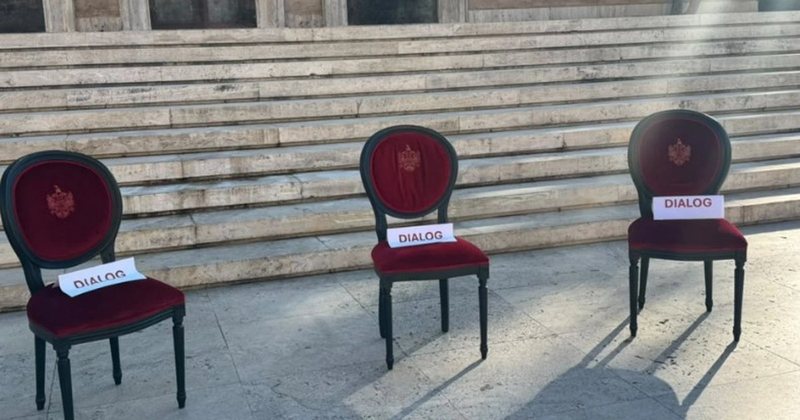
Also on Tuesday morning, Rama issued a call for dialogue and had chairs placed in front of the Prime Minister’s Office. Protesters refused and left the inscription “Resign” (“Jep dorëheqjen”).