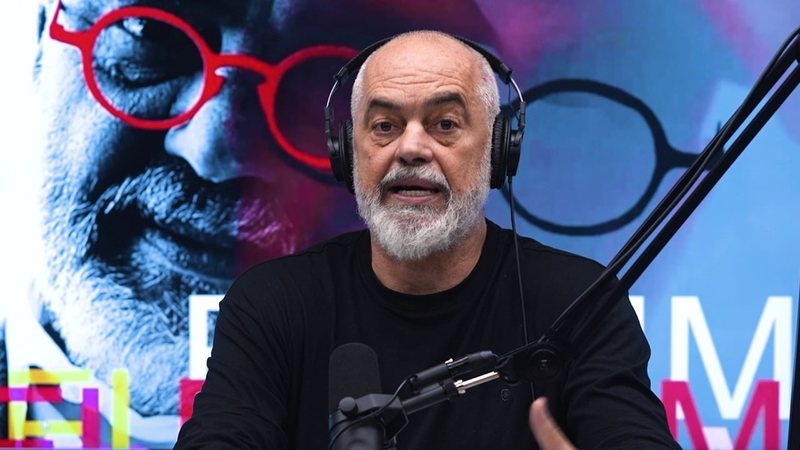
Prime Minister Edi Rama used the eighteenth episode of the sixth season of his weekly podcast, Flasim, to address several policy and governance matters: Albania’s EU accession progress marked on Europe Day, the opening session of the World Law Congress in Tirana, the launch of the second phase of the EU for Municipalities programme, and an AI-powered analysis of media sentiment in Albanian outlets. Below is an edited transcript of the weekly address, lightly condensed and corrected for clarity from the original recording.
Yesterday, on May 9, on Europe Day, Albania found itself closer than ever to the European Union.
For the first time after many decades, the road toward the European Union no longer looks like a distant horizon, but like a summit now visible to the eye and reachable within the time we have available. Negotiations have advanced at pace. Chapters have been opened in record time. The relationship with the European Union is built day by day with concrete results, and now the European Commission and the member states, through their ambassadors, are in a key phase of the process, discussing the Commission report which underlines that Albania has fulfilled all of its homework and is ready to enter the phase of closing chapters, passing through the intermediate benchmarks. And all of this has not come by chance. It has come through work, it has come through results, it has come from a transformative process that continues in every sector. Justice reform, the transformation of the administration, the digitalisation of services, the modernisation of the economy, investments and transformations in energy, infrastructure, new standards in strategic sectors: these are not disconnected parts, nor a list of words behind which there is little substance, but are the links of an ever more solid chain in the building of Albania’s future as a European state. And therefore May 9 is not for us only the celebration of Europe, but is also the moment when we draw breath with a legitimate sense of pride and move forward to reach the summit that is now reachable through nothing more than commitment, commitment, commitment, and will, will, will.
In the week now behind us, Tirana hosted the opening session, the prelude to the World Law Congress, one of the most important international platforms in the field of the rule of law, which is coming to Albania and for which Albania becomes the host: something unimaginable until a few years ago. Because this is not simply an event for tourism. This is not simply an event for economic development. This is not simply an event for bringing together experts of one field or another to speak about a sector. This is an event that marks an era, that marks the opening of an era now confirmed by the prestige of the World Law Congress platform, which would never have come to the Albania of just a few years ago, because there would have been no possibility of speaking and reporting from this country on the rule of law, on the commitment of democratic states to the rule of law, and on the will of governing majorities to guarantee the inviolability of the justice system. And the fact that Tirana is chosen today to bring together such important figures in the field of law, jurists, experts, protagonists of battles for justice in our common history, is connected precisely to the confirmation of this transformation. So it is once again a reason to be not simply proud of the justice reform, but determined to carry it forward, remaining faithful to that step and to that historic decision we took to separate politics from justice, to separate the executive and legislative powers from the power of justice, and to hand the sword of justice to Lady Justice, who needs in Albania to be supported, helped, and understood, in a process where not only the sword, but also the blindfold and the scales, to be equal and just with all, are part of this great and shared effort.
The week has also had another significant moment worth noting: the launch of the EU for Municipalities programme, the European Union for local government, phase two. A programme supported by the European Union that is directly linked to the modernisation of local governance, to the strengthening of the role of municipalities in the EU membership process, and to the growth of their capacities to become more ready to be competitive in the effort to attract more European Union funds in the future. This programme builds precisely the supporting bridge to convey more knowledge from the European Union toward our municipalities, to grow their awareness of the role they play in relation to the European Union in a country that tomorrow becomes a member of the European Union. And for this reason I believe this programme is a fact that comes at the right moment, as part of the totality of facts that prove that the European Union is ever closer, that Albania is ever more a country seen as a member of the European Union, not in the distant future, but in the years ahead.
This week I posted an analysis produced by a startup of talented young Albanians, using artificial intelligence to gather and assess the direction of media positions, of articles and evaluations and comments in traditional media and online media, in relation to politics. I posted it because it was a reflection that does not personally surprise me, since I and we know very well the factual reality of the relationship between the media and the government and the governing majority, which is nowhere near the reality claimed by the howlers who do not know what else to do with press freedom other than complain about its absence. But it was a reflection that I believe was worth sharing with many who wish to be informed, with many who are interested in facts, and with many who in all cases do not lose their respect for facts and do not go to war with facts when facts prove an opinion different from their own.
And this reflection shows clearly that, across the entire body of media output in relation to politics, sixty percent of television airtime in Albania in total is taken by the opposition, meaning positions against the government. Another portion is rated as balanced factual analysis, and a very small portion as pro-government. Meanwhile, broadly the same situation holds in online media, in portals that lean clearly toward the camp, toward the side of those who oppose the government. And for this I am sincerely pleased, because it becomes clear that this is not a country of captured media. This is not a country where the voices of those who speak, comment, argue, and write against the government are silenced. On the contrary, this is a country where, as in few other places, the exact opposite of the domination that characterises countries with captured media or media that serve regimes or electoral autocracies prevails.
Having said all of this, I have a very simple theory also for why every effort to capture the media is an effort that does not lead to winning the hearts and minds of people, and on the other hand, by leaving everyone free to say what they want, people then find it easier to distinguish between those who do the work, those who try every day, those who fall but fall in an effort to move forward, and those who lounge in their armchairs and howl across the insurmountable fences they have built for themselves through the absence of vision, the absence of a programme, the absence of leadership, the absence of much else that characterises that camp as a whole today, and I am not speaking of one party alone but of the whole.
And so this is a note I chose to close these weekly notes with, being very curious to see the continuation of analyses produced by a programme entirely beyond accusation of bias and built entirely on the power of artificial intelligence.