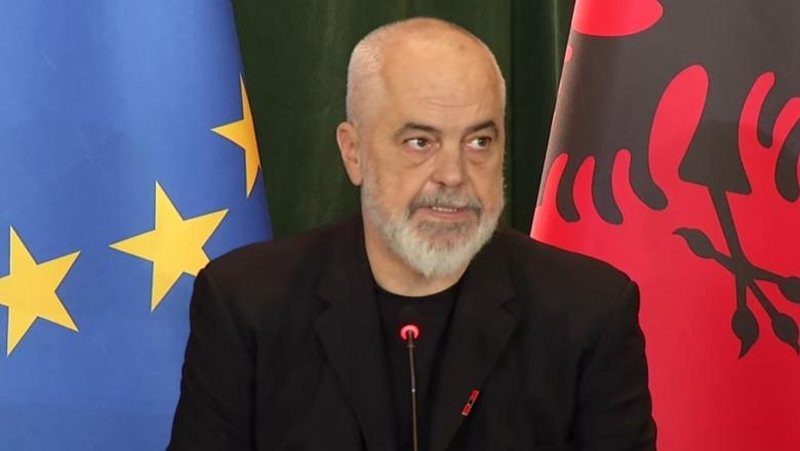
Prime Minister Edi Rama held an extended press conference at the Council of Ministers on 11 May to mark Albania’s progress on Chapter 5 of the European Union accession negotiations, the chapter covering public procurement. He was flanked by the director of the Public Procurement Agency, who did not speak. The briefing ran past the procurement file into the broader negotiation status, the SPAK dismissal request in the case of the former head of the Public Procurement Commission, the planned operational expansion of the government’s artificial intelligence system Diella, the recent amendment to the law on tourism ports, and the Democratic Party’s protest cycle. The session lasted roughly an hour and produced material on six distinct fronts.
Procurement metrics
The substantive procurement file was the announced occasion. Rama presented a set of comparative figures placing Albania above the European Union mean on several procurement integrity indicators.
According to the figures cited, single-bidder contracts account for 23.5 percent of total contracts in Albania, against a European Union average of 32.3 percent. The average number of bidders per procedure stands at 3.7 in Albania, against an EU mean of 3.2. Procurements closed with one winning bidder in 2025 accounted for 12 percent of the total, against an EU average of 14 percent.
“If on average contracts with a single bidder make up 32.3 percent of contracts in EU member states, in Albania they are 23.5 percent,” Rama said. “Even in the number of bidders per procedure, which the report sets at 3.2 in the EU average, Albania is at 3.7 bidders on average. Further, in the Albania of 2025, the number of public procurements closed with one winner and one bidder is 12 percent, while the EU average is 14 percent.”
Rama said the increase in the number of winning companies, measured not in absolute terms but as a ratio of the number of procedures, indicated significantly broader access to public contracts. He framed the figures as a counter-narrative to claims in domestic media that the procurement system is captured.
He distinguished between the contracting authority that announces a tender and the Public Procurement Agency, which handles operator complaints, presenting the separation between the two as a structural integrity feature of the system. He returned to a formulation he has used previously: “It is not people who corrupt systems, it is systems that corrupt people. The public procurement system we have built, year after year, is ever less corruptible.”
Chapter 5 status
Rama said Chapter 5 has no interim benchmarks set by the Commission, only three closing conditions. The three, as listed by the government, are: full alignment of the national legal framework with the EU acquis; adequate administrative and institutional capacity at all levels; and a demonstrated record of sustained implementation.
Rama used the absence of interim benchmarks to argue that Albania’s procurement framework is already operating at a level comparable to EU member states, rather than as a still-aligning candidate. “Albania, in this field, has no interim benchmark,” he said. “This means that in procurement we are an EU member state.”
Wider negotiation status and the IBAR
Asked about the wider negotiation framework following the IBAR report and the ongoing COELA discussions, Rama said the process is proceeding normally and that member-state approval is awaited to move into the closing phase. He pushed back against opposition claims that the negotiation has stalled.
“The Commission agrees with us, not with some of you,” Rama told journalists. “The Commission agrees that we have fulfilled the tasks to enter the new phase, the closing phase. The member states are 27 and they ask their questions. The questions and concerns of member states are not tied to the interim benchmarks, but to the closing ones. Member states cannot change what has been done and what the Commission has put forward.”
Rama said Albania is not the country making one-way concessions in the negotiation, contesting a recurrent opposition line. “We do not do only what they tell us, but also what we need to. We negotiate on areas where we need time.”
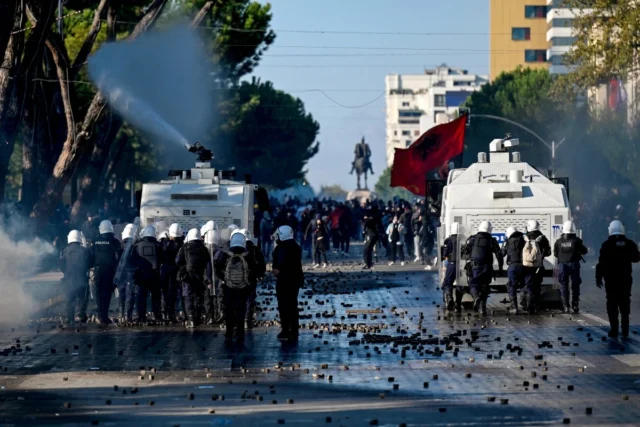
He addressed the Democratic Party’s street protests and the appearances of party leader Sali Berisha in European capitals in unusually hard terms. He linked recent opposition protests involving Molotov cocktails with the display of German flags by demonstrators, and said the opposition’s lobbying abroad against accession had no parallel in the region.
“We are not a country coming from an ethnic, religious or ideological conflict, nor from civil war, as some other countries in our region are,” Rama said. “Nobody has seen Montenegro’s Serbs or Montenegrin opposition figures travel European capitals asking that their country be placed on a blacklist rather than supported to enter the EU. We have a kind of species that is unique, that no country on the continent has had during this process.”
The framing was directed at Berisha, who has appeared in Brussels and Berlin during recent months.
The Myzyri case
Rama commented for the first time on the case of Jonaid Myzyri, the former head of the Public Procurement Commission. SPAK had opened the case on suspicion of violations of equal treatment in tenders. After investigation, the Special Prosecution requested the dismissal of the case. The dismissal request, if granted by the relevant court, terminates the case without indictment.
Without naming Myzyri, Rama said the former Commission head had been wronged by the public treatment of the case ahead of the institutional outcome.
“The man who transformed public procurement was made a target of mud,” Rama said. “For reasons that occur in a state with independent justice, he was placed under investigation. As a result of the investigation, he turned out to be connected to no kind of fault or problem. But the mud thrown at him was thrown to destroy him personally and his family, and it did its work. I have not noticed any reflection or any apology from anyone regarding what was done to that man.”
Rama presented the case sequence as evidence of the procurement system’s resilience and of the independence of the justice institutions, while criticizing the media and opposition treatment of the case during the investigation phase. He did not name the outlets or opposition figures he held responsible.
Diella moves into operational procurement
Rama confirmed that the Diella system, the artificial intelligence platform introduced by the government last year, is being expanded into operational procurement infrastructure within the current mandate.
He said local experts have drafted 450 pages of detailed technical specifications, which were submitted to the World Bank for review. According to Rama, the World Bank cleared the specifications “without objections” several days ago.
“There may have been an impression that Diella does the job it did before and sleeps,” Rama said. “Now we are in a new phase of the process. The 450 pages of detailed technical specifications, on which local experts have worked, have been put forward for review by the World Bank, which gave the green light a few days ago without objections. We are now ready to move into the building phase of an electronic procurement system with AI.”
Rama said Albanian experts have not worked in isolation and have interacted with experts in several countries. A workshop with 16 countries that use AI elements in procurement processes has fed into the design, he said, but the Albanian project aims to be the first of its kind to integrate all elements into a single chain.
The new system, according to Rama, will integrate over 40 public registries, automate the gathering of business documentation, mediate the full cycle from market study through bid submission to contract monitoring, and place every interaction on a transparent and traceable interface. Diella, he said, will process the full volume with AI algorithms impartially.
“No business will be forced to gather papers, no civil servant will hold business papers in their hands,” Rama said. “All data will be collected by Diella through over 40 public registries. Then they will be in the hands of business to activate with a single click. Every interaction will be on screen, transparent and traceable.”
Rama presented the system as the operational transition between procurement eras and said its delivery would mark a structural change in how business is done in Albania.
The marina law amendment
Rama defended the recent amendment to the law on tourism ports, the legislation that has produced sharp parliamentary exchanges between the majority and the Democratic Party. The opposition has characterized the amendment as legislation written to favor government-linked clients.
Rama said the amendment removed only a single procedural element. Under the unamended text, an investor building a marina as part of an existing resort that the same investor had developed would have faced a separate public tender for the marine component, opening the possibility of a third-party bid on infrastructure attached to a project the third party had not initiated.
“We have not made legal changes for tourism ports. We have made a single change to remove the possibility of an absurd consequence,” Rama said. “The change is not connected to tenders. If we want to grant a concession or partnership to build a port, it is 100 percent certain that it is done through tender. The change we have made concerns cases where someone invests in a resort and wants to also build a marina. Under the unchanged law, for the marina that someone wants to build next to their resort, a tender would be required so that someone else could come in and start a fight that would never end. This does not happen in any country in Europe.”
Rama said larger port projects, concessions and partnerships remain subject to full public tender procedures. He framed the parliamentary controversy around the amendment as a function of opposition obstruction of accession rather than substantive legal disagreement, naming Berisha directly: “We have a species that prays in Europe that Albania should not become a member of the EU.”
He did not address by name the Democratic Party’s specific allegations about which investors stood to benefit from the amendment.
The closing benchmarks listed
The Council of Ministers’ communication accompanying the briefing set out the three closing conditions for Chapter 5 in full:
First, Albania fully aligns the national legal framework with the EU acquis. Second, Albania establishes the necessary administrative and institutional capacities at all levels. Third, Albania demonstrates all data of a sustained record.
The briefing did not produce a timeline for the closing of the chapter. Rama presented the procurement file as ready for closing in substance, pending the technical work on the closing benchmarks and the formal positions of the 27 member states in the closing phase.
Chapter 5 of the EU acquis covers public procurement and sits within the cluster of fundamentals, the cluster opened first under the revised enlargement methodology and required to be closed before the negotiation can be concluded. The fundamentals cluster was formally opened for Albania at the October 2024 Intergovernmental Conference. The Commission’s Interim Benchmark Assessment Report, known as the IBAR, has since assessed Albania’s progress on the interim benchmarks tied to chapters within the cluster, with COELA, the Council working party on enlargement, deliberating the trajectory toward closing through 2025 and into the first half of 2026.
The Public Procurement Commission, the body Myzyri previously led, handles complaints against tender procedures and is one of two procurement bodies, alongside the Public Procurement Agency, which administers the procurement system itself. The Special Prosecution Against Corruption and Organized Crime, known as SPAK, opened the investigation into Myzyri in late 2024. The request for dismissal of the case became public earlier this year and, if granted by the relevant court, terminates the proceeding without indictment.
Diella was introduced as the world’s first artificial intelligence minister at the start of the current mandate. Its operational role to date has been advisory and presentational. The procurement deployment described by Rama on 11 May represents the first announced integration of the system into a core administrative process at scale.
The amended law on tourism ports passed parliament in recent weeks against Democratic Party opposition. The party has accused the majority of writing the amendment to benefit specific coastal investors and has named the dispute as one of the substantive grounds for its current protest cycle.