By Albatros Rexhaj (Tirana)
In June 2003, at Thessaloniki, the European Union told the Western Balkans that their future lay inside it. That was twenty-three years ago. Somewhere in those years our waiting stopped being patience and became an admission that someone else had acquired the right to decide our future. We were too busy celebrating our progress towards Europe to notice that Europe had been here all along, and that the institution promising to admit us to it no longer knows its own destination.
We should stop organising our future around eventual membership of the European Union. We should prepare instead to become strong, sovereign European nations, able to meet as partners the Europe that will come out of the present one.
Croatia got in. Montenegro may follow. For the rest, Brussels is promising what it cannot give. Enlargement needs the consent of every member state, and the awakening under way across the continent is producing governments that will not give it. The Commission can recommend. It cannot compel Paris, Vienna or The Hague. It is selling fog.
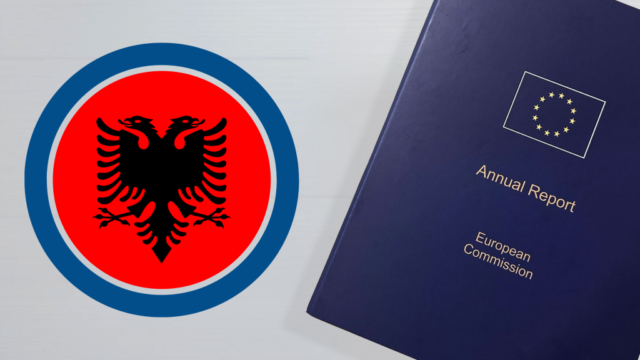
Yet the office that cannot admit us governs us. Our laws are rewritten, our priorities rearranged, our governments rewarded or punished by assessments written elsewhere, and the yearly report has become a player in our elections. We call this preparation for sovereignty in Europe. Sovereignty is the one thing we have learned to exercise conditionally.
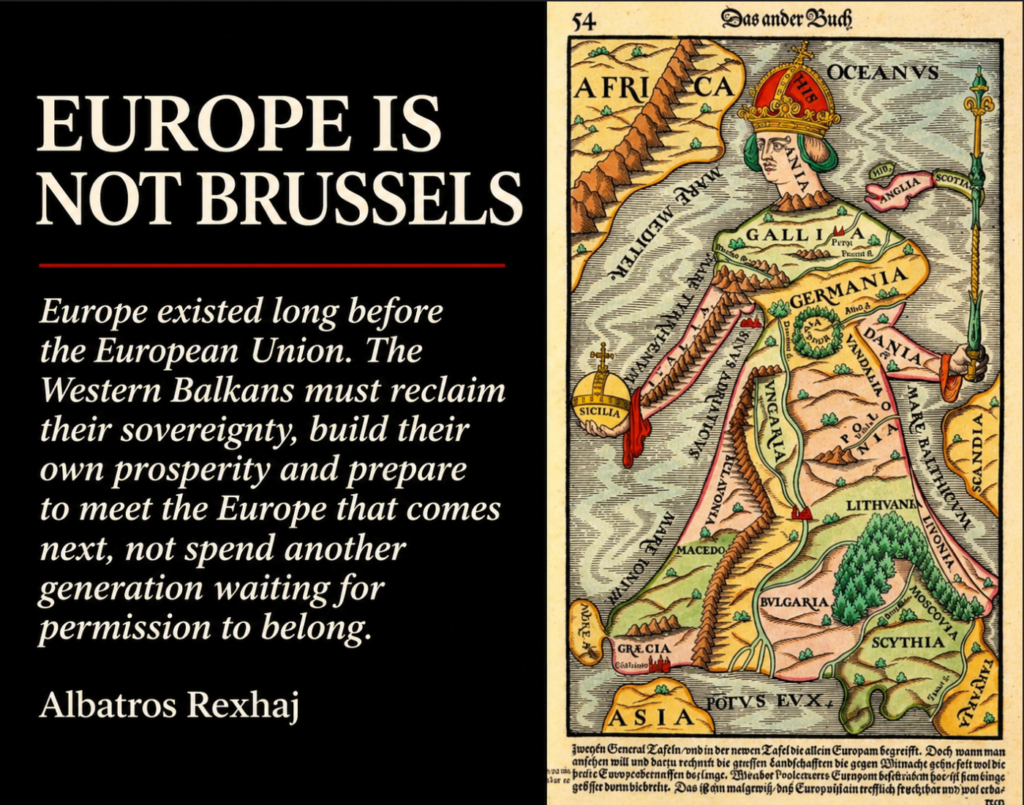
Europe is a civilisation made over centuries by its peoples, faiths, languages and quarrels. The Union is an arrangement that has existed for a fraction of that time, and we have let its administrators behave as though they held the certificate of authenticity for the civilisation. Albanians need no such certificate. We are among the oldest peoples of this continent, a people of many faiths, and our nation has never belonged to one confession. Pashko Vasa, a Catholic, told us a century and a half ago that the religion of the Albanian is Albanianism. Enver Hoxha later used the same line to close every church and mosque, so we also know what an office does with a doctrine about who a people ought to be.
Liberal doctrines on family, gender and religion, still contested inside the Union’s own member states, arrive in Tirana, Pristina and Skopje as settled European obligations. They are experiments on our societies, and they take apart our traditional values and whatever makes us distinct. In November 2025 Albania’s parliament passed a gender law over the protests of its religious leaders, justified as alignment with the Union. A bureaucracy cannot manufacture moral consensus by making disagreement a condition of delayed membership.
Belonging to Europe is nothing Brussels can issue. Neither is the rest of what we have been waiting for. A state that works, an economy that produces and a people that decides who belongs to it are made at home.
Blaming Brussels has become almost as convenient as obeying it, and those of us who write have done both, sometimes in the same week. Obeying spares us the decision. Blaming spares us the consequences. Either way the decision stays where it was. A country that wants to be treated as sovereign must first show that it can govern itself, and that means reform without hesitation or excuse. The rule of law, democratic government and a working economy are debts we owe our own citizens. Corruption is not a tradition worth preserving, and neither is a servile judiciary. What has to return is reason and common sense, the habit of asking whether a law is good for the people who will live under it before asking whether it will please the examiner.
We have also grown used to living on payments. The Union’s newest plan for the region is six billion euros, two thirds of it loans, released in instalments as conditions are met. No nation grows prosperous by perfecting the art of receiving assistance. We need factories, energy, farms that compete, exports, and young people who build their lives at home instead of becoming the labour force of the countries that lecture their governments about development. Our elites should be judged by the wealth their societies create.
And a sovereign country decides who belongs to it. Europe invited workers and slowly lost the distinction between offering a job and conferring membership of a political community. It assumed that residence would produce integration and that citizenship was the administrative reward for staying. In too many places that did not happen. People came from other continents and went on living as they had lived there, frozen at the hour of departure. Nobody had asked them to do otherwise. They had been hired, and a hired man keeps his own house. If this continues, Europeans risk being replaced in their own countries. In parts of Europe the risk is already the reality. Replacement was called a conspiracy theory. It is a fact, and it can no longer be ignored.
The mistake reaches our own children. One in five of the men who went to Syria under Kosovo’s name had been born or raised in the West. At home a young Albanian grows up among three faiths. In a European suburb he belongs fully to neither country, and a boy in that position is easy company for anyone who offers him a cause. He falls in with extremists from outside the continent, whom no one has integrated and whom the host state still subsidises. I am convinced that this company is the cause. It is odd, and it is sad.
We are early enough to learn before we repeat it, though our laws have already copied the error. Albania lets a foreigner apply for citizenship after seven years of lawful residence; Kosovo, five years after he receives a permanent permit. Both add conditions such as income and a clean record, and both rest on the idea they took from Western European law, where Germany cut its own wait from eight years to five in 2024: that time served is the title to membership. That idea should go.
In the cafés of Tirana the tray is now carried by a young man from the Philippines, because the young man who used to carry it is carrying one in Munich. They are the same man. Each left home because home could not pay him. A great part of my nation lives as he does, on other people’s terms, and here I am proposing terms. I do not think that contradiction can be argued away. It can only be answered with honesty about what we offer. We of all people know what it does to be promised a membership that never comes, so we should promise a worker only what we mean to give him: work, fair pay and the protection of the law. A work permit is permission to work, and it is no first instalment on a claim to citizenship. Stay is tied to purpose: when the work ends, the stay ends. Citizenship should be granted rarely and for a reason, and the fact that someone from another continent has stayed long enough is not a reason. Otherwise we will be replaced as well.
The peoples of Europe are reaching these conclusions faster than their institutions, and it is no secret that the Union as it stands cannot survive. It has piled up regulatory ambition while confidence in its institutions drained away, and its bureaucracy has come to mistake its own expansion for European progress. Whatever follows will have less Brussels in it. It will be a Europe of nations working together, held by values their peoples share and no longer by rules their peoples never chose. It will have to offer development where it now offers subsidy. And on immigration its awakening will be rude, because it comes so late.
That Europe will need partners, and a partner brings something to the table. We sit on the Adriatic and at the continent’s south-eastern door. A country can belong to Europe’s economy and its politics without being a member of the Union: Norway takes part in the single market from outside and pays its own way, and Switzerland negotiates agreement by agreement. We should take the best of the two, market access and cooperation where they serve us and our own political authority where it matters.
Our six countries differ, and each will choose its own course. All of them face the same choice of how to meet the Europe that is coming: as nations that function, or as applicants worn out by another generation of waiting.
There is great danger in organising the destiny of a people around a decision that belongs to someone else. We should not be governed by this Brussels while it makes up its mind. We will reform and build, and we can be patient while Europe fixes itself. Patience is what a people has when it is busy with its own work. Waiting is what is left when the work belongs to someone else.