Albatros Rexhaj
I am Albanian. I loved Europe long before I saw it.
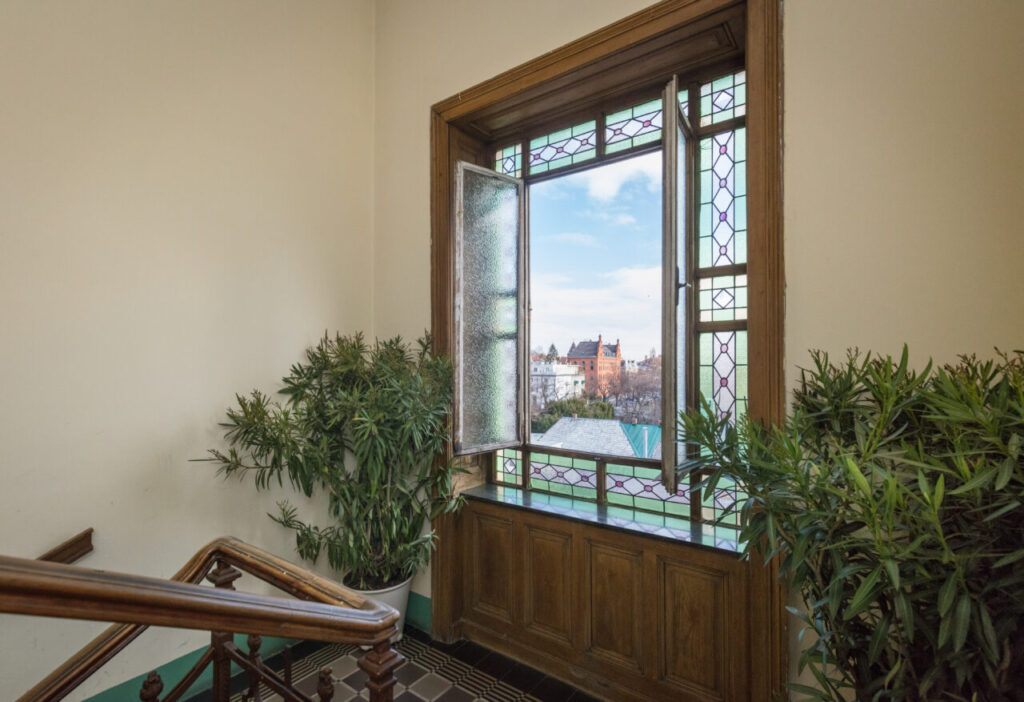
It began with a staircase, the one in Steppenwolf, in an apartment house in a city Hesse does not name. On a landing, outside the door of someone else’s flat, stand two potted plants, an azalea and an araucaria. The floor is polished, the air smells of wax and turpentine, and Harry Haller, the lodger from upstairs, supposes that behind this door people rise early. He is a man of about fifty who could not live that way and misses it all the same. Sometimes he sits down on a step and looks at the plants and the gleaming floor. He stays a while. Then he goes up to his room, to the books and the bottles.
As a young reader I saw mostly the order. Haller interested me less than the question of who polishes that floor. The book says only that a widow lives behind the door. She never appears. I pictured her every morning on her knees, with a rag and a tin of wax. I took that woman for Europe.
The other book was Demian. I read it the way you read books at a certain age, when you believe that somewhere between two covers lies the thing the adults are keeping from you. What I carried away was a sentence that is not in it, not in those words: Become someone. I took it for a summons addressed to me alone. I could not imagine that a person was allowed simply to stay what he had happened to become, and Europe, I assumed, was where that effort went without saying. Yet the same book says that this Europe had gained the whole world and lost its soul. I must have read past that. With these two things, a polished landing and a sentence Hesse never wrote, I prepared for Europe as if for an examination. Two novels. It did not seem so little at the time. I did not want to come as a supplicant. I wanted to pass.
The first city was Vienna.
I found two. One I knew from catalogues, magazines and books, and it kept to the pictures: the façades, the coffee houses, all of it where it was meant to be. I walked through it with the odd familiarity of a man recognising a place he has never been. Vienna looked like Vienna, and for a while that was enough.
The other city I heard. At some point I had stopped looking at the buildings and begun listening to the people, and what I heard was hardly Viennese any more. There were many languages, and I understood few of them. It should not have bothered me, since I would not have understood Viennese either and was one of those voices myself, but it bothered me.
What was I missing? A language I cannot even speak. Pictures have no sound; I had supplied one myself, and only one. But this city never spoke with a single voice. In the Vienna of the emperors you heard Czech, Hungarian, Polish, Yiddish, and anyone who reads the doorbells there today will find Nowak, Swoboda and Prohaska, and names do not come more Viennese than those. They too came from somewhere, and the city made Viennese of them. I wonder how. It must have wanted something from them.
I had expected an examination. I might have known from Demian that there would be no examiner; in that book nobody spares you the labour of becoming what you are. I had read it and still waited for one. None came. I looked around for others bent over the same task.
Later there were other cities, and in each I found something of the two Viennas. I got used to streets that did not sound as I had imagined. Some things I did not get used to. Often I did not feel safe, and that I had not expected of Europe. I wanted to blame it on the foreign voices. But it was the streets themselves. There were some that people only wanted to get through. Nobody seemed to be looking for anything there, nobody waiting for anyone.
In time I listened less to the new voices than to the old, to the people who had always been here. I was waiting for one of them to demand something: of me, of the others, of himself.
In one of those cities I sat in a restaurant with a married couple, both in their late thirties, intelligent and comfortably settled. Somehow we got onto children. They had always wanted them, the wife said. First there had been their studies, then work, then the flat, then the world, which had grown so uncertain. They were still waiting for the right moment. “We’ve been saying that for nearly ten years,” her husband said, and smiled. She did not smile. She folded her napkin into a small square, unfolded it and began again. Then we talked about something else, holidays, I think.
It was none of my business, but I could not shake the thought that a life can be spent preparing for the moment it will be allowed to begin. Then it struck me that I was one to talk. I had spent my youth preparing for another life, in another place. Two novels.
In another city it had rained hard in the evening. Water stood along the kerb where leaves had blocked the drain. People walked round the puddle; some crossed the street. Nobody stopped. I stood under an awning with my hands in my coat pockets, watching, annoyed that something so simple was being left undone. I wondered how long it would be before someone from the council came. I stood there longer than anyone who passed. They at least were in a hurry. Then I went over and pushed the wet leaves aside with my shoe. The water drained, slowly, and not all of it. An elderly woman with a shopping bag stopped and watched me. She said something about the council. I did not catch all of it, and it did not sound like thanks. I walked on with one wet shoe.
As I walked I thought of Hesse’s landing. I had always taken the woman who polishes it for someone who does her duty whether or not anyone is watching. It may be that the floor was simply dirty and she could not bear to leave it so. All I know of her is that she is a widow.
Even so, I do not believe I imagined all of it. Someone had laid the paving stones I was walking on, and was long dead. I wanted to ask the people in those cities whether it still mattered to them to leave something behind that they themselves would never need. I found no one I could ask without it sounding like a reproach.
Sometimes I suspected that I was asking something of them while allowing myself to remain a stranger. I could be disappointed and move on. They had to get up the next morning and go on living in their cities. Perhaps it is easy to love Europe so long as you do not have to live in it. I did not like the thought. I have kept it.
Haller did not belong, and knew it. But the landing below him had been polished that morning, and the thing he missed was real. I came later. A stranger does not walk into other people’s stairwells, and I have lived nowhere long enough to know what goes on in the mornings behind those doors. Whether an araucaria still stands behind one of them, and whether the floor beneath it still shines, I cannot say. I would have liked to see it.