A Montenegrin court called the Albanian eagle a foreign symbol and an insult, and sanctioned four Albanian minors in Kotor for it. The ambassador called the judges honourable and the case isolated, the embassy called it no punishment, Ferit Hoxha’s ministry found nothing to say to Podgorica, and all of them thanked the people who did it.
By Ardit Rada (Tirana)
On 7 April, Ferit Hoxha stood in the “Naim Frashëri” gymnasium in Durrës, on his “Europe Starts Here” tour, and posted that he had met the generation that will shape Albania’s European future. On 31 October, four pupils of that school, all 17, spent the night in a police station in Kotor.
The misdemeanour judge in Kotor ruled the next morning. As the president of the Budva Misdemeanour Court, Marko Đukanović, summarised it to Vijesti, the four had insulted a 55-year-old woman from Tivat on grounds of national and religious affiliation by crossing their hands at the chest to show the double-headed eagle, which, in the court’s words, associates with the national symbol of another state. They received a reprimand. The woman, charged with punching one of them on the shoulder, received a warning. In that ruling, an adult’s fist on a child weighs less than the child’s hands.
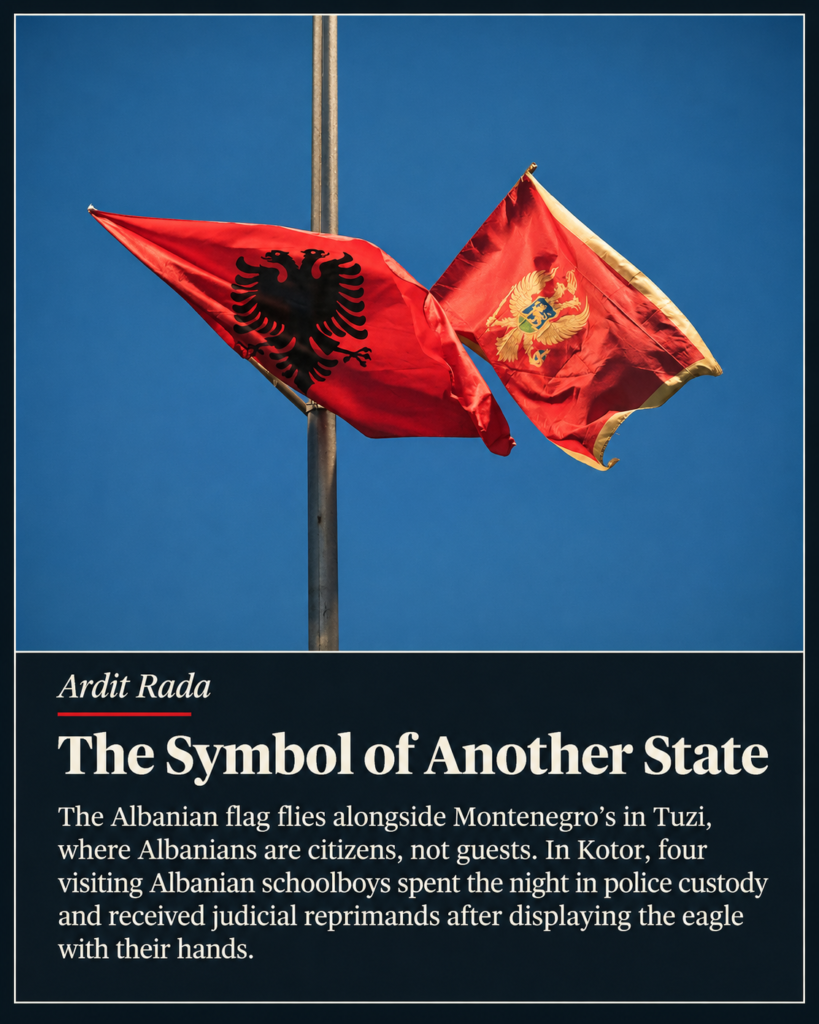
The four were tourists and went home. The ruling stayed with the thirty thousand Albanians who are Montenegrin citizens, about five per cent of the country, whose constitution guarantees the display of their national symbols. On 20 August, on the square in Tuzi, police charged a 21-year-old and two 16-year-olds under Article 23 of the Law on Public Order and Peace for displaying the flag of another state, the Republic of Albania, without permission, announced that the parents would be reported for neglect, and sent the foreigners’ inspectorate after the one boy who holds Albanian citizenship. When Albanian politicians in Podgorica protested, the culture minister, Tamara Vujović, set out the doctrine on 12 September: the same flag is the Albanians’ national symbol and Albania’s state symbol, and which it is in a given case depends on who displays it, in what capacity, on what occasion and under which legal right. An Albanian in Montenegro holds his flag on licence; it is his until an official decides otherwise, and then it is another state’s. The Council of Europe recorded in 2024 that the 2020 symbols law was adopted because minorities had been prosecuted for their symbols, that interethnic relations had worsened since 2018, and that Serbs in Montenegro report an ethnic distance towards Albanians of 0.74 on a scale of one.
There is nothing European in any of this. How can a state that treats the national symbol of tourists, four minors on a school trip, as a provocation and an ethnic insult be the European Union’s frontrunner? How can the country whose accession treaty is being drafted in Brussels be the country whose police call the flag of its own Albanian citizens the flag of another state? A state that licenses its citizens’ flags and sorts their gestures by passport is an older kind of state, with a European calendar.
That calendar reads 4 November, when Marta Kos presents the enlargement package, in which, per the draft RFE/RL has seen, Montenegro is the leader and this may be its last regular report. Chapter 23 is where a statute like Article 23 would be examined, if anyone examined it. How can the EU Delegation in Podgorica stay silent? Its ambassador, Johann Sattler, served in Tirana for Austria and speaks Albanian; he knows what the eagle means to the people who make it. He said nothing about Tuzi, nothing about the minister’s doctrine, and in the week of the Tuzi charges posted that Montenegro had taken another major step towards the EU. He has said nothing about Kotor. Does the Delegation consider a court finding that the Albanian eagle is a foreign symbol and an ethnic insult compatible with Chapter 23? If not, where and when will it say so? If the pattern holds he will say nothing, because a Delegation whose task is to close the file does not open it, and that silence is the fundamental-rights chapter certified by not looking.
Brussels at least has a calendar to hide behind. Tirana has only its habits. The embassy in Podgorica secured a lawyer, an interpreter and a psychologist, and then announced that the four had been released without punishment and that it appreciates the cooperation of the Montenegrin authorities. The court had just sanctioned the children. The embassy thanked the state that did it and told their parents there had been no punishment.
That evening the ambassador, Zhaklina Peto, went on Klan News and gave the ministry’s view of the matter in full. She could not comment on a court decision. The judges were honourable and had their careers. She did not believe there was any intent behind the ruling. The case was isolated. Albanian school groups should keep coming to enjoy the beauty of Montenegro, the excellent relations between the two countries, and the road the two are walking together towards the European family. She thanked, by office, the interior minister, the justice minister and the police director. In the same interview she listed protecting the dignity of Albanian citizens among the embassy’s main duties. In her account, four Albanian children sanctioned for the Albanian eagle, weeks after a Montenegrin minister had explained that their flag is foreign when a foreigner holds it, were a minor incident on an otherwise happy road, and the duty of dignity was discharged by the lawyer and the psychologist.
The ministry itself said nothing. Its presence in the affair was Peto’s phrase that the case was followed under the special attention of Minister Hoxha. No note to Podgorica, no request for the text of the decision, no Montenegrin ambassador asked to call, no sentence stating that the eagle is not an insult. Nothing on Tuzi in August either, when a Montenegrin police release called Albania’s flag the flag of another state and the ministry let it pass. Last month Hoxha answered a Serbian minister’s remark about a flag in Prizren within hours and in his own name. Belgrade can be answered for free. Podgorica, the frontrunner, cannot, and the ministry’s silence is its own estimate of what Albania can afford.
Hoxha knows the forms. He sat as Albania’s permanent representative at the United Nations and presided over the Security Council. He knows what a note verbale is, what a summons is, and what silence says. The ministry he runs carries Europe in its name, and in April, in Durrës, he discussed with these very pupils, in his own words, the image of Albania. The image of Albania in Kotor was four of them in a police station and a ministry with nothing to say. A ministry that cannot find one sentence for its citizens’ symbol when a neighbour’s court calls it an insult has told every Albanian outside the borders what the constitution’s promise is worth when the other side is a frontrunner: nothing.
Any member-state foreign ministry whose minors had been sanctioned abroad for their national symbol would have had the other side’s ambassador in the building by noon. Albania’s ministry thanked. It thanked in writing, it thanked again on television, and its ambassador explained why: the excellent relations, the shared road to Europe. That is an inferiority complex stated as policy. It holds that Albania’s place in Europe is granted on sufferance and must not be disturbed by Albania’s own dignity, so the dignity is set aside first, as a precaution, before anyone has asked for it. Article 8 of the constitution says the Republic protects the national rights of Albanians living outside its borders. In Montenegro the ministry had the four visitors and the thirty thousand residents to protect, and chose instead to be no trouble.
In April the minister told the pupils of “Naim Frashëri” that Europe starts here. Four of them learned in Kotor where it stops. They came home with a reprimand. Their state came home with a thank-you note. Of the two, the reprimand is the more honest document.