A French historian told Tirana what foreign interference looks like. The same week, the Russian ideologue who claimed the riots as his revolution supplied the enemy, and within a day a Belgrade-briefed account that spent October photographing Albanian bases was placing Israeli intelligence at the airport. The Albanian state has yet to say which office answers for it.
By Drizan Shala (Security Desk)
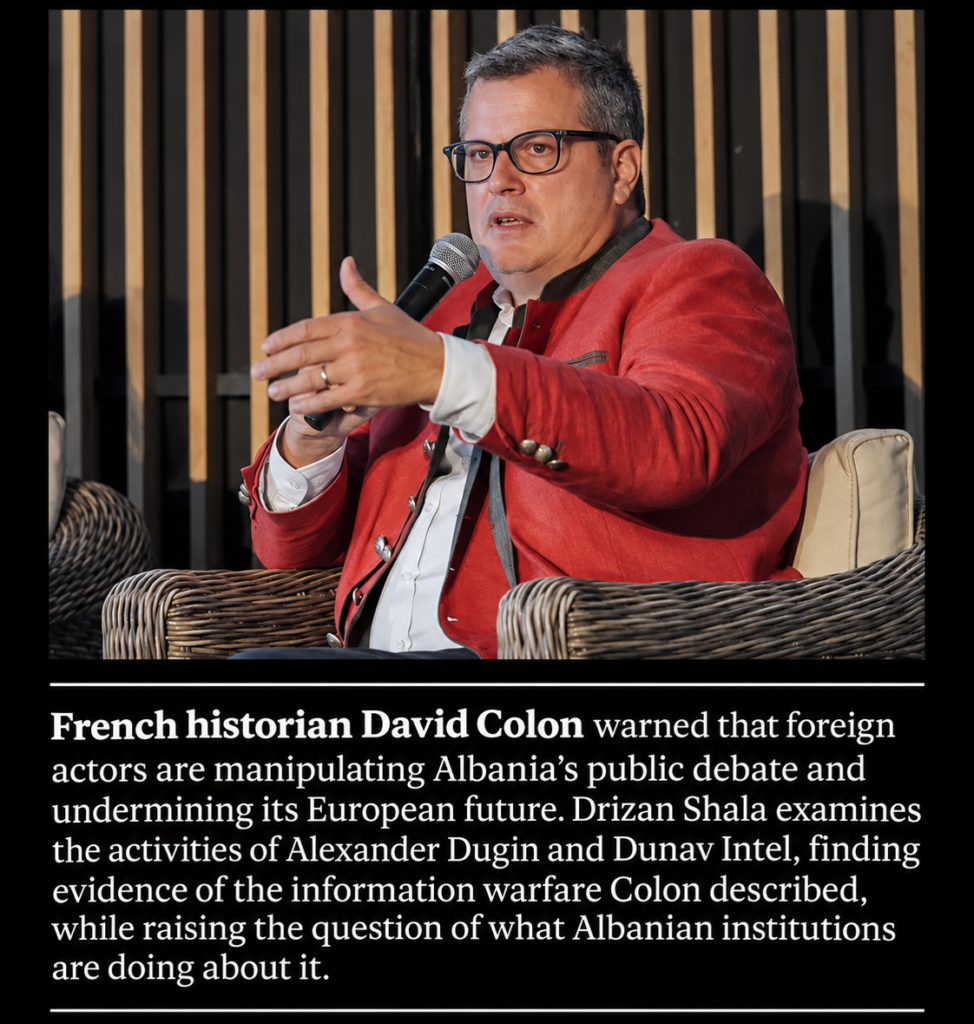
David Colon crossed the forecourt of the French Institute on the boulevard and spoke for two minutes. He teaches the history of propaganda at the Centre d’histoire de Sciences Po and his La Guerre de l’information took the Prix de la Revue des Deux Mondes in 2024. The Embassy of France posted the video under a single hashtag, disinformation, and the ambassador, Catherine Suard, was the first name to like it. The embassy deserves thanks for the word; its neighbours spent October on proportionality and dialogue, and Paris named the threat. Colon’s thesis, in the Albanian rendering that circulated on Monday, is that foreign state actors are intervening in the Albanian public debate and distorting how that debate is perceived abroad, with the aim of damaging the country’s EU accession, and that they do it through fake accounts, influencers paid in secret, and agents of influence who carry a chosen narrative into the debate in order to divert it. He placed Albania “at the forefront of this global information war”. The week his video was being edited supplied the proof.
On 17 October, the night the Bank of Albania and the High Court were attacked, Alexander Dugin posted that Albanians “are awakening now”. On 28 October he told his Geopolitika portal that Albania is “a genuine, deep anti-globalist revolution” that “could end in a real revolution”, with Fan Noli recruited as evidence of Albanian depth. Dugin founded Russia’s Eurasian school; his Foundations of Geopolitics prescribes instability inside Atlanticist states; ten days earlier Benjamin Netanyahu had told Russian-speaking bloggers that a large part of Western antisemitism traces to Russian structures and “that terrible person, Dugin”. On 29 October the account Dunav Intel (@Lukai1861) posted three business jets “allegedly linked to Israeli intelligence and VIPs” landing in Tirana during the protests. Two states, two instruments, one week. The attribution rests on their own words: Dugin’s seat in the Russian apparatus is the one Netanyahu described, and Dunav describes itself as holding discussions with Serbian stakeholders and taking its findings to analysts in Belgrade.
The Dunav post is the operational finding of the week. Until now the account’s product was collection: imagery of Albanian Armed Forces exercises at Bizë, of Kuçovë, of Pristina airport, documented by this publication in October. A collection account guards its credibility, because the credibility is the asset. On 29 October it spent that asset on a narrative. The jets are real; tail numbers and routes sit on any transponder tracker. Everything else is supplied from each aircraft’s past: 4X-CZA once carried an Israeli president to Bahrain and therefore, in the post’s words, “increases the possibility” of an intelligence role; 4X-CZH once flew in “hot areas of Africa and the Middle East”; T7-AAMA, Maltese, is listed with no date at all because the list needed to be three. The graphic names the second jet 4X-CXH while the text says 4X-CZH, which tells an analyst that nobody on the producing side expected to be checked. The hedges, “allegedly”, “increases the possibility”, are the design: the verifiable part carries the unverifiable part, and no denial can touch it. The post even discloses its supply chain, distinguishing its jets from “the scheduled commercial flights reported by some Albanian media outlets”. The Israeli-flights story was already inside the Albanian debate; the agent’s job was to upgrade it from commercial to clandestine. That is Colon’s agent of influence, carrying a narrative the debate already contained one step further than the Albanian outlets had taken it, and it is the same node that photographs Albanian bases. Whoever tasks Dunav now uses one channel for the camera and for the story.
The narrative was chosen for its reach. Israel as the hidden hand serves the street, where a protest about Albanian grievances becomes an uprising against an alien and ancient foreigner and the government becomes foreign-owned; it serves Belgrade, where an Albanian capital receiving Israeli jets is set against the Orthodox crowd Dugin praised in the same interview for marching without “a single American or Israeli banner”; and it serves the international right that reads Dugin, for whom Israel as the enemy has been the organising theme since October 2023. In the 28 October interview Dugin explains Washington through “the powerful Zionist lobby” and calls Netanyahu “the Hitler of modernity”. A 2018 essay he republished on his own press in March finds in Zionism “a kind of ‘Jewish Satanism’”. His 2024 text on Nasrallah’s killing describes Israel as a worldwide network “not just a state”. On 21 October he answered Netanyahu that he is “certainly not an antisemite in any sense”, because Arabs are Semites too. The man who claimed Tirana’s revolution and the account that films Tirana’s bases name the same enemy in the same week. No document shows command, and this publication claims none; convergence of a stated interest and a matching operation is what a security service records, and it records it as attribution.
Abroad, the two products do the damage Brussels will feel first. Dunav’s post is in English, tagged to defence aggregators, built around a map made for a screenshot; Albanians are not its first audience. Its Tirana is a city where Israeli intelligence lands during unrest. Dugin’s Tirana is the one European capital in genuine uprising against the liberal order. Neither city exists, and both are now what a reader in Belgrade, Moscow or an American conservative timeline holds. A government depicted as foreign-owned and a country depicted as an intelligence theatre are the two pictures a Council working group is handed when it asks whether Albania is a stable candidate. Whether the account was told to obstruct accession is a question for the service that should be reading its traffic; the effect does not wait for the answer. Serbia voted on 25 October and Vučić’s party lost; within three days Dugin had hedged on the victors and relocated his revolution to Albania, the next NATO summit host and the third leg of the Croatia-Albania-Kosovo defence partnership that Belgrade’s collection has followed all year. An account engaged in overhead collection on Albanian bases accusing another state of clandestine flights also seeds the answer for the day Albania exposes that collection: everyone spies here.
Has SHISH identified who operates Dunav Intel and who briefs it in Belgrade? Has anyone in the Albanian state assessed the account’s move from collecting on Bizë to distributing allegations about Israeli intelligence in Tirana, and understood it as one operation? Has the Ministry of Defence, which has known about the collection since at least October, said one public word about the narrative? Which office in Tirana owns foreign information interference at all, with the summit eighteen months away? The Embassy of France denounced the threat in public, which is the first half of Colon’s remedy. The Albanian state has not yet named the account, the capital that briefs it, or the ideologue who claimed its streets.
The professor is right. The question is who in Tirana was listening.