Three days, two Alpine forums, a US under secretary, a Commissioner, a Director-General and the EU’s Kosovo–Serbia envoy. The Foreign Minister closed the sequence with a live interview from Slovenia on chapters, consulates, NATO and Greece.
Tirana Examiner Newsroom
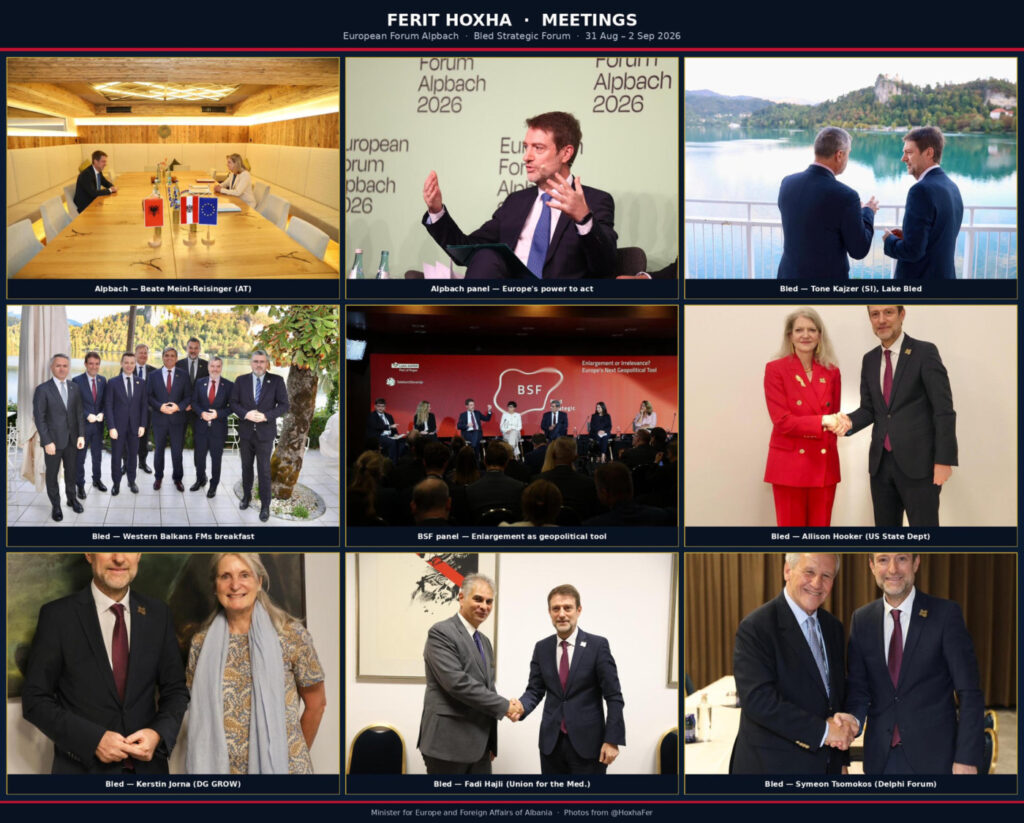
Ferit Hoxha spent the last three days of the summer on the conference circuit that opens the European political season, moving from the European Forum Alpbach in Tyrol to the Bled Strategic Forum in Slovenia. Between 31 August and 2 September the Minister for Europe and Foreign Affairs published readouts of nine engagements, including two panels, one of them alongside the Commissioner for Enlargement, and met the US Under Secretary of State for Political Affairs for the second time since July. He ended the trip with a live interview on Report Tv’s “Sot Live në Shqipëri” from Bled on 2 September, in which he set out the government’s positions on the pace of accession negotiations, gradual integration, the NATO summit Albania will host, the consular exchange with Serbia, the political crisis in Kosovo and the open files with Greece.
What follows is the record of the trip as the minister published it on his own account, with the interview in full at the end.
Alpbach, 31 August
Hoxha’s first stop was the European Forum Alpbach, where he attended at the invitation of Austria’s Foreign Minister Beate Meinl-Reisinger. The two met on the margins of the forum on 31 August.
The minister’s readout of the meeting placed Austria’s role in the accession process first. He reiterated Albania’s gratitude for Austria’s “continued support for Albania’s EU path and its steadfast role in advocating for the Western Balkans, including through its leadership of the ‘Friends of the Western Balkans’.” Austria, he wrote, “remains one of the key strategic investors in Albania,” and the two ministers discussed expanding that footprint in areas of shared interest. The readout also cited the growing number of Austrian visitors to Albania each year.
The security passage of the readout is the one to note. The two ministers discussed “the growing complexity of the European and global geopolitical landscape” and, in Hoxha’s words, “stand together in advancing regional stability, strengthening resilience against emerging hybrid threats, including FIMI.” FIMI is the EU acronym for foreign information manipulation and interference.
The same day the minister took part in the Alpbach panel “Capability & Renewal: Mobilising Europe’s Power to Act.” His published summary of his contribution is the fullest statement of the doctrine he carried through the rest of the trip.
He framed the question of Europe’s capacity to act as an internal one for Albania rather than an external one. “As a country firmly on its path towards EU membership, our present and our future are deeply intertwined with Europe’s own future. Europe’s concerns are our concerns, its challenges are our challenges.” He argued that the Union “must be able to act with greater speed, determination and strategic purpose across a range of key priorities, including enlargement, because enlargement is not merely about making Europe bigger. It is about making Europe stronger.”
The contributor argument followed. “Albania is not only preparing to join the EU. We are already contributing to Europe’s security and stability through our steadfast alignment with the EU’s CFSP, including the adoption of EU sanctions and participation in EU-led missions and operations; through our active role within NATO; and through our firm commitment to the values, principles and responsibilities that underpin the European project.”
The panel post closed with a line the minister evidently intends as a slogan: “Our ambition is not simply to be ready for Europe; it is to be useful to Europe.” It carried the hashtags #Albania2030 and #BelieveInEurope. The 2030 tag would recur on four of the nine posts.
Bled, 1 September
Slovenia’s Foreign Minister
The Bled day opened with a bilateral with the host, Slovenian Foreign Minister Tone Kajzer. The readout covered Albania’s accession, the future of Europe, the strategic importance of the Western Balkans, and economic relations: he and Kajzer discussed “the need to further strengthen our economic ties and people-to-people contacts, bringing them in line with the excellent political dialogue between our two countries.”
The enlargement language was the same two-track formula Hoxha used throughout: merit first, geopolitics second. Albania and Slovenia, he wrote, “share the conviction that the EU enlargement is, first and foremost, a merit-based process, earned through reforms, delivery and mutual trust. At the same time, it is increasingly a geopolitical imperative and an investment in a stronger, safer and more resilient Europe.” The stated objective was “advancing decisively towards the conclusion of accession negotiations and membership in the European Union within this decade.”
The Western Balkans breakfast
Kajzer then hosted a working breakfast for foreign ministers and senior officials from across the Western Balkans. Hoxha’s account of it was brief: “a roundtable exchange on our shared perspectives regarding the region’s European future, as well as on advancing regional cooperation and fostering stronger partnerships across the Western Balkans.” He did not name the other participants. The Bosnian Foreign Ministry confirmed that Elmedin Konaković attended the breakfast at Kajzer’s invitation, and Montenegro’s Foreign Minister Ervin Ibrahimović was in Bled the same day for the enlargement panel. The host ministry has not published a full list.
The enlargement panel with Commissioner Kos
The minister then joined the forum panel he titled “Enlargement as Europe’s Next Geopolitical Tool” together with Commissioner Marta Kos. The forum’s own billing for the session was “Enlargement or Irrelevance? Europe’s Next Geopolitical Tool”; according to the moderator, Vesko Garčević, the panel also included Montenegro’s Foreign Minister Ervin Ibrahimović, Slovenian State Secretary Tamara Weingerl Požar, Natalie Kauther, Director for the Western Balkans at the German Federal Foreign Office, and Vessela Tcherneva of the European Council on Foreign Relations. Hoxha published three messages from it.
The first was on process and pace: “We agree that enlargement is, and must remain, a merit-based process. Trust and credibility are essential and so is keeping up the pace of negotiations. We have and are making difficult choices, have undertaken far-reaching reforms, and remain fully engaged in building stronger, more resilient democratic institutions.”
The second restated the contributor case in the form of an offer. “Albania does not see itself simply as a future beneficiary of the European project. EU membership is both an aspiration and an offer. We seek the benefits of belonging, but we are equally ready to contribute to the strength, competitiveness, and security of the Union we join.” He cited full alignment with EU policies and decisions as the evidence already on the table.
The third was historical. “History has shown that every round of enlargement has made the European Union stronger, more prosperous, and more influential. The next enlargement will be no different. On the contrary, in today’s geopolitical environment, it is a strategic investment in a stronger, more secure, and more united Europe.”
Under Secretary Hooker
The meeting with the most direct bearing on Albania’s security file came when Hoxha met Allison Hooker, the US Under Secretary of State for Political Affairs, on the margins of the forum.
The minister’s readout opened by placing the meeting in a sequence. “Following up on our discussions in Washington, last July, we reaffirmed the importance of the Albania–U.S. strategic partnership and our shared commitment to further deepening our bilateral cooperation across areas of mutual interest.”
The July reference is to Hoxha’s visit to Washington in mid-July, reported by Albanian outlets on 18 July, when he attended the Ministerial on the Return of Political Terrorism convened by Secretary of State Marco Rubio. On the margins of that ministerial, in his own account on X, he met Deputy Secretary of State Christopher Landau and, in what he described as a more in-depth meeting, Under Secretary Hooker. Hooker posted after that meeting that the two had discussed the close ties between the United States and Albania and opportunities to strengthen shared security and prosperity. Bled was the second Hooker–Hoxha meeting since the minister took office in March.
The agenda at Bled was defence and NATO. “We exchanged on defense and security cooperation, as well as on our cooperation within NATO, particularly in the aftermath of the Summit in Ankara and ahead of the upcoming Alliance Summit in Albania.” The two also “discussed the security environment and latest developments in the Western Balkans, reaffirming the importance of continued engagement in support of regional stability and security.”
The readout closed on delivery: “We look forward to continuing our close dialogue and cooperation, with a focus on delivering tangible results that advance our shared interests and benefit both our countries.” As of 2 September the State Department had published no readout of the Bled meeting; the account rests on the minister’s post, carried the same day by RTSH, Euronews Albania and Albeu.
DG GROW
The last meeting of 1 September was with Kerstin Jorna, Director-General of the European Commission’s DG GROW, the Commission directorate for the internal market, industry, entrepreneurship and SMEs.
Hoxha set out the economic reform agenda he intends to run in parallel with the negotiations: “improving the business environment, reducing administrative burdens and continue digitalising public services.” The purpose, as he described it, was to prepare Albanian firms for “their successful participation in the Single Market and integration into European value chains.”
He welcomed “the prospect of closer cooperation with DG GROW to support Albanian enterprises in meeting EU standards, accessing European business and innovation networks, and making the most of the opportunities created by digital transitions.” His closing line tied the economic track to the accession one: “A competitive Albanian economy, fully integrated into the European Single Market, will be one of the strongest foundations of our EU membership.”
Bled, 2 September
Sørensen, Hajli, Linkaits
On the morning of 2 September the minister published, in Albanian, a combined readout of three further meetings held during the forum: with Peter Sørensen, the EU Special Representative for the Prishtina–Belgrade Dialogue; with Fadi Hajli, the acting Secretary General of the Union for the Mediterranean; and with Tālis Linkaits, Director of the Permanent Secretariat of the Transport Community.
The Sørensen meeting is the one with regional weight. Hoxha’s account, rendered from the Albanian: “With EUSR Sørensen, I stressed the importance of a sustained dialogue, oriented towards concrete and tangible results, in order to advance faster towards the normalisation of relations between Kosovo and Serbia, as an indispensable contribution to peace and stability in the region.” The operative phrase in the Albanian is “rezultate konkrete e të prekshme,” concrete and tangible results.
With Hajli the discussion covered “the strengthening of Euro-Mediterranean cooperation and the possibilities to advance concrete projects in fields of importance for the development and prosperity of the region.” With Linkaits the focus was “connectivity, infrastructure and mobility, as key elements for a Western Balkans that is more integrated and closer to the European market and space.”
The post summarised the three under a formula: “Dialogue, connectivity and cooperation are three pillars of a more stable, more integrated and more European region.”
Delphi Economic Forum in Tirana
The final meeting of the trip was with Symeon G. Tsomokos, founder and president of the Delphi Economic Forum, whom the minister called “a friend of Albania.” The subject was the next edition of the forum’s Albanian chapter, which Hoxha said would take place in Tirana “later this year.” The chapter runs as the Tirana Economic Forum; its fifth edition was held on 10 December 2025, and the Delphi Forum’s events calendar had not yet listed dates for a sixth.
The minister’s framing of the capital’s role was the most expansive of the trip. “Albania and its capital, Tirana, are increasingly seen as the European hub of the Western Balkans,” he wrote. The Tirana chapter had “already added an important dimension to the dialogue on the challenges shaping our region and Europe.” The agenda he described for the forum ran “from geopolitics and security to economic competitiveness, connectivity, innovation and European integration,” and he closed on a line that reads as directed at the region as much as at the audience: “A forum for ideas, in a region where ideas must increasingly translate into action.”
The interview: Report Tv, 2 September
Hoxha’s live interview with Report Tv’s “Sot Live në Shqipëri” was conducted by live link from Slovenia on 2 September and published by the station at 13:47. The passages below are rendered from the Albanian broadcast transcript as published by Report Tv.
Chapters: “the maximum this year”
The minister put the 2030 objective first and insisted it was a working target. “2030 is an objective and not a slogan for the closure of negotiations and membership in the European Union,” in the station’s summary of his opening.
On the negotiations themselves he refused to describe any part of the process as easy. “There is absolutely nothing simple in the interaction with the European Union. There is nothing simple in the integration process. Naturally, in some areas we are more advanced, as we know when we receive the progress report every year in October or at the beginning of October; we see where we have advanced, where we have more to do, where greater efforts are needed, and naturally some areas are more demanding than others, but all of these we treat in parallel.”
He then gave the count and the target. “So far we have closed three chapters. We will try to do the maximum to close the maximum of chapters this year, so that during next year, which is also the moment when we think we will be in a position to close them, we leave as few chapters as possible for next year, but in any case it is work that is calendared.”
The three chapters are those the ministry’s statement of 27 July recorded as closed in Brussels on 14 July. The minister added, per the station, that Albania has the support of all 27 member states and that every request and approach is examined and addressed.
Gradual integration: “a bridge, not a replacement”
Asked about the gradual-integration proposals under discussion in Brussels, Hoxha gave the government’s reading and drew one line.
“In essence, gradual integration brings, or at least this is our reading, Europe closer to the citizen before the day of full membership arrives. That is the core of this process for a citizen, for a business. What matters is whether the European change is felt in daily life, and this can mean greater access to the common market, participation in European programmes and policies with many opportunities for businesses, students, professionals, as well as concrete benefits from the reforms we carry out.”
He put the point in a figure of speech: “The idea is that in many respects we do not wait for the day, the stroke of midnight when the gong of Albania’s membership sounds, but have the possibility that where it is possible, where we are prepared, where there is interest, where there is common interest, not only for Albania but naturally also for our partners, these doors, small or large, whichever they may be, can open in advance.”
The purpose, he said, was to sustain belief in the process: “If citizens see that the reforms and the EU bring concrete results, I am certain that then Europe is no longer an abstract project, as you may have seen it for a long time over the years, but a part of their daily life.”
Then the line. “Gradual integration, whatever the concept, whatever the practice, whatever its realisation, is a bridge towards membership, not a replacement for it, and for us it would run from this moment, from tomorrow, from yesterday, until the moment we are admitted to the European Union, and for us, as you know, that is Horizon 2030.”
He added that a communication from the Commission on how the mechanism would function is needed, along with a debate in the European Council on the proposal tabled by Germany and France.
The NATO summit: “an open question”
On the summit the Alliance has agreed to hold in Albania, the minister confirmed the venue and left the year open.
“It is absolutely an open question. Absolutely it has not been discussed yet. We will see whether it is possible to organise it within 2027, if all the other partners think so and there is added value. If not, naturally we will find a common solution, but I have the impression that it is a minor matter.”
Per the station’s summary, there is no doubt the summit will be held in Albania; whether in 2027 or 2028 remains open.
The consulates: “agreement in principle, no concrete action”
The longest passage of the interview concerned the proposed exchange of consulates, an Albanian consulate in the Preshevo Valley and a Serbian one in Shkodër.
“We have reached an agreement in principle. Naturally these things in foreign policy, in diplomatic relations, in relations between states, have a certain logic, and naturally one of the main elements is reciprocity. You want to do something in Serbia, we want to do something in Albania.”
On the status: “No real, concrete conclusion has been reached, there is no formal exchange, but there is an agreement which naturally was made public in the way that we know it was.”
On the purpose: “What I want to say is that our aim is very clear. I want Albania to be close to the Albanian citizens of the Preshevo Valley, to offer them more services, to offer them more support, to give them continuous help. It is an instrument of service for citizens, not a political instrument, and still less one for producing tensions.”
The ministry’s written statement of 30 July had likewise described reciprocity as the framework, adding then that it did not necessarily imply equality of content.
Kosovo: “we have no lessons to give”
Asked for advice on the political crisis in Kosovo, the minister declined to offer any and gave a position instead.
“We have no lessons to give Kosovo, but what we want is the strengthening of institutions, the development of Kosovo, the advancement of the Euro-Atlantic path, the advancement of the normalisation process, and naturally this is done better when institutions are installed, when it is known with whom one should and will be talking. This is also the approach I have seen in the discussions I have had with other parties, with those who are as interested as Albania in the development, advancement and strengthening of the subjectivity and democracy and the state of Kosovo.”
The station summarised the position as a wish to see institutions consolidated while sparing the cost in time, organisation and political stability.
Greece: “dialogue, prudence, mutual respect”
On the open files with Athens, among them the pensions question, Hoxha placed them inside a relationship he described as strategic and multidimensional.
“We have an important, strategic, multidimensional relationship and of course we have issues to discuss, but our approach is that they be handled with dialogue, with prudence, with mutual respect, in accordance with our interests, naturally bearing in mind that we also have the other side, which has its own interests, but also where necessary, where possible, in accordance with international law, always in the spirit of good friendship.”
He then set the frame he wanted the relationship read in. “Relations between our countries cannot any longer, and must never, be reduced only to the issues that divide us, because we have many things that unite us: human relations, economic ties, trade, investment, tourism, security, shared security in NATO and partnership in Europe. So we are for a dialogue and for the resolution of the issues, and we are absolutely working on that.”