Tirana Examiner Newsroom
Prime Minister Edi Rama renewed his invitation to protesters on Sunday morning, this time without the stone table in front of the Prime Minister’s Office. He shared the link to folmekm.al, the online platform he presented on Friday, and wrote that the Dialogue screen was now on their phone or computer [“me pasqyrën e Dialogut në telefonin apo kompjuterin tuaj”], wishing them a peaceful Sunday.
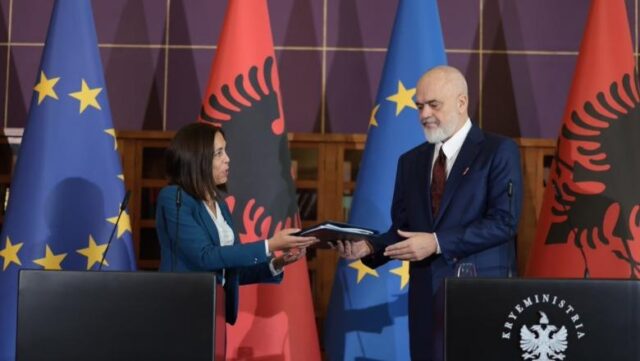
The site had been announced two days before it opened. On Thursday 5 November, at a press conference with the EU ambassador Sofia Moreira de Sousa, who handed him the Commission’s progress report, Rama said a new communication and dialogue platform would open the following day, through which students and anyone interested could put their concerns directly to the government. He said the initiative was meant also for students who, in his account, had been threatened and prevented by other student groups from meeting him, and that three groups had been forced to withdraw because of pressure and bullying both online and in person. The meetings, he said, were to have taken place without cameras, photographs or a press release, simply to talk; the students’ names had been made public and they were then bullied. He described the three groups as named individuals, “të dekonspiruar dhe pastaj të bullizuar në ekstrem” [outed and then bullied to the extreme]. He said there would be a legal response to those applying pressure, threats or violence, with both criminal and administrative measures. He said he would not retreat before threats and violence, and recalled his own part in the student movements against the communist regime. He also said that the resignation of an elected prime minister “nuk imponohet nga rruga” [is not imposed by the street].
At the same press conference, Moreira de Sousa said institutions must create space for dialogue to address the popular grievances expressed through the Tirana protests, that violence has no place in a democracy, and that any response to acts of violence must remain proportionate and lawful. The Commission’s report describes the continuing protests as “mobilizimi më i madh qytetar që nga tranzicioni demokratik i Shqipërisë” [the largest civic mobilisation since Albania’s democratic transition] and recommends that all sides make sincere efforts to engage in dialogue. Citizens.al reported that the Commission names two government laws, the 2024 amendments to the protected areas law and the strategic investments law, as the root cause of the protests that began in May. Rama said the report demands dialogue and that it is the government’s duty to guarantee it.
The platform went live on Friday 6 November. Rama announced it on Facebook with a video explaining how the page works, under the caption that the Window of Dialogue was open, followed by a heart emoji. In the video he said the page was ready for anyone wishing to communicate and enter into dialogue, in conditions he described as following a background of protests, escalation, violence, pressure, threats and attempts to obstruct dialogue at any cost: “kjo është ura që është ngritur për ju” [this is the bridge built for you]. He called it a functional bridge open 24 hours, with a dedicated team following the exchanges, said technology offered a golden opportunity for direct communication, and ended with a welcome to dialogue. He said that sooner or later the ice set artificially by those who believe they can impose themselves on society and on democratic coexistence would melt.
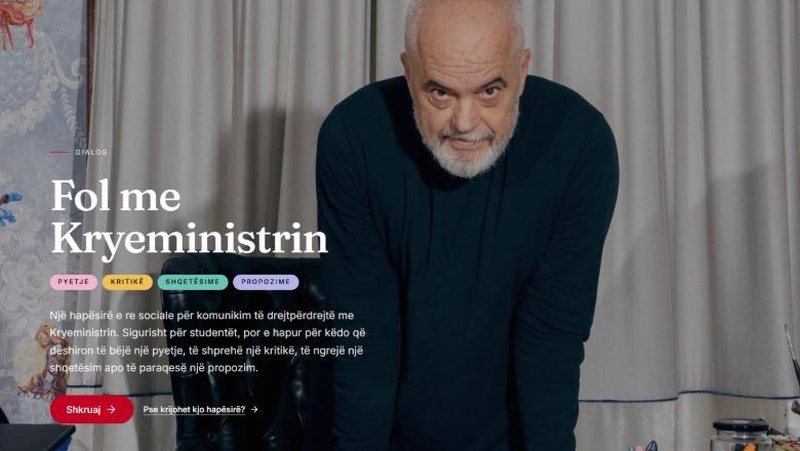
The website carries the heading Kryeministria, Zyra e Komunikimit [Prime Minister’s Office, Communication Office], the copyright of the Prime Minister’s Office of the Republic of Albania, and the footer line “Identifikimi bëhet vetëm me e-Albania” [identification only via e-Albania]. It describes itself as a new social space for direct communication with the Prime Minister, for students in the first place but open to anyone who wishes to ask a question, express a criticism, raise a concern or make a proposal, and lists those four categories: Pyetje, Kritikë, Shqetësime, Propozime. Under the heading “What can we discuss?”, it says messages may be addressed to the Prime Minister, the government or the parliamentary group of the majority, that no question is banned for its critical content, and that users need not agree with the government to take part. It lists six guarantees: respect, confidentiality, transparency, inclusion, equality and pluralism, and says the identity of a user is not made public without consent and that personal data are handled under data protection legislation. Under “What happens to my message?”, it says the message is registered and stored securely, reviewed according to its nature, that questions of general interest may receive a public answer from the Prime Minister, that individual matters are handled through private communication or the responsible institutions, and that a periodic summary of topics, answers and steps taken will be published.
The page is illustrated with photographs from the past weeks: Rama placing red chairs labelled “Dialog” before the steps of the Prime Minister’s Office, the “Dialog” card on the stone table with the building’s steps behind it, and the Prime Minister at his desk among pencils, brushes and drawings.
A letter signed Edi Rama, Kryeministër i Shqipërisë, explains why the space was created. It says every protest has a reason at its start and a wider background than its opening banner; that protest is part of democratic coexistence, protected by the state even when directed against the government, parliament or the courts; and that violence against institutions, threats and vandalism against public and private property are crimes, so rejecting violence is the other side of the right to protest. He writes that he belongs to a generation that won freedom of thought and political pluralism through peaceful protest, and that there are students today who want to speak, ask, object or propose but do not feel free to do so publicly because of continuous intimidation by those who do not want dialogue. The letter says the initiative does not aim to replace protest with a digital form, nor to make dialogue conditional on agreement, and that the identity of those who wish to communicate without publishing their names will be kept confidential. One of its lines reads: “Askush nuk duhet të zgjedhë mes së drejtës për të protestuar dhe mundësisë për t’u dëgjuar” [nobody should have to choose between the right to protest and the chance to be heard]. It closes by inviting those who wish to protest peacefully to do so without obstacle, and those who also wish to talk about what they protest to come in, with the word “bujrum”, and proposes that both sides start by agreeing they may never agree. The state news agency ATA ran the letter’s text as a news item on Sunday, including the sentence “Protesta është një trokitje në veshin e pushtetit” [protest is a knock on the ear of power].
The frequently asked questions page sets out the access rules. Participation is open to students first and then to anyone, through the individual e-Albania account; no new account is created and no data already held by the state are entered again. On data, it says: “Nga e-Albania merren vetëm emri, numri personal dhe adresa e emailit” [only the name, personal number and email address are taken from e-Albania], that they are used only for this process under data protection legislation, and that dialogues are anonymised after the retention period. No retention period is stated on the page. Messages are reviewed by the team of the Prime Minister’s Office according to their nature; a user chooses whether their name may be mentioned in a public answer, and the periodic summaries contain neither names nor individual dialogues. The footer links for “Privatësia e të dhënave” and “Moderimi” lead to sections of this same page.
Citizens.al, in a report by Arbjona Çibuku published on Saturday, examined that arrangement. It wrote that even if the identity of those who write is not made public, it becomes known to the Prime Minister’s Office, the institution the protesters are criticising; that the platform has no dedicated privacy policy and does not define who the data controller is, how long data are kept or to which institutions messages are forwarded; that Law 124/2024 on personal data protection requires citizens to be informed who processes their data, how and why, and that only data necessary for the purpose be collected; and that technically e-Albania could verify that a user is a real person without passing their personal number to the Prime Minister’s Office. Albeu made the same point in shorter form, noting that anyone wishing to enter the dialogue must log in through e-Albania, which allows the Prime Minister to identify citizens.
The student movement rejected the platform on the day it opened. The group Studentët n’protestë said there would be no dialogue with Rama and that protests would continue until his resignation: “nuk kemi për të dialoguar me një autokrat” [we are not going to dialogue with an autocrat]. Its statement added: “Nuk njohim asnjë grupim studentësh që të ketë synuar dialog me kryeministrin” [we know of no student group that has sought dialogue with the Prime Minister], and said the protest continues with the same aim, his resignation. Shteg reported that Rama made his claim about pseudo-students obstructing the meetings “pa paraqitur publikisht prova për pretendimet e tij” [without publicly presenting evidence for his claims].
Citizens.al carried reactions from inside the movement. Student protester Jesmina Sengla called the Prime Minister’s continued invitation political deafness, said it frustrated her as a protester, and said Rama had shown over the years that he knows only how to monologue; in her view his first concern is to present himself as the reasonable party open to change and the protesters as the ones refusing to communicate. The academic and activist Ervin Goci said an invitation to dialogue from the man who had ordered the beating of students amounted to the code of the strong, who beat you well and then invite you to close the matter; he said citizens had not asked for a single day of dialogue but for fair elections on equal terms, and that dialogue would come when the government regained its integrity and the people felt equal before it. He added: “Kur nuk e ke, pse të bësh sikur e ke?” [when you don’t have it, why pretend you do?]. The writer Fatos Lubonja compared the invitation to the fable of the wolf and the lamb, in which the wolf finds a justification to eat the lamb whatever the lamb says.
The platform follows a sequence of initiatives presented during the protests. Shteg recalled that in July, in the second month of protests, Rama presented the political document “Besa”, promising a relationship between government and citizens built on trust, empathy, service and commitment, and that the government later opened “Pasqyra e Flamingos”, a portal promising transparency on the documentation of the contested projects at Sazan and Zvërnec; Shteg’s own check on 3 October found that the architectural project, the environmental declaration, the investor’s environmental study and the in-depth environmental impact assessment all carried the status “pending” while institutional decisions and procedural documents were public. Citizens.al wrote that on 1 October, at a joint press conference with Commission President Ursula von der Leyen, Rama promised transparency on the Zvërnec tourism project; that the Flamingo portal opened on 3 October; and that of the 42 documents listed on it, four were only titles, while some citizens’ questions had no answer. Shteg described the movement’s origin in protests against planned interventions in the protected Vjosa-Narta area, which then grew into a broader movement against the government, and put the duration of the protests at about 160 days.
The physical invitation preceded the digital one. For several days in October Rama had chairs set out before the Prime Minister’s Office with the inscription “dialog”; protesters broke and burned them day after day, and from 26 October he left only the stone table with the “dialog” papers on it. On 27 October the stone table was again in place, again without chairs. The protesters had refused his calls for dialogue since the first day of the protests and had burned the dialogue chairs. By 6 November the concrete table had stood before the building for more than two weeks, and Rama placed letters marked “dialog” on it again that Friday morning. On Saturday he posted photographs of it and wrote that the site had “become a tourist destination”.
The protest movement changed rhythm in the same week. Studentët n’protestë announced that after more than 150 days of protest the movement would hold two national protests a week, every Wednesday and Saturday at 14:00, starting before the Ministry of Education on Saturday 7 November; the demand for Rama’s resignation remained non-negotiable. The group said it was prepared for a long battle and that the new phase was meant to build a stronger and more durable movement; the boycott of classes continued. On 5 November the groups Studentët n’Protestë and Revolucioni Studentor filed three complaints at the Constitutional Court against two normative acts and a decision of the Council of Ministers from the government’s protest package; on the 160th day of protest, Citizens.al counted 95 police fines in four days and reported detentions, violence and identification by photograph under the new rules.
On Friday the Democratic Party leader Sali Berisha called on citizens of all ages and political convictions to join Saturday’s protest, with his supporters to march to the Prime Minister’s Office and then join the students at the Ministry of Education; ATA reported that Rama was ready to consider any proposal from students and lecturers and that the government was preparing a package of measures on their concerns. On Saturday the students gathered before the Ministry of Education at about 14:00, with lecturers among those supporting them, one week after the previous Saturday’s rally at which they had refused to let PD representatives and supporters join; the opposition marched from the Prime Minister’s Office toward the ministry. The students formed a cordon to block the approach of the PD group, held up a banner reading “Rama n’burg, Berisha n’burg” [Rama in prison, Berisha in prison], shouted at them to leave, and there were physical clashes between the two groups for some minutes before the students held their ground. Police escorted one person away during the rally. It was the students’ 26th protest, and they chanted for resignation and against dictatorship. Later some protesters set fire to two rubbish bins and pushed them toward police lines and threw stones; police imposed 10 administrative measures on protesters who blocked the road. On Sunday, Berisha said those who had blocked PD deputies from the protest “Nuk ishin studentë, por njerëz të paguar” [were not students but paid people]. A group of citizens protested again before the Prime Minister’s Office on Sunday.
The launch was carried in English by Euronews Albania, Albanian Daily News and others under the title “Talk to the Prime Minister”. Albanian Daily News reported that the initiative is primarily designed for university students but open to anyone, with four categories for questions, criticism, concerns and proposals. Domestic headlines on Sunday included Boldnews’s “Studentët në rrugë, Rama në internet” [students in the street, Rama on the internet]. No public figure for the number of messages received, and no first published summary of the dialogue, were available by Sunday evening.