The EU brokered a transition framework, not a retreat. Prishtina got what it wanted — just more slowly.
by Fatos Kabashi (Prishtina)
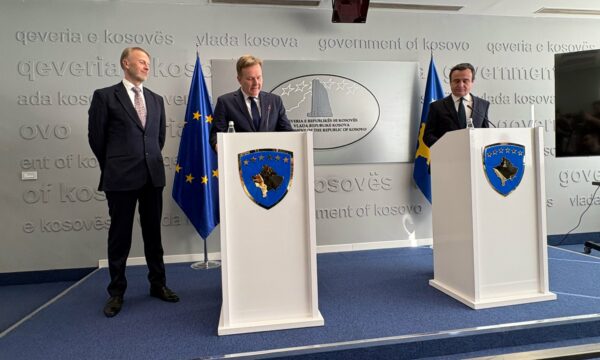
On the morning of March 14, Prime Minister Albin Kurti sat down with EU Special Representative Peter Sørensen and emerged with something that looked, at first glance, like a compromise. It was — but not in the direction the law’s critics had predicted.
For weeks, Serbian officials, sympathetic commentators, and anxious community representatives had warned that enforcement of the Law on Foreigners would trigger an immediate humanitarian rupture: hospitals closing, teachers barred from classrooms, Kosovo Serbs effectively expelled from the institutions that serve them. The law entered force this morning. The crisis did not arrive. A transition framework was announced, European ambassadors praised Prishtina’s constructive approach, and Belgrade was consulted but did not dictate the outcome.
What Was Agreed
The arrangement rests on three operational pillars. First, one-year temporary residence permits will be issued to workers and students connected to Kosovo’s parallel structures in health and education. The Ministry of Internal Affairs will receive staff lists from local leaders, which will serve as the administrative basis for permit issuance. The permits are renewable.
Second, Serbian-issued identity cards — provided they were issued no later than March 15, 2026 — will be temporarily accepted as identification documents for administrative procedures. This is the most politically sensitive element of the arrangement, and also the most carefully framed. Those documents are not being recognized as legitimate state instruments. They are being used, in Kurti’s own language, as a bridge into Kosovo’s Central Civil Status Register System, where eligible individuals will be formally registered under Kosovo law.
Third, a new three-month window has been opened for Kosovo Serbs to register civil-status facts — births, marriages, deaths — previously recorded only by what Kurti explicitly called “illegal structures.” When that window closes, Kosovo’s registry becomes the only registry that counts. Sørensen confirmed that Kurti had also committed to amending the law itself, with priority given to residence permits for workers and students for an initial twelve-month period.
The EU’s Role — and Its Limits
Brussels did not force Kosovo to abandon its law. That point deserves emphasis, because the diplomatic choreography surrounding the announcement could easily be misread.
EU Ambassador Aivo Orav described “intensive talks” with the Kosovo government over recent weeks, with agreement reached on implementation through “additional substantive measures” — the language of coordination, not capitulation. Sørensen confirmed that the EU had welcomed Kosovo’s December decision for gradual implementation, meaning Pristina had already defined the enforcement runway and Brussels was working within it. French Ambassador Olivier Guérot said it was “essential” that actions taken not negatively affect the living conditions of Kosovo’s Serb community. German Ambassador Rainer Rudolph welcomed the avoidance of disruptions to health and education services.
The reaction reached higher than the resident diplomatic corps. EU foreign policy chief Kaja Kallas called the agreement “an important step forward for the benefit of all people in Kosovo,” welcomed the continuity of public services, and announced she is “ready to host a high-level meeting soon” on the Belgrade-Pristina dialogue. Her statement also carried a quiet warning — “implementing past agreements remains vital” — a line aimed at both capitals and not without edge.
What the EU extracted from Kurti was not a rollback but a supervised lane. Sørensen’s insistence that the process proceed “in close cooperation” with him as EU Special Representative is the tell. Brussels is positioning itself not merely as mediator between Pristina and Belgrade, but as operational supervisor of the implementation timeline — and Kallas’s announcement of an imminent high-level meeting suggests the supervised lane feeds directly into a broader dialogue push. Kosovo gains legal normalization; it accepts structured EU oversight over the pace and optics of that normalization. That is a real constraint.
Incorporation, Not Retreat
The deepest significance of March 14 is not the permits or the documentary accommodation. It is the legal grammar shift those measures represent.
Once this framework operates, staff employed inside Kosovo’s parallel structures are no longer an undefined gray-zone population. They become persons whose status must be regularized under Kosovo’s foreigners law — holding Kosovo-issued permits, registered in Kosovo’s civil registry, working in institutions subject to Kosovo’s licensing requirements. The transition framework is calibrated precisely to prevent overnight disruption. But it reframes the parallel structures fundamentally.
The reclassification is quiet but durable. By requiring staff to obtain Kosovo-issued residence permits, the framework converts what had been described for years as an autonomous Serbian institutional presence into something legally different: facilities staffed by foreign workers holding permits issued by the Kosovo state. The buildings remain. The services continue. But the locus of documentary authority shifts to Prishtina. What had existed in practice as infrastructure outside Kosovo’s legal order is being absorbed — bureaucratically, permit by permit — into a legally managed presence operating under Kosovo authority.
State consolidation rarely arrives as a dramatic moment. It arrives as paperwork.
Kurti said after the meeting that the final aim of incorporation is not the reduction of rights but their strengthening. Whether Kosovo Serbs experience it that way will depend on how the administrative machinery performs over the next twelve months. The direction, however, is set.
What Could Still Go Wrong
The arrangement is workable but not self-executing. The three-month civil-status registration window is short; if extended indefinitely under political pressure, the temporary exception hardens into a permanent workaround and the sovereignty gain evaporates. The precedent question is sharper still: having intervened once to smooth the enforcement runway, Brussels will expect similar access the next time Prishtina moves against parallel structures. That is useful for managing escalation and costly for autonomous decision-making — simultaneously, and by design.
Belgrade, though not in the room, was not outside the process. Orav noted that Sørensen had been “in close contact” with the Serbian government. Serbia did not veto the outcome. But it was part of the diplomatic choreography, and it will claim a role in the next one.
Kosovo Enforced the Law. The Crisis Never Came.
The law entered force. The parallel structures did not collapse. The EU brokered a transition, Prishtina retained the law, and Belgrade did not prevail. The question is no longer whether Kosovo’s legal order applies to the parallel sector. It does. The question is whether Prishtina has the administrative capacity and political patience to see a twelve-month transition through to something durable — and whether the supervised lane Brussels has inserted itself into remains a temporary scaffold or becomes a permanent feature of how Kosovo exercises sovereignty in the north.
Those are the questions that matter now. They are harder than the ones that dominated the debate of recent weeks. They are also the ones nobody was asking.
first published in the Kosovo Dispatch