Maximilian Krah: the Western Balkans will be the heart of the new European architecture. The AfD’s rapporteur on Albania tells Albatros Rexhaj that the end of today’s European Union is “a question of maths”, five to ten years away, and that the new axis of Europe will run from Berlin to Ankara, with this region on the line. Bosnia-Herzegovina “will not stay forever”. Albania can only win, and should watch what Brussels demands of it. He is pro-Trump, sees no Russian threat, and says the European right should recalibrate about remigration.
Albatros Rexhaj (Berlin)
Albania is negotiating its entry into the European Union. The man who follows Albania for Germany’s largest opposition party does not expect that Union to exist in its present form ten years from now.
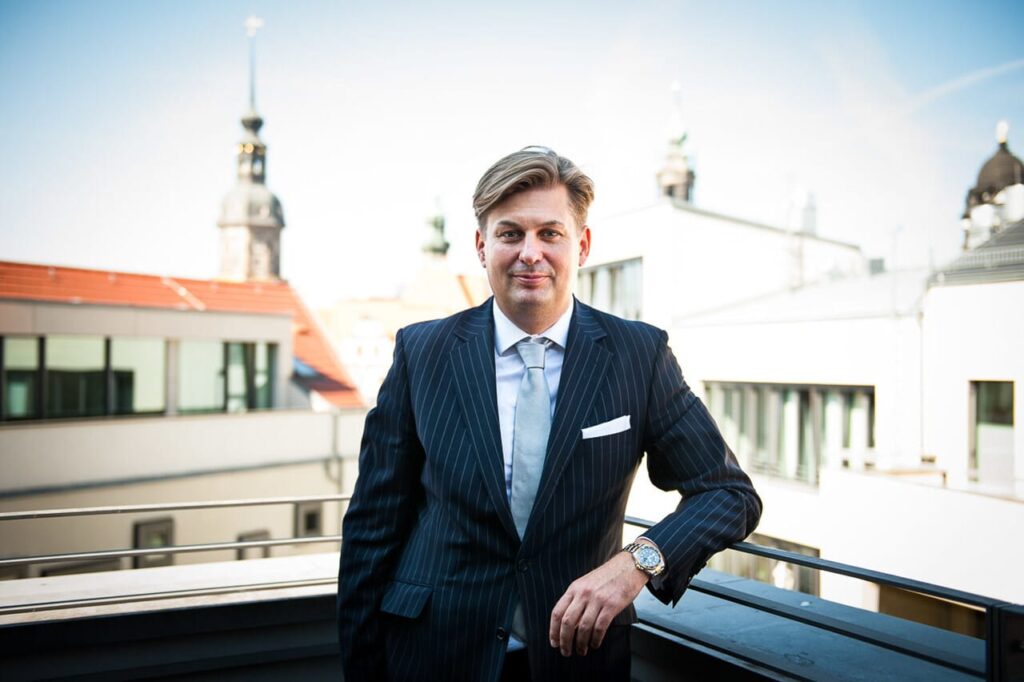
Maximilian Krah sits in the Bundestag for the Alternative für Deutschland, directly elected in Saxony in February 2025. He is a former member of the European Parliament, where he led the party’s list in the 2024 election. Today he is a member of the Committee on European Union Affairs and the AfD’s rapporteur on Albania. By his own count, his party stands at about 30 per cent in the polls.
In the Western Balkans the AfD is known mostly through what its opponents say about it. Krah spoke to Albatros Rexhaj in Berlin on 28 November. He was asked about the future of the Union, Russia, migration, secularism, and where the Western Balkans would stand in the Europe he expects.
The interview was conducted in English, edited for clarity and authorised by Mr Krah.
Rexhaj: Mr Krah, thank you for agreeing to this interview. The first question is simple. Will there be a European Union ten years from now?
Krah: There will be some kind of European community, but not the EU you see today. And it is not a matter of political will or wish. For me, it is a question of maths. If you look at the budgets in Spain and France, you see that we are heading into a deep crisis. Those countries now take on public debt to pay their pensions, to pay money for the elderly. This is not sustainable. And if you don’t have a sustainable way to finance your country, you go into a change. We will have change, and I cannot tell you in detail what kind of change it will be. But the European Union, and Europe, in ten years will politically be something different from what it is today.
Rexhaj: So what is your party’s vision of how this new Europe should look?
Krah: To be honest, we know that it is not what it is today. Even to say this in Germany is a very brave position, because the elites here are completely focused on the EU. They tell us that if the EU changes, if the EU collapses, peace will be gone from Europe. And I say no, it is a chance to have a new Europe. But we are still discovering our idea of how this new Europe will look. I will publish a book next year in which I will promote such an idea. My party has two guidelines. On the one hand, they say we need economic integration, we need free trade, we need a kind of common market and a kind of common trade policy. But when it comes to the political organisation, we are not ready in our discussions.
Rexhaj: In our part of the world, we find it hard to understand how an organisation like the European Union can survive when, in decision-making, the vote of Germany counts the same as the vote of, let’s say, Slovakia, Bulgaria or Cyprus.
Krah: Because there is an informal hierarchy of power. You are right: formally, every nation has the same voting rights. But informally, and you have seen it with Hungary, when they began to pursue a policy of their own, they got sanctions. So the smaller countries within the European Union know that they cannot run the whole thing. There is an informal structure, an informal ranking of power, in which Germany definitely has more power than Slovakia or Hungary. And from time to time the smaller countries are very upset about that. This is what happened with Viktor Orbán.
But the truth is that there is a formal structure of power and there is an informal structure of power. The European Union is not going to collapse because of the difference between the two. The European Union is going to collapse because of a lack of money and a lack of trust. The promise of the European Union is to provide peace and prosperity to every country. And if you now look around Europe, we have a war directly in front of us in Ukraine, which we are not going to end but are going to continue. So we don’t provide peace. And we don’t provide prosperity, if you compare the growth rates, the income, the wealth in the EU with, let’s say, the United States of America, or even Dubai, China, Singapore and so on. We are in a crisis, and they benefit from the technological revolution, from AI. So peace and prosperity are no longer guaranteed by the European Union. Then they have a fiscal problem. Europe has to change and will change. And what we have to think about is how our countries, Albania and Germany, can be winners of this process of change and not losers.
Rexhaj: Small countries like Albania, Serbia, North Macedonia and Montenegro are, how should I say, scared. And the AfD is used as a kind of bogeyman to keep them in line, so to say. What, in your view, is the basic misconception about what the AfD really represents?
Krah: What we really represent is this: we began as the only party in Germany that told the public that the things the establishment is telling us are not true.
Now let’s go to the Balkans. If you have such tiny countries, take Bosnia-Herzegovina, you have a tiny country in which even its people don’t want to live. This will not work forever. This is a state for a certain time and not forever. But the elites in this country, of course, want to keep their power. So they don’t like us and they make us a bogeyman. We don’t want to destroy Bosnia-Herzegovina, but we tell them: this country will not stay forever. If you are smart, think now about your alternatives. That is all I can tell them. If they believe that the European way of multilateralism, the European way of having a legal framework that allows extremely tiny countries to survive, will last forever, they are wrong. Different times will come, and they have to prepare for them now. We are not the ones who make the change, and we don’t want to take away from anyone what he loves. We just say: be smart, prepare for what is ahead.
And let’s come to Albania. I think Albania is a success story. At the end of communism, which was a very special version of communism, Albania was the poorest country in Europe. And now, when I look even here in Germany, there are so many successful Albanians. And Albania now, even in the diplomatic dimension: you are on Donald Trump’s Board of Peace. So Albania is definitely a winner of the last 20 to 30 years. We see that with Kosovo there is another Albanian country now.
Rexhaj: An Albanian-majority country.
Krah: Yes, an Albanian-majority country, but one which is Albanian by language, by majority, ethnicity and so on. And Albania is a very reliable country in Europe with a very reliable policy. So in my mind, as an AfD politician, if we see another Europe and also a changing Balkans, I think Albania can only win and not lose from it. It can become stronger, and it can be a beacon of stability and hope in the southern Balkans. For my part, I love to see the development in Albania and I would like to tighten our relations.
Rexhaj: But your colleagues in German politics tell us that the AfD is pro-Russian. What kind of “pro” are you?
Krah: First of all, like all right-wing parties, we are pro-German. And when it comes to foreign policy, of course we are pro-Trump. And you see that Trump wants to end the war in Ukraine.
Rexhaj: So you also want the war to end.
Krah: Yes, but if anybody wants to end the war in Ukraine, then under German conditions you are labelled pro-Russian. Because the official German position is to prolong the war, to spend money and to allow the Ukrainians to continue the war. And if you want to stop the war, you are labelled pro-Russian. So if Germans tell you the AfD is pro-Russian, it means nothing other than that we are pro-Kushner, pro-Witkoff, pro-Trump.
Rexhaj: But senior officials of the German government, at different levels, say even publicly that there might be a Russian attack by 2030. Is this realistic?
Krah: No. Look, the Russians even failed to get eastern Ukraine under their control. Russia is also a country that faces a lot of problems. Russia is definitely not planning to attack NATO. Russia just wants to prevent Ukraine from becoming a NATO country. Why? Because the Russians are smart and they learn from history. If Hitler or Napoleon had begun their wars against Russia on what is today the Russian-Ukrainian border, they would both have won and there would be no Russia anymore. So Russia cannot allow Ukraine to become a country that is fully part of NATO, because NATO is possibly hostile to Russia, historically. So Russia has to fight to keep Ukraine neutral, just to defend its own existence. This is the very simple version, and the Americans accept it. But the Europeans, for some crazy reason, want to fight against Russia to the last Ukrainian. And if we don’t do that, if we are not in that camp, and my party is not in that camp, then we are labelled pro-Russian.
So Russia is not a threat. Russia is now a country with a lot of problems, economic problems, demographic problems. They don’t have access to AI. They are in between China and Europe and the West. They want to restart their relations with the West, but for now they are forced into the Chinese camp. I think it is time to hold out our hand to Russia and restart our partnership with Russia.
Rexhaj: One of the problems we are seeing in Europe, and it is mirrored in our part of the world, is the deindustrialisation of our countries, our societies. The second is the lack of will among the younger generation to work. How do we solve this?
Krah: Deindustrialisation is a consequence of high energy prices. High energy prices are a consequence of the climate voodoo. If you are with the European Union, you buy the Green Deal. The Green Deal believes that you have to get poorer to save the world’s climate in 50 years, which is completely irrational. So Donald Trump is completely right. You cannot have an industry when you follow the climate narrative. But the European elites and Brussels follow the climate narrative completely. Germany has the highest energy prices of all G20 countries. When you have the highest energy prices, you cannot be competitive when it comes to producing chemical products, cars, steel and so on. So deindustrialisation is a direct consequence of high energy prices, plus the fact that we failed to invest enough in technical progress. If you go to China, you will find factories where no person is working anymore. Everything is done by robots. The robots are controlled by AI. We don’t have the robots. We don’t have the AI. We don’t have the energy. So a wrong, left-wing, climate-focused policy destroys industry. That is the first thing. We have to change it.
If Albania joins the EU, take care what they demand from you. Look at Bulgaria. The EU demanded that they switch off their nuclear power plant, which increased Bulgaria’s cost of energy and also caused poverty in Bulgaria. Don’t let them do the same with Albania.
And when it comes to the youth: sometimes you need pressure. People work when they feel the need to. We have too many youngsters who believe they can become rich by becoming an Instagram influencer. And my message is very clear. There will be Instagram influencers in the future, but only very few. And not everyone is born to become an Instagram influencer, especially as you will see AI-generated Instagram influencers too. So it is better to look for a decent job. And if you want to become rich, work. The difference between being poor, or let’s say lower middle class, and having a nice life, with nice vacations sometimes, with your own house, with real estate of your own, is work. You can work at whatever you want. But if you are not willing, when you are young, to work six days a week, to take risks, to invest in your education, you will stay poor. So it is up to you.
Rexhaj: As an outside observer, visiting and travelling around Europe, I have the impression, and I want to be blunt, that Europe is kind of lost, in the sense that your immigration policies were wrong. In the streets of Europe you find two types of immigrants. You find the immigrants who came through the 1990s and early 2000s, who came, so to say, from a cultural bedrock similar to Europe’s and have successfully integrated into German society. And then you have a wave of immigrants that started around 2013, 2014, 2015. And these are people who, we see, are either failing to integrate or refusing to integrate. What kind of future is there for Europe?
Krah: I think there is no future only if we give up. And I am not going to give up. So I have to find a way to do it. First of all, you are right: the immigration policy that Merkel, especially Merkel, pursued from 2015 on was a catastrophe. But here is the solution. The first thing, as you did, and I am very thankful that you did it because this is what I preach to my people, is that you have to distinguish between those immigrants who are valuable and those who are a problem. Because we can only solve the problem if we unite with the good ones.
The problem some right-wing parties have is that they don’t distinguish. They say: we have problems with immigrants, so we don’t like any of them. That is wrong and we need to recalibrate. Because if I tell even the good ones that I don’t like them, they will unite with the bad ones. What I have to say is: if you are a good immigrant, if you have integrated, if you create value, if you are just a good person who fits in here, we unite against the others, because they harm us both in the same way. So it is a divide-and-conquer strategy that I propose.
In that respect, what we see now on the European right is this movement of remigration, and it harms and threatens all immigrants. That is not the best strategy. We need to say: whoever is here and fits in is my partner in going after those who make problems, so that we can get them out.
And the next lesson we learn for the future is: immigration only of people who are smart and valuable, and not of just anybody. So we have to be very selfish when it comes to immigration, because we have to ask whether they benefit us, and not whether we are a benefit to them.
Rexhaj: It boils down to a simple thing, in my opinion. If you left Afghanistan, you left because you wanted to live differently. And if you come to Germany or France and want to live here as in Afghanistan, better go back.
Krah: Absolutely. The point is that it is easy to leave Afghanistan, but much more difficult to leave the Afghanistan within you at home. People have to learn that when they leave their country they cannot bring with them all the standards they learned there, because then this country changes into another Afghanistan, another Africa, another country. But most people are not smart enough to do that. So we have to send them back.
Rexhaj: So what is the political currency of your party? Is it fear, or do you have a concrete vision? And if so, what is it?
Krah: We have both. The party began by saying no. We began as a protest movement. First against taking on more and more debt to stabilise the euro currency. Then we said no to mass migration. Then we said no to the COVID measures, which imprisoned us in our homes. Then we said no to the Ukrainian war. Then we said no to deindustrialisation based on the climate voodoo. So we collected all those people who stopped believing in what the state media told us.
And now we have to transform this protest against the official narrative of German politics into a positive vision. So we are in a process of transformation, from a collection of people who realised that Germany is heading the wrong way into a party that leads the right way into the future. We are in the middle of it. So the party is very vibrant, it is changing a lot. Don’t forget, we are now at about 30 per cent in the polls, as a party that came from 10 per cent five years ago. So everything is vibrant, everything is possible.
The point is, we know that what you see today in German and European politics will not last. It will be over in five to ten years. We need an answer. And there are some guides, some directions. First, we have to tackle immigration. We have to get over the climate nonsense and deindustrialisation. We have to find a solution for the demographic decline. We have to find a solution for the dramatic changes that AI will bring. And we live in a completely different world order, one no longer focused on multilateral legal systems, but where diplomacy, war and strength come back.
Rexhaj: Secularism is the greatest achievement of European society, something that evolved out of centuries of social experience. Will Europe continue to be secular, or will it fall into the hands of religious ideas, regardless of where they come from?
Krah: Right now we don’t see any comeback of religion. We saw, when the Pope visited France, that there were millions on the streets, but they looked very peaceful and very happy. The point is, we lack children. We don’t have children anymore. And you can see that the more religious you are, the more children you have.
Rexhaj: Or, some would say, the more conservative you are.
Krah: The same. So obviously the next generation will probably be more conservative, and that means even a little more spiritual than today, which in my mind is not a bad development, because we come from a very poor, very low standard. There is of course the fear that we will see some kind of extremism. There are three possibilities. You can have evangelical extremism, but this is more something we see in America, both North and South. There is no structure, no field for it here. The Catholic Church is still in a big crisis, a spiritual crisis. I would love to see it recover a little, because in the past the Catholic Church always stabilised societies, but I would not say that extremism is knocking at our door. And when it comes to Islam, we saw a wave of extremism about 20 years ago. What I see now is that young Muslims see the opportunities they have in countries like the Emirates, or in Istanbul, that the Muslim-majority regions are developing and that people have a decent life there. And it seems to me that young Muslims are also looking for a good life, progress, wealth.
Rexhaj: And a secular society.
Krah: A secular society. There are some regions with extremists, like Yemen with the Houthis, like Afghanistan, some parts of Pakistan. There we have to take care. But when I look at young Muslims now in Turkey, in the Emirates, in Iran, in Lebanon…
Rexhaj: They share the same dreams.
Krah: Probably. So I am optimistic about them, and I think the fears we had 20 years ago no longer exist.
Rexhaj: If you read left-wing articles or the mainstream media, they say that if your party takes over, or Le Pen takes over in France, that will be the end of peace in Europe. What is your answer?
Krah: The end of peace in Europe is that we have a war in Ukraine and we give money to make it longer instead of making peace. So obviously the current elites are the ones who continue the war. We are not willing to continue the war. We want to end the war and end the killing there. So peace is definitely something people vote for us for in Germany. And if you want peace in Europe, then we are the right party in Germany for that.
I am much more concerned to see that the youngsters are now open to very old-fashioned left-wing ideas again. They see, of course, because of deindustrialisation, that it is hard for them to become rich and wealthy. And this is why they now believe in the left-wing, communist ideas of taking money away from the successful and the wealthy. We have to tell them that we will create a country in which they can become rich and wealthy by good work, and not by taking away money from others. So the left is telling lies about us. And those lies keep people from looking at the extreme danger the left poses to European wealth, because they want a new kind of communism and socialism. And we have to stand, of course, for a market economy, and for people who work hard, who have a good idea, who take risks, being able to become rich and enjoy their wealth.
Rexhaj: And the message for the Western Balkans? Can the Western Balkans be a partner to whatever new Europe emerges?
Krah: Yes, clearly. Especially in my vision, because my vision is that Europe is no longer a business between Paris, Brussels and Berlin. The new axis in Europe is between Berlin and Ankara, because Turkey, of course, is emerging strongly, and so are the Caucasus and Central Asia. And Europe itself will be more and more centred on Central Europe, which is definitely Germany and the surrounding countries. So if you now draw a line from Berlin to Turkey, what region lies along this line? It is the Western Balkans. So, welcome. My vision means that the Western Balkans become the heart of the new European architecture. This is why I am so interested in Balkan affairs, travelling a lot, and looking forward to visiting Albania soon.
Rexhaj: Thank you.
Why This Interview
If Albania ever signs an accession treaty, the Bundestag will have to vote on it. The second-largest group in that chamber belongs to the AfD, and Maximilian Krah is the member it has assigned to follow Albania. That alone is reason to ask him what he thinks.
Until now the region has known this party through what others say about it. The word used in this interview was bogeyman. Readers of Tirana Examiner are adults. They can hear a politician in his own words and decide for themselves what to make of him.
Some of what he said will be welcome in Tirana. He calls Albania a winner and a reliable country. He wants closer relations. He says that an immigrant who has integrated and creates value is a partner, and that the European right needs to recalibrate on remigration. The many Albanians who live and work in Germany have reason to keep that sentence.
Some of it will not be welcome. He says Russia is not a threat. People in Prishtina, who watch what Moscow does in Belgrade, will read that line twice. He says Bosnia-Herzegovina will not stay forever. Sarajevo should know that this is being said in Berlin, by a member of the Bundestag’s EU Affairs Committee.
That is the use of an interview. It puts a man on the record. If his party comes closer to power, Albania and its neighbours will deal with it whether they like it or not. They will be better served by knowing what it has said to them than by what they were told about it.
Tirana has placed everything on one promise, made by one generation of politicians in Brussels and Berlin. A careful country also learns who else is in the room.