The cold arithmetic of a very warm country
by Keler Marku (Washington D.C)
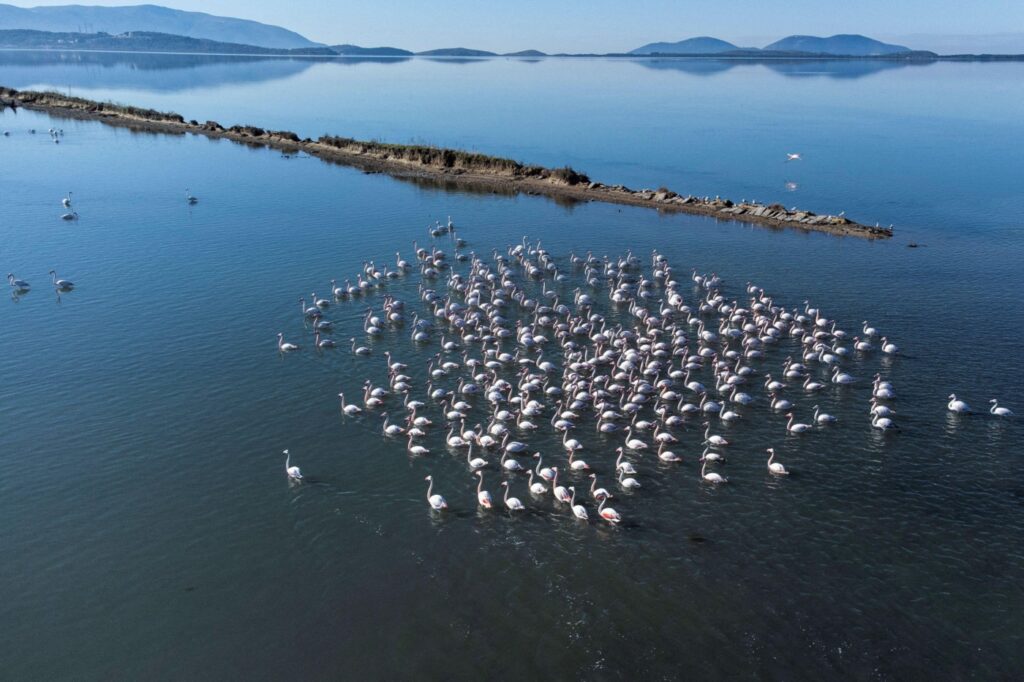
In the spring of 2026, tens of thousands of Albanians took to the streets of Tirana. They called it the Flamingo Revolution — after the flamingos of Zvërnec, a protected coastal wetland threatened by a resort project on a nearby former military island backed by the Kushner family. Their slogan was Albania is not for sale. The protest was beautiful, politically charged, and, in its central economic diagnosis, wrong. Let me explain.
Almost concurrently with the protests, SPAK — Albania’s special anti-corruption prosecution body — issued arrest warrants for a network of drug traffickers whose money had found its way into Tirana’s towers and luxury resort plans along the southern coast. The state being protested was, at the same moment, beginning to prosecute the people who had built what was being protested about. The kind of coincidence a short story writer would be warned against.
Let’s start with a man sitting in Dubai. His name is Eldi. He has a problem most Albanians would kill for: too much money. Specifically, several million euros. The cocaine arrived via container ship from Ecuador, passed through three ports, and was converted into euros somewhere between Rotterdam and Milan in a series of transactions that nobody wrote down. Now Eldi has the euros, and cannot under any circumstances deposit them in a bank. He has options. London property. Dubai towers. A shell company in the Netherlands holding a shell company in Luxembourg holding absolutely nothing of substance.
And yet, he chose Albania.
If that is not patriotism, I don’t know what is.
Eldi did not begin in Dubai. In the late 1990s he was a teenager in a northern Albanian town — the biscuit factory had closed, the teachers hadn’t been paid in months, the older boys were already crossing to Italy on boats with Kalashnikovs. He had an eye for an opportunity and no particular structural incentive to keep things legal. Another man from that same town — the one Albanians would come to call the Skifter — made approximately the same calculation. What separates them is the scale of their subsequent ambitions, and the fact that somewhere along the way Eldi married a former Miss Albania. The Skifter added another floor in Laç. Both, in their own way, built Albania.
While Albanian politicians give speeches about loving their homeland and influencers post Dhermi sunsets — Dhermi being prime real estate on the Albanian Riviera — with soulful captions about belonging, Eldi is actually putting his money where his mouth is. By revealed preference, the only kind economists take seriously, he decided Albania was worth it. He didn’t have to. He chose to. Someone should give him a medal. Or at least stop blaming him for rising apartment prices, because that part is just wrong.
Here is how it actually works. Take a developer — let’s call him Shtufi, since we’re not writing a bedtime story. A normal developer wanting to build a Tirana tower borrows from a bank at 9% interest, and that cost gets baked into every square meter he sells. Eldi’s money cannot go through a bank. It needs a destination — somewhere it can enter as construction capital and emerge as legitimate receipts. So it flows to Shtufi at below-market rates, with no credit committee, no regulatory scrutiny, no Raiffeisen interest rate. The primary goal is laundering; any return Eldi extracts is a bonus on the cleaning service. Shtufi is getting a subsidized loan no legitimate bank would offer, and that saving — the spread between cartel capital and commercial debt — gets competed into lower apartment prices. He builds more, builds faster, and the buyer on the other end pays less than they would have in a world where all construction was financed by cautious men in suits.
A first-year economics course asks students to do one thing before anything else: determine whether a given event shifts the supply curve or the demand curve, because the direction of the price effect follows automatically. Drug money entering construction is a financing event. It funds the building of apartments. Apartments are supply. More supply, holding demand constant, pushes prices down.
Albanian public discourse has failed this exercise completely.
The argument, repeated with great confidence by politicians, television commentators, and people who describe themselves as analysts, goes like this: drug money is flooding into Albanian construction, therefore apartment prices are rising. The implicit logic is that drug money is demand. It is not. The distinction is not subtle. It is the difference between a sentence and its opposite. And yet here we are, with an entire protest movement organized around the wrong variable.
There is a character from a 1909 Albanian comedy by the playwright Çajupi — a physician of such catastrophic incompetence that his diagnostic method is invariable: whatever the complaint, the treatment is amputation. Rash on the ankle? Remove the leg. Scratch on the elbow? Off with the arm. Albanians call this character Doktor Adhamudhi, and he became part of the national vocabulary for a specific type of confident, well-credentialed incompetence. Our housing analysts have mastered his technique. They have looked at a city full of empty apartments, correctly identified that something is wrong, and concluded the solution is to stop building apartments. The relationship between diagnosis and remedy has been severed entirely.
If Albanian networks have cornered British cocaine supply to the degree British tabloids insist, Eldi — our unsung hero — has, in the process, generated considerable consumer surplus for Britain’s Friday night economy. This is not a shift in demand — the British appetite for cocaine predates Eldi by several decades and requires no Albanian explanation. What Albanian networks did was move prices down an existing demand curve: the same buyers, paying less. The more precise observation, from a welfare economics standpoint, is that the constituency complaining loudest about Albanian criminals has been quietly pocketing the consumer surplus. Maybe Eldi deserves a medal in Britain as well, hand-delivered by none other than Nigel Farage.
Albania is a country of entrepreneurs, and the entrepreneurial spirit manifests at every level of the market. Another of Farage’s favorite targets — smaller in scale than Eldi, but no less resourceful — the Skifterat, named, with a poetry that only Albanians could manage, after the falcon. They are primarily from the north, with a particular concentration around Laç; their business model is elegantly simple: they go to the UK or Italy — as far as they are concerned, Brexit never happened — in October, when the clocks change and darkness arrives early, and they rob houses until March. Before departure, the Skifter goes to the Church of Laç to pray for protection and good fortune. Then, spiritually fortified, he gets in a modest, unremarkable car — the Skifter is not stupid; the Range Rover stays in Laç — and follows the darkness north toward the Italian motorway. In July he comes home and adds another floor to the family house outside Laç. He drives the custom-painted Range Rover, purchased used in Birmingham and imported already registered, its steering wheel on what Albanians consider the wrong side. His economic contribution follows the same supply-side logic as Eldi’s, just at village scale: the three-story marble villa rising from a two-room communist house increases the housing stock of rural northern Albania. He builds. Supply increases.
There is, however, one market where the Skifter has genuinely, measurably pushed prices up because it shifted demand and not supply: stadium tickets for the Albanian national football team. Fixed number of games, fixed number of seats. When the Skifterat return in July, flush with harvested gold, and the national team is playing, they come in groups and pay without negotiating. Supply is fixed. Demand increases. Prices rise. This is economics working exactly as advertised — in the one market the Skifter forgot to check before arriving with his wallet open, and inadvertently caused an inconvenience for his beloved compatriots. Everywhere else, he’s pushing the right curve.
The bewildered analyst huffs and puffs. “Drive around Tirana. Count the dark windows!” he says. “How is this not evidence that drug money has made life unaffordable in the city?”
The instinct is to blame Eldi. The supply and demand diagram says otherwise. First, Eldi is not stupid. Laundering money to keep an empty apartment makes no financial sense — he is better off keeping his cash in a vault. Laundering through construction requires sales receipts; the cycle closes at the sale. Second, even if we allow that Eldi, despite his immense expertise in intercontinental commerce, never quite recovered from the trauma of Albania’s 1997 pyramid scheme collapse, and has decided to turn his cash into concrete silence — keeping the half of the tower he financed with the lights permanently off — the other half of the tower is still a supply curve shift. His net impact: lower apartment prices. If he built the whole tower and left it entirely empty, he affected neither supply nor demand. The only way dirty money raises prices is if it buys something already built — but then the tower is not a symbol of the narco-state, Shtufi should get out of jail, and the analyst needs a new diagnosis. Maybe another meaningless slogan: Albania is not for purchase.
If there is a real villain here — villain being a generous description for someone who merely shifted a demand curve — she studied law in Bologna, did a master’s in Amsterdam, works in logistics in Munich. She saved money legally, declared her income, paid her taxes — to the wrong country, but
still. Somewhere in her mid-thirties she started thinking about Albania again: the light over the Adriatic in late afternoon, the food, the fact that a Saturday night in Tirana is more entertaining than a Saturday night in most European cities, which everyone who has experienced both knows to be
true and slightly unfair. So she came back — not permanently, or maybe permanently, depending on the year. She rented an Airbnb in Blloku — Tirana’s former Communist Party quarter, now an address that rivals SoHo, Manhattan, its Oppenheim-designed towers in sculptural concrete prettier
than anything the Financial District has produced in the last thirty years — because staying in the family apartment felt like a step backwards after the Amsterdam years. She tipped in euros, took her Italian colleagues to Dhermi, posted photographs that made Albania look, correctly, like somewhere
worth visiting. Those colleagues told their French colleagues. Travel pieces appeared. Albania: Europe’s Last Hidden Gem. Move Over Montenegro. The demand curve shifted.
The flamingo-shaped pitchforks should come for her. Not Eldi. Not the Skifter adding another floor outside Laç. She is the diaspora Albanian with clean savings, real purchasing power, and genuine demand for quality accommodation — buying apartments to live in, or listing them on Airbnb for the Italian colleagues whose curiosity she personally ignited. And here is the irony: she is among the most celebrated figures in Albanian public discourse, proof that Albania produces people of quality. She is also the single largest driver of housing costs in Tirana. Eldi built your apartment building. The diaspora vacationer priced you out of it.
A confession is owed. The author left Albania for the United States about twenty years ago, to study, teach, and pay taxes applying supply and demand curves. He returns at least once a year and stays in an Airbnb rather than the apartment he grew up in — he is, by the same arithmetic, making the same demand-side contribution. He grew up in the same Albanian world that produced the Skifterat, and found his own path — one that happened, through luck and circumstance, to fall within the law. His last trip home coincided with the Flamingo Revolution, and prompted him to write this article.
The Flamingo Revolution had already been underway for a week when, on May 30th, guards from a private security firm called Major Security assaulted a protester while police stood and watched. What had been an environmental movement became something larger: a reckoning with who owns Albanian public space and whose safety the state is actually responsible for.
The boulevard today runs under towers that arrived without announcement — no public debate, no visible capital, no credit committee anyone can point to. Built by people like Shtufi, allegedly financed by money like Eldi’s. Tens of thousands of protesters are now marching at their base, against the very forces that built them. Balzac would have recognized the boulevard immediately — not the architecture, but the people on it. He built entire novels out of exactly this: a society in transition, its contradictions walking around in public, each person the perfect embodiment of something larger than themselves. The towers do not interest Balzac. He has his notebook out for the crowd.
There is the environmental activist and progressive liberal — one person, which is important. She has been to Zvërnec, the coastal lagoon at the center of the development dispute. She has photographs of the flamingos. She knows the names of the protected wetland species and the international treaties that cover them, and she will tell you all of it. She is also the person who has been waiting her whole life for a protest that looks like this — creative, ironic, Mediterranean, Instagram-ready, proof that Albania has finally arrived somewhere culturally. She brought her LGBT friends. A protest with flamingos — the unofficial mascot of gay bars across Western Europe since roughly 1987 — seemed, self-evidently, like a safe space for all of it at once: the birds, the politics, the identity, the future she wants for her country. She is living the dream — and would also, if pressed, admit that part of the dream is being the one who finds it before everyone else does. The flamingo lagoon, the uninhabited island, the cove still blank on every travel map — those were supposed to be hers to find first, not someone swimming off a yacht, Barbie-doll pretty and already with nine million Instagram followers.
She is also watching, with growing unease, as her friend holding an LGBT flag receives stares that do not belong in the dream. This was not in the plan. The protest was supposed to be clean — one coastline, one law passed without anyone being asked. Now there are placards she didn’t design and agendas she didn’t invite, and the crowd keeps acquiring new complications. What she came for — the coastline handed quietly to the connected, the law that arrived without public debate — was right before any of this got complicated. It still is. The risk is that the protest, having found its symbol, will mistake the flamingo for the policy.
There is also the Democratic Party militant who has been waiting thirteen years for a protest of this magnitude — thirteen years during which Edi Rama has governed with the confidence of someone who controls both the government and the television frequencies. He has a Berisha poster at home (Sali Berisha, DP patriarch, the dominant opposition figure for a generation), a firm conviction that Soros is behind everything that has gone wrong with Albanian culture, and a mental board of string connecting events since at least 2013. He is here because Rama must go; he is certain of this, and less certain about most of the other things in his vicinity. Specifically the LGBT flag three rows to his left, which he is monitoring with the expression of a man watching his board acquire a new node he cannot yet place. There is also the matter of Kushner: he has been a reliable admirer of Trump since 2016, and the protest is partly against a Trump family project. Berisha himself has taken positions on the resort that have required a certain mental contortion to follow. The string is getting complicated. He has waited too long to leave. He will figure it out later. He isright that thirteen years is too long, and this is the only node on his board that does not require stringto explain. The risk is that the string leads him to Doktor Berisha — and he ends up with Doktor Adhamudhi’s prescription.
The Blloku crowd — educated, well-traveled, weekend flights to European capitals, fluent in the complaints of city living but not fluent enough in them to leave — are here too, near the front. Several of them organized the WhatsApp thread, made sure someone printed the placards. Their presence here is, without delegitimizing a word of it, the most telling evidence of progress Albania has made in thirty years: they stayed, and staying was a choice. Their frustrations are real, some more than others. They would like their children to run out of breath the way they did as children — there is nowhere in Blloku to do it, no parks worth mentioning, no open space, nowhere to exhaust a child properly. This is a legitimate complaint. It is also made by the same people who will not walk four hundred meters to the coffee shop, because walking would elevate the heart rate, which might produce a sweat drop, which would ruin the thirty-minute morning coffee ritual that follows the school drop off and precedes the two-hundred-meter drive to work — which is why they drive, and why their blood boils when a custom-painted Range Rover from Laç rudely cuts them off in traffic. Too many supply and demand shifts in their life. The equilibrium outcome: Laç, where the children would have a garden, room to run, and the commute would likely not be much longer. They live in SoHo and want Central Park moved to Tribeca — but move to Laç? Are you insane? Have you tasted the macchiato in Laç?
Somewhere near the back of the protest, squinting at a Google Maps pin that insists his accommodation is “15 minutes from city center,” is a British tourist who found a €15 Airbnb without fully registering that Bathore — the informal settlement on Tirana’s northwestern fringe — is not what the thumbnail suggested. He took a 45-minute bus to get here. He thinks the protest is beautiful. He will post about it with a caption about authenticity, and three of his colleagues will book flights. He raises Albanian Airbnb prices modestly, though primarily in Bathore, which the Bathore landlord — himself a distant cousin of a Skifter — appreciates enormously. He is considering Dhermi for the weekend. He has been quoted €80 for the taxi and is composing a stern mental review about Albanian price gouging — unaware that the driver needs sixty of those euros just for diesel, and that he is himself one of the three colleagues whose booking started all of this. He forgets about price gouging — hooked on the mesmerizing beauty of a drop-dead gorgeous lady getting ready with her placard, shifting her hips left to right, trying to get the right pose.
The influencer. She is professionally dressed for this — in the sense that her outfit, the light, and the background were considered together in advance. She left the Range Rover at home because of the traffic. The Range Rover was bought for her by her boyfriend — purchased used in Birmingham, imported with the steering wheel on the wrong side — whose precise line of work she describes, when asked, as import/export. Her post from the protest will generate more engagement than anything any economist writes today. This is correct and appropriate and also, to the economist, slightly maddening.
The man who dropped her off is sixty-three — a former PE teacher who switched to taxis when the body stopped cooperating with the morning drills. Albania is doing well, he concedes readily. Last August he drove Swedes to Dhermi. Swedes. He still finds this slightly unreal. What he talks about, as he drives, is the sea bass.
When he was younger he would pack his spearfishing kit on a Friday evening and take the old road to Dhermi before the bypass existed. The sea bass he would catch — his mouth watering at every anatomical detail of that beautiful creature, a description he has been refining for the past hour of the drive — is, it turns out, the perfect lubricant for a long one-directional dialogue that has left the Swedes mesmerized, or at least politely silent. But forget the sea bass, he says. The lobster. Oh, man. The lobster. He knew where the lobsters lived — not approximately, but precisely: a specific ledge under a specific overhang at a specific depth, where they sat in the shade and could be lifted out by hand if you entered the water without startling them. 158 meters down the coast from the former communist Dictator’s villa, exactly.
The influencer is on top of that rock now. She is wearing a bikini, smaller this year than the previous, right on par with the trend of the past decade. The lobster left, got priced out of the rock. Cruel supply and demand. Or maybe not so cruel — the taxi driver can’t decide, mentally recalling the taste of wild sea bass while indiscreetly sneaking a peek at the long legs of the sexy Swede, uncomfortably shifting positions in the backseat, in his rearview mirror. The math of his senses is getting complicated — too many curves, one hand already on the stick shift.
The boulevard, by now, had almost everyone.
One person was missing from the protest. Dallendyshe — barn swallow in English, the ultimate harbinger of spring — will turn seventy-three next week. Everyone calls her Dyshka. She is at home, watching the coverage on television, smoking a cigarette.
Her son Arjan and his wife Blerta, high school sweethearts now in their late thirties, picked up her two grandsons — five and seven — from her apartment around five in the afternoon and took them three floors up to their new apartment in the same building. They finally got a loan last autumn, after years of trying to save enough for a down payment. It is an old communist-era block, Dyshka on the second floor, Arjan and Blerta now on the fifth — close enough that the boys get dropped off in the morning and collected in the late afternoon, after Dyshka’s home-cooked lunch and the mandatory nap. There is no four-hundred-meter drive to daycare. There is a staircase.
Dyshka had considered going to the protest today. She is tired, and her recent health issues are not helping. Yesterday she kept the grandsons until nine while Arjan and Blerta were both at the march, so today she opted for the couch.
Dyshka’s husband passed away unexpectedly eight years ago, just as they were both retiring. Within that same month, Blerta and Arjan learned they were expecting. Blerta moved in with Arjan and his mother. They planned to stay six months, a year at most, while they saved for a down payment.
It took eight years.
Arjan was an assistant project manager at Shtufi’s construction company. On paper, his salary was minimum wage. His real salary was more than double that; the other half arrived in an envelope at the end of the month. Blerta’s public sector pay was fully declared but not generous. Together, their declared income was not enough for a mortgage on the apartment three floors above Dyshka, which was then selling for €75,000. The years passed. Their savings grew. Apartment prices grew faster. The same apartment is now €200,000. Last year, Arjan’s bonus was unusually large and came with a promotion — Shtufi, it seems, had access to good cash and was worried Arjan was going to emigrate to Germany. Arjan has since read the SPAK announcement that followed the Aruba summit — a meeting between men like Eldi and Shtufi where, SPAK alleges, the terms of cleaning money through construction were arranged. He has a rough idea of where that bonus came from. With the bonus, their savings, and a loan for which they finally qualified, they bought it. Seventy-five square meters, three floors above Dyshka, for €200,000. If Arjan’s salary had been fully declared from the start, they could have qualified for a mortgage on that same apartment eight years ago, when it cost €75,000. The bygones are the bygones. An apartment in Laç could have been financed even on declared wages — but the macchiato in Laç is a no-go. Arjan was lucky: in the race between supply and demand, with Dyshka’s labor and, maybe or maybe not, a small contribution from Eldi’s cleaning cycle, he crossed the line. Many of his friends who did not emigrate have not. He still needs to be at the protest, though. The park for the kids is a real issue.
Anyway, back to Dyshka. She is the kind of Albanian the communist system was, in its own distorted way, designed for: educated, cultured, with a professional title and a defined place in the social order — a teacher, an engineer, a doctor — the type whose relative standing in Albanian society has never quite recovered from 1991, when money arrived and rearranged everything. She would never say she misses communism. She would also never quite finish the sentence that begins with “but at least back then…” Her grandchildren know not to waste food. When one of them flicks an orange slice across the table, she catches his wrist. “Don’t throw that like that,” she says. “In our time, we would get one orange for New Year and suck on the peels for days just to keep
remembering the flavor.” The boys are getting a little chubby — they don’t run as much as they need to. Nowhere to run.
For years she has been the silent economic infrastructure of Arjan’s household: the daycare, the school pickups, the daily cooking — labor worth several hundred euros a month in costs the family never had to pay, but not accompanied by a pension raise. With Arjan finally upstairs and the younger grandson starting school, she is cautiously beginning to dream of something that resembles retirement. She dreams of Dhermi — the communist version, the workers’ camp, the beach utterly quiet, a handful of fishermen who knew every rock in the water, and the Dictator’s villa, near the lobster’s old home. The sea was clear because there was almost nothing else. She does not dream of the orange peel. She burns them on the stovetop after the evening clean, her old-school Febreze. Tonight one catches — a small flame she swiftly presses out with a dish cloth.
Albanians have a phrase for demanding the impossible: qiqra në hell — chickpeas on a skewer. The protest, for all its energy and genuine grievance, is organizing around several incompatible versions of Albania at once. The environmentalist wants to rediscover a coastline that was pristine precisely because most Albanians were too poor to develop it. The grandmother’s Dhermi was beautiful because the state decided who could access it; her nostalgia is real, and so is the orange peel she sucked for days after New Year because there was nothing else. The taxi driver’s lobsters lived under that rock because the Albanian economy could not yet afford to overfish it. The Blloku crowd wants a city that is affordable and spacious and central and quiet and has schools and parking and no traffic — which is to say, they want Blloku to be something Blloku cannot be. These are not ignoble dreams. They are also not policy. The Flamingo Revolution is the moment Albanians looked at what their state had been doing in their name and decided to want more. The question is whether “more” means qiqra në hell, or something that can actually be built.
The answer, I think, is closer to the latter. It can be built — but before we do that, we need to understand the economics behind it. Supply and demand. That is the first thing. The second problem is harder. Even once the economics are understood — once Eldi is exonerated of the crime of raising apartment prices, not the one SPAK is after him for — there is still the question of what we do next. Do we build the resorts as planned? Do we build something else that doesn’t scare the flamingos away? Or do we simply not touch anything and keep sucking on the orange peels? The right path forward is a highly complex exercise in balancing economic growth, ecological preservation, and the redistribution of gains from growth. It would be complex with or without Eldi. Not blaming him would be a start.
The Flamingo Revolution began as a response to Law 21/2024 — the legislation that quietly opened Albania’s protected coastal areas to development. Quietly is the important word. This was not a law that arrived with public debate or legislative drama. It was passed two years prior, and it took Ivanka Trump swimming ashore on a friend’s yacht to draw enough attention to force Albanians to look at a piece of legislation their own parliament had not surfaced for them, and find it wanting — which is, in its way, a more useful thing than any podcast episode.
The Kushner resort project began, by Ivanka’s own account, when she and her husband were vacationing on a yacht in the Adriatic and swam ashore to an uninhabited island. That island spent decades as a fortified military zone — Soviet submarines docked there until 1961, then Albanian communist troops maintained it until the regime fell, then the Albanian navy kept it closed until 2019 — military isolation so total it accidentally preserved one of the last intact Mediterranean ecosystems in the Adriatic. The Soviets left. The flamingos stayed. Ivanka swam ashore. They hiked to the top barefoot. They were captivated.
There is something in this story that is difficult to place precisely. It is not quite Marie Antoinette — nobody is being told to eat cake. It is more the mildly vertiginous experience of watching someone discover, from a friend’s yacht, a country that three million people have been living in the whole
time. Albanians are a proud people who have been through a great deal. Being found by Ivanka Trump while she was sailing the Adriatic is not quite the discovery they had in mind. And yet: the project is a supply expansion on a stretch of coast that currently has essentially none. The environmental case against it is legitimate and stands on its own. The affordability case against it is Doktor Adhamudhi at full stretch — opposing new accommodation supply in the name of keeping accommodation affordable is a sentence that does not survive being written down slowly.
One is left wishing, mostly for aesthetic reasons, that Eldi had found Albania the same way. Picture it: Eldi, somewhere in the Adriatic in late August, on a vessel that is modest but not inconspicuous. He swims ashore. He sees the flamingos. He is moved. He returns, eventually, with a construction
company and several million euros of working capital whose precise origin need not detain us. He builds. The multiplier runs. He gives an interview about his love of the Albanian coastline. For Albanians, this is better cinema than Ivanka on the hill — even if you called him Marko from Tropoja and he’d just killed Liam Neeson in Taken 5. The supply curve, as usual, does not care either way.
The protest found the right law. Whether it finds the right remedy is a different question, and here is what that remedy actually looks like.
The first thing the protest should want is transparency in how Albania makes decisions about its coastline. The law was passed without the scrutiny it deserved. The environmental concerns the protesters are raising are legitimate — the displacement of protected wildlife, the opacity around permitting, the speed with which coastal areas have been handed to politically connected developers. The EU accession process offers the most credible forcing function for fixing this: environmental assessments that cannot be signed away on a Friday afternoon, permitting processes that are public, appeals that are meaningful. This is not anti-development. It is the condition under which development becomes legitimate, and under which the grandmother’s longing for what Dhermi once was can be given the weight it deserves without turning into policy that punishes her grandchildren.
The second thing the protest should want is harder to put on a flamingo placard. Albania has already proved, with SPAK — an agency established under international pressure and deliberately insulated from political interference — that it can build a credible enforcement institution when the political will exists. SPAK did for criminal accountability what no Albanian institution had managed before it: it established that powerful people face real consequences, that the rule of law is not purely decorative. While SPAK is currently going after crimes committed abroad, we also need its analogue to police domestic markets — not for cocaine, but for proper enforcement of fair competition, consumer, and labor laws across all kinds of industries. Call it SPAK for the market: an independent competition and consumer protection authority with equivalent insulation from political interference, equivalent resources, and equivalent teeth. What SPAK is doing to narco-traffickers and corrupt officials, this authority does to the employer sliding the envelope across the desk, the sector keeping labor markets slack enough that workers have no choice but to accept it, the fuel price regulator citing Strait of Hormuz disruptions while diesel prices rise fast and fall slow. Arjan does not need a check from the state. He needs an employer who cannot pay him in an envelope without consequence. That is an enforcement problem, and Albania — for the first time in its post-communist history — has proved it can build institutions that solve enforcement problems.
The protest on the boulevard is, in a technical sense, a class action that has not yet found a courthouse. Tens of thousands of people, each with a legitimate individual claim — the employer who slid an envelope, the fuel company that blamed Hormuz while prices moved in only one direction, the developer who built without an environmental assessment, the mortgage that required a declared income nobody in Albania is fully allowed to have — arrived at the same address at the same time and decided that aggregating their grievances was the only instrument available. In a country with functioning collective enforcement mechanisms, some of these people would be in a law office. In Albania, they are on the street. The street is louder. It is also slower.
The model — private plaintiffs, aligned incentives, damages that actually sting — is over a hundred years old, at least since the Sherman Act of 1890.
Albania already has competition and consumer protection laws broadly aligned with what the EU requires. What it has, alongside those laws, is an authority the size of a small accounting firm, fining industries it monitors in amounts that do not register as a cost of doing business. This is not primarily a legislative problem. It is an institutional one — not a question of what the law says, but of whether anyone enforcing it is genuinely feared.
Albania will have to rewrite these laws for EU accession regardless. The question is whether it rewrites them understanding the economics — understanding that Arjan’s envelope, the taxi driver’s diesel, the flamingos, and the empty park where the Blloku children have nowhere to run are not separate grievances but variations on the same problem: gains that accumulated in a few hands, with no mechanism to flow back. A class action, at its most basic, is a pipe in the opposite direction. The details of how that pipe is built — whether through a public authority modeled on SPAK, a private right of action, or some combination the EU accession negotiation will eventually specify — would need several articles of their own.
What matters here is that the protest already knows the pipe is missing. It just hasn’t found the word for it yet.
Epilogue
The cacophony on the boulevard is beautiful. The policy prescriptions need some quiet time — sitting down with a pen and paper, drawing supply and demand curves, and tallying up the numbers. They do not photograph as well as a flamingo. They are harder to meme. But they are the ones that, addressed, would let Arjan get a mortgage, let the grandmother retire, and give the taxi driver back something the GDP figures never registered losing.
Somewhere in Tirana, in a bar that has not yet been discovered by the diaspora vacationers, not yet photographed for Instagram, not yet kitsch enough to attract even the most avant-garde tourists now flooding Albania, a table of men is drinking raki — the Albanian spirit, clear and unambiguous. They are somewhere in their fifties and sixties.
Then the television above the bar cuts to the news: SPAK has issued an arrest order for Eldi. One of the men looks up. He is wearing an FC Tirana shirt. His family had a house and land on what is now the most expensive street in Blloku — the communists took it, and nobody gave it back. He sets down his glass. “What is this nonsense?!” he says. “I knew Eldi. He was a flori boy.” Gold, in Albanian. A good person. “What is wrong with these Europeans? They wanted drugs in their clubs, Eldi brought it to them by the truckload. Now they get it at half price. But god forbid he brings some of that money home — for that they have to send SPAK after him. They want all the money for themselves, god forbid some of it comes here.”
The taxi driver, who has been listening, nods. “And they make a face when they pay eighty euros to Dhermi,” he says. “It costs me sixty euros in diesel. Five hours on the road. Because the Transparency Board is still blaming the Strait of Hormuz.” The Transparency Board is Albania’s official fuel price regulator, which adjusts maximum prices weekly by tracking Mediterranean oil markets. He shrugs. “Every week, Hormuz. The price goes up fast. It comes down slow. But yes, Hormuz.” He mumbles. “Transparency my ass.”
He takes a sip of raki.
“Anyway. And we want to join Europe.”
Nobody at the table has ever drawn a supply curve. All of them have independently arrived at the same geopolitical conclusion. For the ones that take an Adhamudhian approach to reading this piece: This is not a defense of drug trafficking. It is a description of what happens when a state is slow to build, and a man with cocaine money builds faster.
So far, as an antitrust economist, looking at the supply and demand curves, I can do nothing but stand with the narco-patriots.
The characters in this article are composites — each distilled from a dozen people any Albanian might recognize from the news, the neighborhood, or the family WhatsApp group. This is analytical fiction: it gets to the point faster than documented fact, in the same way that artificial intelligence gets to a draft faster than a human. Both methods involve occasional hallucination. The author’s are about Albania, which he considers a mitigating factor. This article was written with the assistance of artificial intelligence, which he considers the intellectual equivalent of the Skifter’s Range Rover from Birmingham: not entirely his, assembled on the slightly wrong side, but it got him where he needed to go. The views on this article are solely the author’s and do not represent in any way the views of his employer or anyone else.