A French judge has placed Michel Houellebecq under investigation over an interview that predicts violence. Finland’s highest court has fined a former minister for keeping a church text online. The criminal law is being asked to rule on what a man expects and what a woman believes.
By Maringlen Cara (Tirana)
The Pharisees came to Christ with a trap about taxes, and He asked for a coin. “Whose image and inscription is this?” They said Caesar’s. “Render therefore to Caesar the things that are Caesar’s; and to God, the things that are God’s.” Caesar is owed what carries his image: the coin, the road, the peace of the street. He is owed more than the fist, because some words are deeds: the threat, the order, the call to drive a man out or burn his house.
Between the mind and the deed there are steps. A man holds something true. He says what he expects. He says what he wishes. He tells others to act. Caesar’s jurisdiction begins at the last step, where a sentence tells someone to do something to someone. Everything before it carries another image.
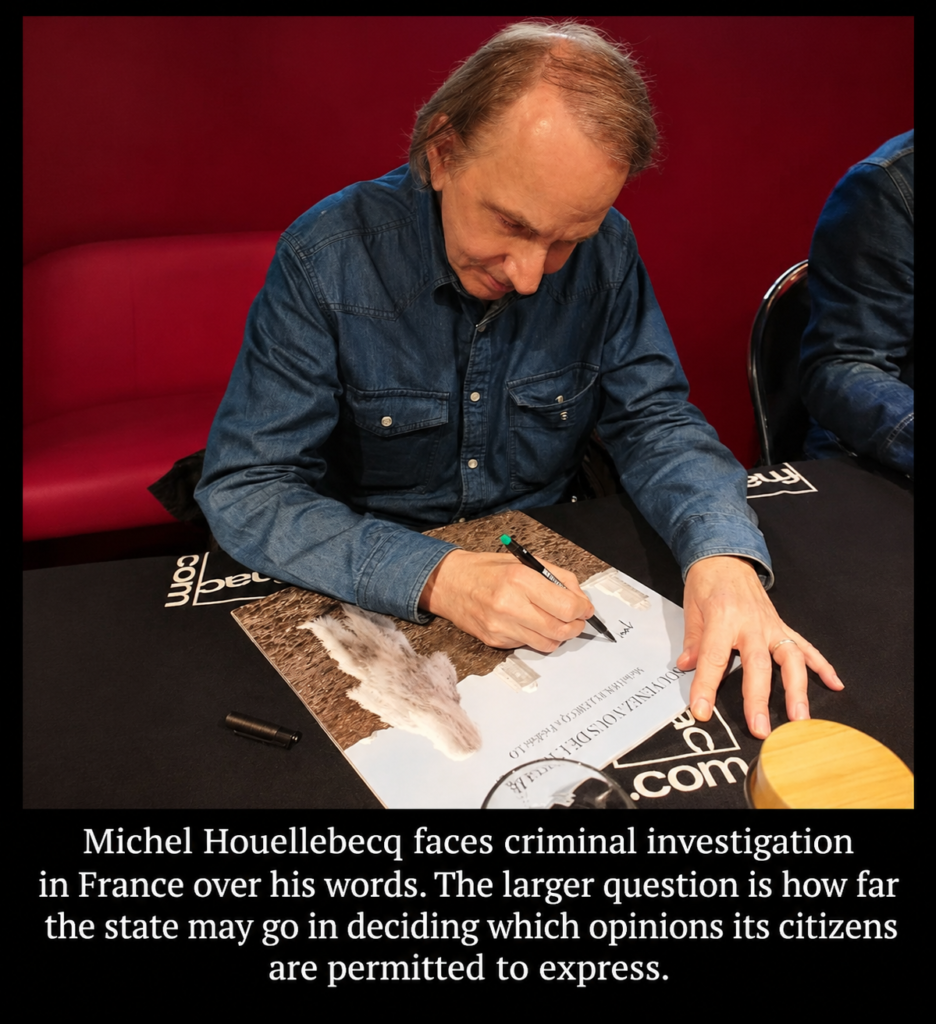
On 10 November 2026 an investigating judge in Nanterre placed Michel Houellebecq under formal investigation for complicity in incitement to discrimination, hatred or violence. The law allows a year in prison and a fine of 45,000 euros. In November 2022, in a conversation with the philosopher Michel Onfray printed in the review Front Populaire, the novelist said that once whole territories had passed under Islamist control there would be acts of resistance: shootings in mosques and in cafés where Muslims gather. He called it a Bataclan in reverse.
The verb is in the future tense. A man who says the river will flood has not opened the dam. “Resistance” is a word that leans toward the men he describes, and a reader may hold it against him. It gives them no instruction. A forecast may be false, reckless or malicious, and a court has no means of trying it except to wait. If saying that violence is coming becomes an offence, the warning is silenced together with the wish, and the state loses the one alarm that costs it nothing.
In the same interview he said that the native French do not ask Muslims to assimilate. They wish that Muslims would stop robbing and assaulting them, or else leave. That is the language of the third step, a wish, and he placed it in other mouths. The sentence wrongs several million people who rob no one. On 5 January 2023 the rector of the Grand Mosque of Paris, who had announced a complaint, sat down with the writer at a meeting arranged by the Chief Rabbi of France. Houellebecq conceded that passages were ambiguous and promised to rewrite them. The next day the Mosque dropped its planned action.
The Union of Mosques of France said the apology was not enough and filed at Nanterre that month. The anti-racism association MRAP stands beside it as civil party. Whether “or else leave” crosses from wish to order is a question Caesar may put, in open court, with the text in front of him. French press procedure puts it to no one. The investigating judge may not ask whether the words are criminal. He establishes who spoke and who printed, and the charge follows almost of itself. The interview is four years old, the apology nearly as old, and the charge is new.
In 2002 a Paris court acquitted the same writer for calling Islam the stupidest religion. An insult to a creed, the judges held, does not fall on everyone who professes it. The 2022 words are about people, and the law may treat them differently. Between the man who calls for a thing and the man who fears it, the charge makes no distinction.
No court above Nanterre is likely to restore it. On 20 December 2022 the European Court of Human Rights found no violation of free expression in France’s conviction of Éric Zemmour for remarks about Muslims made on television. The fine was 3,000 euros. The principle was worth more: the guardian of the Convention will let a national judge punish words about a community of believers.
On 26 March 2026 the Supreme Court of Finland, by three votes to two, convicted the parliamentarian and former interior minister Päivi Räsänen, together with Juhana Pohjola, who had published her text on the internet. The text was a church pamphlet on marriage and sexuality written in 2004. The offence was keeping it online years later. Two lower courts had dismissed every charge. The court found an insult to a group, and the statute required nothing more.
Insult is measured in the person who hears it. A deed is measured in the world. A law of insult makes the offended party the yardstick, and there is no belief about marriage, God or nation that offends nobody.
In England and Wales one of the two statutes on offensive communications asks whether a message was “grossly offensive”. Both reach threats and harassment as well as opinion. Figures obtained by The Times from 37 police forces show 12,183 arrests under them in 2023, against 5,502 in 2017. Sentencings went the other way, from 1,995 in 2015 to 1,119 in 2023. When arrests climb and sentences fall, the arrest is doing the punishing. Nanterre works the same way.
What these files share is the threshold. In France the second step was enough for a charge. In Finland the first was enough for a conviction. In Britain the statute sets the test at offence given. Belief and expectation are the furniture of the mind, and the criminal law has moved in.
Albania is sincere in wanting to join the European Union. The Europe it set out for was the place where a man could be wrong in print and answer for it to his readers. Whether that Europe will still be there when Albania arrives is no longer a question for Tirana.
The rule keeps no party. It shelters the imam who preaches that Europe is damned and the satirist who mocks the Mass. The Church has been insulted in print for three centuries and has buried every pamphleteer.
Christ judged the heart, and said so on the Mount. He appointed no police for it. Caesar’s officers now apply for the post.
The mind was never his to mint.
Maringlen Cara writes on religion, law and public life in Albania and the region. A Catholic and a constitutional conservative, he holds that a church which serves the state stops being a church.