The prime minister emerged from the government villa promising a housing program, a plan for food price transparency, and a complaints platform that carries the name of the protest movement against him. He called the protests a real challenge, said governance must improve, and left open the question of changes to his cabinet.
The Newsroom (Pogradec)
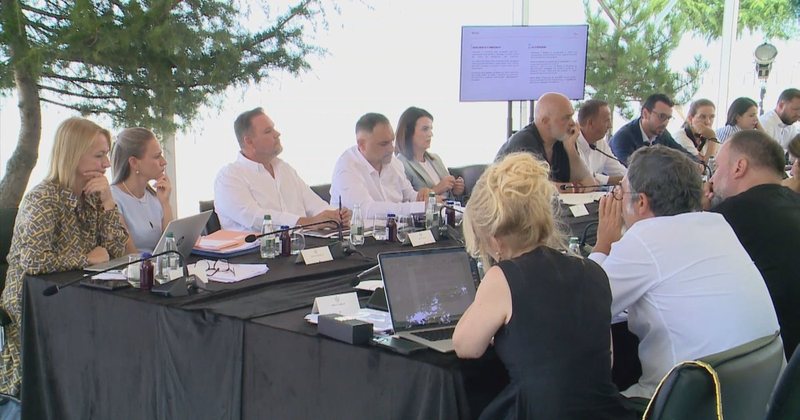
Prime Minister Edi Rama held his full cabinet in session for more than seven hours in Pogradec on Monday, in a meeting the government has framed as the opening of the second year of its fourth mandate. The meeting began at 11:00 and concluded shortly after 18:00, according to the live coverage of Shqiptarja and Report TV, whose footage showed ministers and heads of institutions leaving the government villa with files in hand and Rama exiting last.
The Pogradec retreat followed a seven-hour meeting the previous day between Rama and the political leaders of the Socialist Party’s twelve regions, and it formally closes the Socialists’ summer break. According to Shqiptarja, Rama is now expected to convene the party’s National Assembly, where the largest open question is whether he will announce changes to the government.
The platforms: Pasqyrë Albania, Flamingo Albania, Radar
At the center of the discussions, alongside two strategic documents titled Besa and Prania Besnike, was a new platform Rama himself had presented a day earlier at the meeting with political leaders and the heads of the parliamentary groups. The platform is called “Pasqyrë Albania,” and according to the coverage it will operate through two mechanisms. The first, “Flamingo Albania,” will collect citizens’ complaints. Shqiptarja described the name as inspired by the protests against Rama. The second, “Radar,” is meant to track the path of each complaint’s resolution in real time.
The government’s stated objective is that citizens’ problems receive answers within two weeks, through what it describes as better communication between the central government and its ministries on one side and the municipalities and general directorates on the other.
Speaking after the meeting, in a live transmission from his vehicle on the road back to Tirana, Rama presented the platform as more than a complaints channel. “Pasqyrë Albania will be the single platform where the citizen will turn,” he said, adding that a citizen’s request “will be conceived as a package sent by post, whose status is followed in real time.” He said the platform also covers “the whole other part, where the government goes to the citizen, where the state goes to the citizen, so as not to leave him unprepared, without arguments, before the thing that has entered our lives, the algorithm.”
Rama returned to the same figure in a second statement, saying the platform would serve so that citizens “are informed in real time” and are not left “unarmed with arguments before the algorithm.”
“Social Albania”: housing, health, education, prices
Rama told reporters the most prominent item to emerge from the meeting is a housing program, “because it comes as something entirely new,” alongside what he called a series of other programs touching several sectors. “We have set the markers for every sector,” he said. “We have concentrated on health and education. We have concentrated on creating a chain that will be the chain of Social Albania.”
In his address on social media after the meeting, Rama said the government’s focus is the construction of “Social Albania,” with priority on health, education, and the quality of citizens’ lives. “Today it is the quality of life, not survival,” he said.
He also announced a plan for transparency on the prices of basic foods. “We live in a system where we have no practice of the state setting prices,” Rama said, “but we have a plan to create transparency for the citizen regarding the prices of basic foods, which we will present when it is consolidated.”
On the party’s side, Rama said the Socialist Party will have a new approach in the territory through what he called “prania besnike,” the loyal presence, one of the two strategic documents discussed at the meeting. “We have consolidated several positions, whether regarding the citizen-state and state-citizen relationship,” he said, describing the work as intensive and as “a deepened reflection” on what began before the summer break. Of the other document he said: “Besa is now a consolidated concept at the foundation of the first position, in the state-citizen relationship. We see Besa as an acronym and not as the most precious word in the treasury of the Albanian language.”
The protests: “a real challenge”
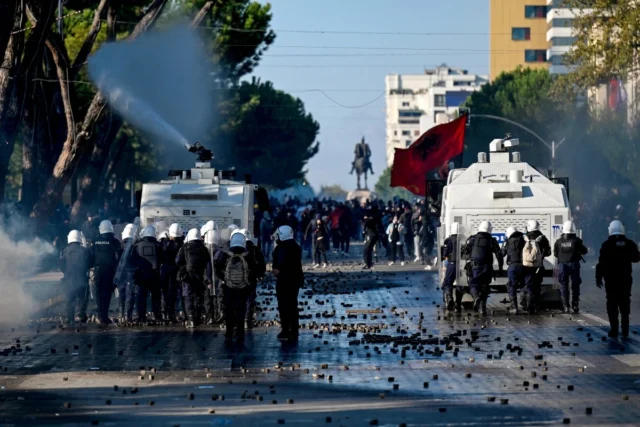
Rama devoted part of his remarks to the protests that have been held in Tirana daily for weeks. “That protest which happened has challenged us in a real way, for as long as it was civic,” he said. “There appeared people brought by the need to join their voice and to say that we deserve more.”
He linked the challenge to the state of the opposition. “We have never had an opposition that challenges us in a real way,” he said, and in that context he called what has happened “truly a gift.” He acknowledged an erosion in the relationship between citizens and the state: “I understand very well that everything that has happened in this period has eroded a bed of the citizen’s relationship with the state and with governance.” He said he remains convinced that “those who will come out stronger will be the Albanian citizens and their government,” and he attached a condition to his own side of that claim: “Governance will improve. Based on the knowledge and experience gained, with the human resources available, it must improve, because otherwise there is no reason for it to continue.”
He closed on an optimistic register. “Do not forget that Albania has never been better, never more valued internationally, and never more supported with real possibilities to do more,” he said. “Albania has not been a country for sale or a sold country, because no such country is respected internationally, increases the possibilities for its own people, and grows every day.”
The agenda
According to the agenda reported by Shqiptarja, the meeting opened at 11:00 with Rama’s remarks and continued with ministerial reports divided into sessions. From 11:00 to 14:00 the ministers of Defense, Justice, Finance, Economy and Innovation, Infrastructure and Energy, Agriculture and Rural Development, and Local Government and Public Administration presented, followed by the ministers of Tourism, Culture and Sport, of Health and Social Wellbeing, and of Education and Sport. Each minister had fifteen minutes, ten for presentation and five for discussion.
At 15:00 a session dedicated to diplomacy and foreign affairs began, with reports from the minister for Europe and Foreign Affairs, the chief negotiator for European integration, the minister of state for Public Administration and Anticorruption, and the minister of state for Relations with Parliament. The agenda then foresaw a presentation at 16:00 on problems in procurement processes for the period January to August 2026, followed by reporting on the measures of the Reform Agenda and on the progress of AIC projects. A thirty-two minute block, from 16:28 to 17:00, was dedicated to communication and promotion in the media, followed by an hour of comments and discussion and Rama’s closing remarks.
Ministers’ accounts
Interior Minister Besfort Lamallari wrote on social media that he presented the ministry’s work of recent months and what he called its non-negotiable priorities: public security, the modernization of the State Police, the fight against lawlessness, and raising the standards of service to citizens. “Besa is a precious guide and a strategic document toward the new relationship we will build with citizens and the realization of our ambitious objective for Albania 2030 in the EU,” he wrote.
Minister Ervin Demo shared images from the meeting and wrote that every policy, institution, and level of the administration must have a single measure, service to the citizen. “To listen, to reflect, and to improve continuously is the only way to answer the ever higher expectations of citizens,” he wrote.
Diella at the table
The government’s virtual minister for Artificial Intelligence, Diella, was made “present” at the meeting. Shortly before the session began, Rama shared a video of an exchange in which he tested her as Education Minister Mirela Kumbaro arrived. Asked “Kumbaro is minister of what,” Diella answered that Mirela Kumbaro Furxhi is the Minister of Education. Invited to give an opinion of her, Diella called Kumbaro “a colleague with precious experience in public service” whose experience “is a value for collegial work.”
Citizens at the gate
While the cabinet met inside, a group of elderly residents gathered outside the venue, and Rama interrupted the session to receive them. “I am 90 years old and I do not want to be left in the streets. We have great trust in Edi Rama. I have given him my vote as a family,” one of them said while waiting.
Among those received was Vasil Belba, who raised two matters. He said he came on behalf of a 90-year-old man, a former political persecutee whose grandfather was interned in Tirana in 1945, who submitted his documentation more than three years ago and has still not received the payments due to him. Belba also described his own dispute: a conflict of thirty-five years with a neighbor who, he said, has occupied part of his family’s house, with the municipality dragging the case while Korça has issued a demolition order the neighbor does not carry out. He said Rama, after seeing the documents, assured him the matter would be resolved. “Rama received us very well. I am very, very satisfied,” he told reporters. “Rama is for the whole people. He is a gentleman.”
Halim Bufi, a 70-year-old emigrant living in Greece, told reporters he traveled five hours to try to meet the prime minister. “For us refugees in Greece he has done a great deal, such as for the pensions,” he said, recounting that he was imprisoned in 1993 and released through Naim Dokle and Fatos Nano. Asked about the protests, which by his count have run for 86 days, he called them pointless.
The coverage also carried an account from the previous day’s meeting with the regional political leaders. Çelnik Shtupalli, a resident of the village of Homçan in Pogradec, said he waited about five hours to raise the matter of his village’s road, four kilometers of it, which he said leaves residents suffering in mud. He said Rama instructed the mayor to asphalt it. “I embraced him and told him: you are the best political leader in the world,” Shtupalli said.
The nose
At the end of the day, Rama addressed what he described as widespread public interest in the visible deformation of his nose. He rejected suggestions that it is connected to drug use. The mark, he said, is a sign his body will carry for life “from an attempt to erase me from the face of this earth, where I was born, grew up, and am here today,” an attempt he attributed to the power of Sali Berisha in the first years of democracy. “Even when I had nothing in my hands, I wanted a country that would stand straight,” he said. “I wanted a country that would not make its own sons lower their heads.” He added that if there is a story he might one day tell, “it is the story of the things I did not manage to do. The rest are there and will be there, it is called Heritiç, we will talk.”
Departure
Report TV footage from the end of the meeting showed the participants leaving the villa with documents in hand. Among them were ministers Enea Karakaçi and Besfort Lamallari, Chief Inspector General Dash Sula, a former Democratic Party deputy, and the director of the National Tourism Agency, Jola Hysaj, a former Democratic Party member. Rama was the last to leave.