The prime minister announces the Merit Ladder recruitment system, weekly constituency sessions from this Friday, a performance module of 100 points for Socialist MPs, and the first public release under PasqyrAlbania, covering Sazan and Zvërnec.
Tirana Examiner
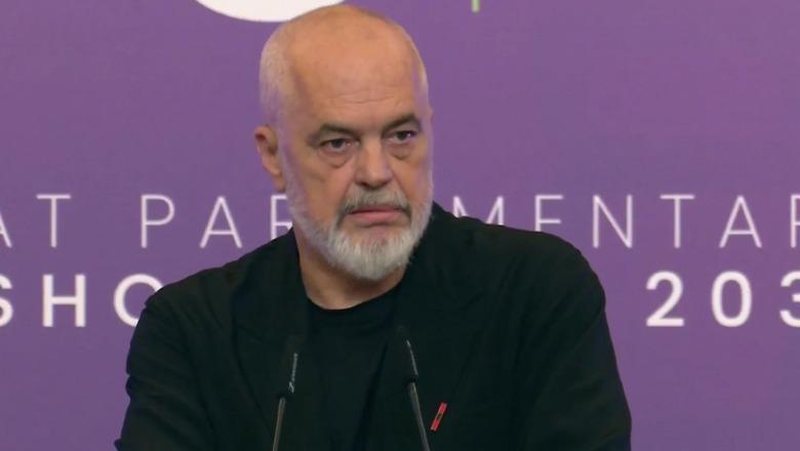
Prime Minister Edi Rama set out a broad package of changes to the relationship between citizens, public institutions and the governing majority on Thursday, announcing a merit based recruitment system for the administration, weekly meetings between citizens and their elected representatives, a performance assessment for Socialist MPs, and a proposal to criminalize political intervention in public hiring.
Speaking for around ninety minutes at an enlarged meeting of the Socialist Party parliamentary group attended by government ministers, Rama presented the measures as interconnected parts of the fourth mandate’s governing model, built around Besa, Prania Besnike (Loyal Presence) and PasqyrAlbania (Mirror Albania). He also introduced a fourth instrument for the first time, Shkalla e Meritës, the Merit Ladder, a digital route into public employment based on qualifications, professional record and examination rather than personal intervention.
The first Prania Besnike sessions take place across Albania on Friday, 4 September, at 17:00 and are to continue every Friday. PasqyrAlbania is expected to make its first public showing within weeks by publishing the documentation on the proposed investments at Sazan and the Zvërnec area.
The address completes a sequence that began with the presentation of Prania Besnike to party directors on 30 July and continued with the seven hour cabinet retreat at Pogradec on 24 August, where PasqyrAlbania was first laid out in detail. This account draws on the Shqiptarja live blog of the speech (published 07:12, updated 13:21). Quotations are working translations from that transcription and should be checked against the video record before publication.
Three wounds
Rama opened by naming three problems which, he said, feed one another in the citizen’s relationship with the Albanian state.
“One wound is the wound of the labyrinth state: the citizen does not know when and who is supposed to answer him. Wound two is the absence of institutional memory. Things are promised, discussed, decided, but no ledger of accounts is kept for what was done, for what was not done, for what was delayed or for what changed along the way. Institutional memory is not the institution’s protocol. It is far more than that. Its absence costs the state and the citizen many times more than can be imagined. The third is the wound of the door that cannot be seen, which you see and can touch in the feeling, very often justified, of every person in Albania that for a service, for a job, connection counts more than merit and luck counts more than the law.”
He presented Besa, Prania Besnike, PasqyrAlbania and the Merit Ladder as “an inseparable part of the effort to answer these questions.”
The package, he said, should not become another communications campaign or another government application. Albanians “do not need another application added to the digital jungle,” and the party “does not need another calendar that produces propaganda material.” The gap between the majority and “the people of Reborn Albania,” in his phrase, “is not filled with a word however big, like Besa,” nor “simply and only with a communication campaign.” He described the four instruments and the new communication system of state and party as “components of a necessary reform of the citizen–state relationship,” one that “reconceives four key points: how the state sees the problem, how the governing majority listens to the person, how the given word is kept by law and custom, how the door of public service opens to merit.”
Criminal penalties proposed for job intercession
The most immediate legislative proposal concerned political intervention in public employment. Rama told Socialist MPs that he intends to propose making an MP’s intervention to secure a job in the administration for another person a criminal offence, and that he will ask the Socialist group itself to vote it through.
“I will propose that every intervention by an MP to get someone into a job be called a criminal offence. I will look every one of you in the eye and ask you to vote for it. Every message sent, ‘put this one in,’ ‘look at that one,’ to be considered a criminal offence. An MP who does this is not worthy of representing all those others who have no access, who are not part of his circle of cronies or friends of his children. A criminal offence.”
He linked the proposal to a broader change in the civil service, under which professional rank would belong to the employee rather than to the position held or the government of the day: “Rank should become the professional property of the person, not the property of the post he holds today or of the government that comes tomorrow.” He told the group that the public administration survey contains a finding that “should stay with all of you today,” a reference to the perceived weight of connections over merit that he had placed among the three wounds.
The proposal has not yet been tabled as legislation. Rama said he would bring it to parliament and ask his own majority to approve it.
The Merit Ladder
Alongside the proposed criminal law change, Rama announced the Merit Ladder, a recruitment mechanism to operate inside PasqyrAlbania. Anyone seeking a post in the administration would register a personal “merit passport” containing education, experience, portfolio, skills and results, and would then compete through a digital examination in which the applicant appears to the system as a code rather than a name.
“The Merit Ladder will open a door that will always stay open, again through PasqyrAlbania, where the citizen who wants to, the young person who wants to, in Tirana, in Albania or in Australia, always a citizen of the Republic of Albania, although it is time to open it to EU citizens as well, presents himself and registers with a merit passport of his own: ‘My education, my experience, my portfolio is this, these are my skills and my results. Whenever there is an open post that may be in my interest, notify me.'”
“The exam is digital. You do not need to know anyone, you do not need to come in,” he continued. “The exam is not just a screen, it is a system. The question bank is handled by the system, the evaluators are completely blind, those who enter the Merit Ladder are for the Mirror only a code, not a name. On the basis of the passport, the code receives the signal and enters the competition. The decision at the end is certified by the relevant commission, but it becomes very difficult to overturn.”
At this point Rama noticed one of those present laughing and addressed him directly. “Someone is laughing over there, but bad times have come, my dear, there is nothing you can do. Whoever thinks he will push it the way he has pushed it will eat it in the end.” A second rendering of the same passage carried by the outlet runs: “Whoever thinks he will push it as far as he can will get pushed himself and in the end will pray to God when he hits bottom. It is not pushed this way any more.”
Weekly citizen sessions begin Friday
Prania Besnike moves from planning to implementation this week. All MPs and government representatives covered by the initiative are expected to be in their assigned areas every Friday at 17:00, beginning 4 September, at a place announced in advance through a published calendar.
“Prania Besnike sets a simple rule: the citizen must know where and when he can find his representative, with a calendar published beforehand. And this Friday at 17:00 is the beginning of a process of Presence across the whole territory of the republic. It will not stop on a single Friday.”
Rama described the format as a queue rather than a meeting.
“Prania Besnike is not a meeting. Prania Besnike is listening in turn, face to face, one by one, in a low voice. Whoever wants to tell his trouble comes at that hour, to that place, and waits for the moment when he will sit at the table across from his representatives, who will take note of what that servant of God is saying, with respect.”
No cameras are permitted. A photograph may be taken at the start of a session only with the consent of those present and without showing their faces. Party affiliation is irrelevant to who may attend: “If you want our ears, our ears are there at 17:00 on Friday.”
The remaining rules are designed to stop the sessions from becoming an alternative patronage channel. MPs are not to hand out phone numbers or offer hope of help outside the rules, and they are not to telephone directors on anyone’s behalf. “Prania Besnike requires that MPs no longer call any director on the phone, but send the citizen’s trouble in writing to its institutional destination. It must discipline the institutions, not turn MPs into brokers of people’s troubles.”
He set out what the sessions are not for: “One does not go to say how beautifully the government is working, but where it is failing. One does not go to show how much incomes have risen, or to collect votes, nor to give people jobs, nor to recruit the next patronage lists, but to take the trouble and refer it to the institutions. And one undertakes to follow the trouble’s path.”
Success, he said, will come when citizens need the sessions less and less “because the system will answer by itself and politics will be an antenna and not a parallel channel.” Subject specific secretariats are to be established to process the issues raised.
MPs to be measured on 100 points
The sessions come with a performance measure. Rama told the group that Prania Besnike “is a computer that keeps notes,” and that the group must adopt a module scoring each MP out of 100 points, split between what he called the two worlds the majority now inhabits.
“We live between two worlds, the everlasting world of the old reality and the world of mirrors. If you look at the balance at the end of the day of the hours spent in front of your mirror, that is what dominates. We spend ever more time in mirrors, and ever more we perceive the other reality through the contexts the mirrors create for us. In this world of mirrors, a governing majority’s loss of contact with people is a fatal model.”
The module, he said, is “not a ritual of punishment or of taking measures” but “the discipline of the fourth mandate, so as not to be kicked out of the history of this mandate.” It ties together parliamentary work, presence in the territory, the quality of listening and of answering what is heard, work with party structures, evaluation by people, and a map on which “today’s Finiq or Konispol must become the Socialist Party of Albania there too.” The group’s main battle, he said, is “the battle with excuses.”
The majority’s problem, in his account, was never a shortage of meetings. “We have been so many times everywhere on the map of Albania for meetings, more than anyone else, and it would take others years to add up all the meetings they hold to reach a mass of meetings close to what we hold in the arc of a year. We have been absent at the point of the person’s trouble; we have been at every point of the map. Distance from the citizen is not measured by the kilometres you travel to get there, but by how open your ears are when the citizen speaks.”
PasqyrAlbania as a “constitutional contract”
Rama devoted a substantial part of the address to PasqyrAlbania, describing it as “a constitutional contract of the citizen with the state.” Its basic unit is the public card, the kartela publike, and its content is limited to what the three powers are actually doing.
“The Mirror has no propaganda text, no statement of what it will do; it has only what the government, the parliament, the judicial power are doing today. The public card meets a few very simple criteria: what is the work being done, in whose interest is it, which institution is following it, where are the documents, the status, what is the proof?”
The purpose, he said, is to move the citizen from potential victim of information to overseer of the state. “A citizen today cannot be blamed for falling prey to disinformation about public affairs, because he has no way of referring directly to the site, the relevant service. PasqyrAlbania will be the place where the citizen can refer by himself to everything being done with his taxes. If a media portal tells him that the road collapsed because the base was excavated beyond what was required and a crime was committed, the citizen cannot be blamed for this, nor can he be expected to change his mind because the institution or the government issues a communiqué or holds a press conference. The citizen must be able to find, with documents, with minutes, what really happened and what is happening.” In the Mirror, “the whole factual, documentary base, the figure, the proof, the minutes, the expert opinion, the reasons for delay and all the persons responsible for what is not working are under the light of the sun.”
He set the standard by which the platform is to be judged.
“A state that does not remember what it said yesterday cannot ask for trust today. PasqyrAlbania is not a mirror where the government, or all three powers if they enter the Mirror, appear beautiful before the citizen. It is a mirror where the citizen sees the government as it is. A government that does not look beautiful to the citizen in the mirror must face the test of its own capacity and the challenge of improving its appearance, not the mirror.”
“If the mirror is used against the government, it works. The government must not quarrel with the mirror; it must deal with itself. If it is not able to deal with itself, it must step aside. Otherwise it is not a mirror but a billboard of government advertising.”
Transparency alone, he added, is insufficient: “Transparency demands responsibility, and without responsibility transparency is a chronicle.” That is why, in his framing, the reason of the mirror is incomplete without the reason of Besa, which he defined as an acronym as much as the Albanian word for the given word: besim, empati, shërbim, angazhim, meaning trust, empathy, service and commitment.
Existing platforms folded in
Rama rejected the reading that PasqyrAlbania was created because the co governance platform had failed. “The co governance platform has not failed,” he said; it becomes part of the Mirror, and what the platform has done to date the Mirror will guarantee. e-Albania is to be a constituent part of the new architecture. Personal files, individual documents and a citizen’s own correspondence about services or problems remain protected there, handled “with dignity and confidentiality.” The change, he said, is that “the individual problem no longer remains an orphan in the impenetrable fog of the digital jungle.”
The platform is to publish in real time where a service is stuck for any Albanian and how long the answer will take. Citizens and small businesses are to be kept in continuous contact with every change to Albania’s legislative and regulatory corpus, with notification by WhatsApp message, on the citizen’s own instruction only. “It does not use the collected data to send a notice, but only if the individual tells the state, I want you to notify me as soon as it comes out, I do not want to find out after a year, I do not want to hear it from media intermediaries or be misinformed by media mirrors, I want you to give me information in real time.” Fire risk alerts were his example of the real time function.
At Pogradec the platform’s complaint mechanism was given a two week target for resolution.
Parliament and judiciary invited
Rama said PasqyrAlbania is being built around the executive but invited the other two constitutional powers to join, while leaving the choice to them.
“PasqyrAlbania is a new space where, thanks to technology and the extraordinary possibility that AI gives us at this stage of our development, the entire public being of the state can coexist with the full right of every citizen to control his own state, to question the state and to seek support from the state. It will be a space where the government will be entirely there, but of course it would be good if the two other powers, the legislative and the judicial, were in PasqyrAlbania too. That is their decision.”
First test: Sazan and Zvërnec
The platform’s first public showing, in a matter of weeks, will be a section called Flamingo Mirror (Pasqyra e Flamingos), and its first subject will be the investments at Sazan and Zvërnec.
“Very soon, a matter of weeks, the first showing of the Mirror, because it is a considerable job to build this whole new architecture, will be one component, Flamingo Mirror, where every possible aspect connected to a matter of particular importance will be exposed from A to Zh, and in the concrete case the subject of Sazan, of Nartë Pishporo, not Nartë Vjosë, there is none, that is fake news, will all be exposed with the relevant documents, the data from the minutes, the status of the negotiations, the legal references for every point raised as a problem, and then it will be enriched step by step.”
The same treatment is to be applied to other matters of particular importance as they arise.
Radar
A further component is Radar, a digital instrument for detecting signals in the online sphere. Rama separated detection from judgment: “The Radar distinguishes the signal, just as it creates the capacity to see the dynamics in different territories, but the human being judges, no question, Besa reacts. The Radar follows dynamics, follows the movement of issues in the sphere of public interest.”
He described the need in terms of the pressure that circulates online. “We cannot be an elephant led by the nose by all the digital world of virtual mirrors that impose fines on business, on you, because nobody has a chance of fining me, but fines on you in the form of pressure. That is why we must have mastery in this world, to separate the citizen and the concern for which we answer from the fine, from the fake news, from the milk that makes the girls who drink it barren, from the bread that whoever eats it has children born with white eyes, or from the medicine that turns whoever takes it from male to female and back. We cannot be prey to all this hysteria in which you no longer know who is behind it, what it is telling you and what to believe.”
KLGJ and KLP pay, and the civil service
Rama returned to the salary increases the High Judicial Council (KLGJ) and the High Prosecutorial Council (KLP) awarded themselves, which the government has since blocked, and drew the contrast with the special justice bodies and with the wider administration.
“Pay is insufficient for everyone. When the KLGJ and the KLP find their pay insufficient, imagine the administration. The KLP and the KLGJ are the face of the failure of the justice reform, if SPAK and the Special Court are the face of its success, and when the KLP and the KLGJ, which are the failure and govern the judiciary less, find insufficient a pay several times higher than ours here, imagine what the administration employee may say.”
He named the absence of sanction for poor performance as a second problem alongside pay. He set it against a record he asked the group to note: public administration employees “are in their great majority among the cleanest people in the republic,” and one thousand of them “have excelled in representing the Republic of Albania in Brussels in the most challenging process for any state that wants to enter the EU, the screening process.”
“The party does not make the state”
Rama closed the institutional part of the address with what he called the non negotiable line for all four instruments, tying it to the credibility of Besa itself: “if we want Besa not to remain the big word robbed of content, if we want the Mirror to work not as the Socialist Party’s last show in the public space, but for all of this to give a new strength to our majority.”
“The non negotiable line for all of these is that the party does not make the state, the MP does not broker the favour, and the party chairman is not an employment counter.”
The four mechanisms are meant to operate around that division: PasqyrAlbania as the public information and tracking system, Prania Besnike as the fixed point of contact with citizens, Besa as the governing framework, the Merit Ladder as the route into public employment.
The first deadline comes immediately. At 17:00 on Friday, Socialist MPs and government representatives are expected to open the first Prania Besnike sessions across the country.