The prime minister defends the coastal development program, rejects claims of public land privatization, and rules out resignation as protests enter their second month.
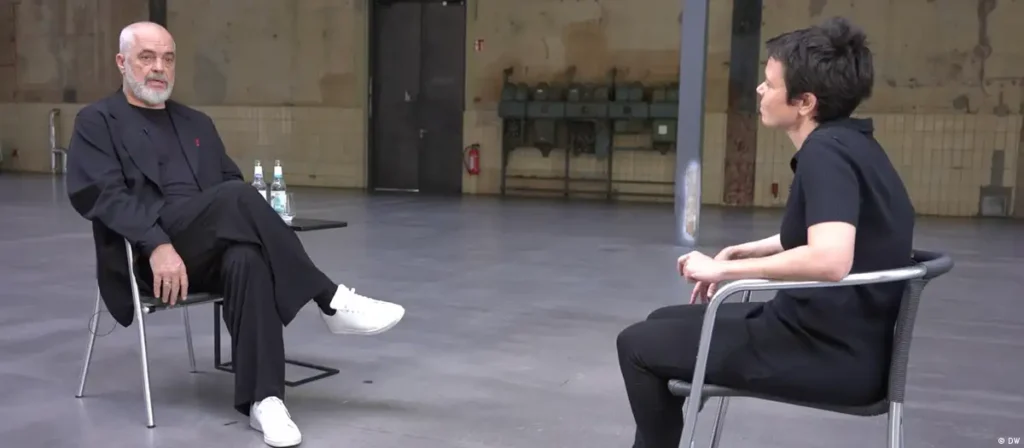
Speaking to Deutsche Welle on the margins of an artificial intelligence summit in Bochum, Prime Minister Edi Rama delivered his most extended foreign press engagement since the protest movement began. Pressed by DW’s Kate Laycock on the luxury tourism developments linked to Jared Kushner, the 2024 amendments to environmental legislation, and the demonstrators’ charge that major coastal decisions were taken without public consultation, Rama held to a single line of defense: accusations require evidence, and none has been produced. He called the claim of public space privatization “a lie,” challenged the interviewer to document it, and declined to discuss any project by name, saying the development will be debated when it is ready.
On the protests themselves, Rama offered a double framing that will be read closely in Tirana and Brussels alike. The daily demonstrations, he said, are proof of Albanian democracy rather than a symptom of its failure, a “beautiful example” on a boulevard where, within living political memory, protesters were shot. At the same time he closed the door on resignation, invoking the mandate of 868 thousand voters and the mission of concluding EU accession negotiations, and told citizens demanding the government’s departure over healthcare or emigration that the remedy is the ballot box, not the street.
The interview also captures Rama the theorist of the information age, warning that “freedom of reach is not freedom of speech” and that algorithmic amplification of falsehood may prove democracy’s undoing. Readers may judge for themselves how that argument sits alongside his dismissal of the protesters’ grievances as products of manipulation and amplification.
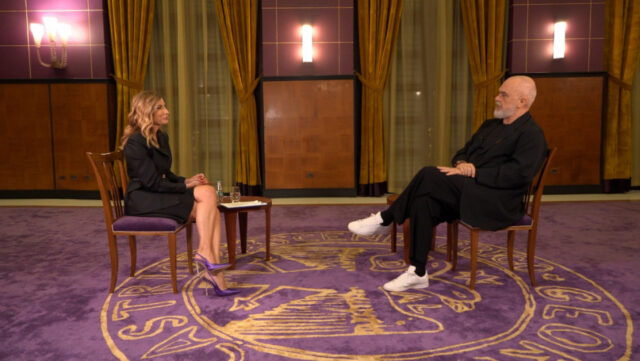
The Tirana Examiner republishes the interview in full, translated from the Albanian original published by DW on July 2. The interview was conducted by Kate Laycock and Elona Elezi.
DW: Prime Minister Edi Rama, we are here at the Jahrhunderthalle and I just heard you deliver a keynote speech in which you spoke about Artificial Intelligence and democracy, power and governance. Albania is expecting a major influx of money. We are talking about 4 billion euros coming from tourism developments along the coastline. I think my opening question is what role Artificial Intelligence will play in overseeing this money.
Edi Rama: I see no connection between the two, but what I can say is that through Artificial Intelligence we can give ourselves more knowledge every day and can benefit from assistance that is absolutely unimaginable in its capacity to inform us, in its capacity to advise us. So that is where everything is heading.
DW: What about the question of trust? You spoke about the architecture of power. At the moment, in Albania, there is a breakdown of trust in that “architecture.” Demonstrators are speaking about the absence of consultation and democratic oversight, the absence of public consultation and scrutiny. How will you assure them that this will happen?
Edi Rama: Trust has not broken down in Albania. In Albania there exists a beautiful example of freedom, of democracy in action, of a boulevard that belongs to people from all walks of life who have their own point of view, who want their voice to be heard. So this is a credit to Albania, and it is not a problem for Albania. It is an excellent example of how far we have come, remembering that on that same boulevard, not a century ago but within our own political lifetime, people were killed while protesting. So I would say this is a beautiful example that Albania is showing the world, and a very unique example for our region.
DW: I would very much like to talk to you about beauty, because as an artist you understand the importance of beauty and you understand how the public transformation of space can change how a nation feels about itself. If Albania’s future looks like a Trump-Kushner luxury resort, what does that say about the Albania you are creating?
Edi Rama: First of all, people can lecture me on many things, on the economy, on legal matters, on agriculture, on healthcare, but there is one thing on which nobody can lecture me, and that is beauty. And not because I am an artist, but because I have served as Minister of Culture, I have served as mayor, and I am serving as prime minister basing my entire thinking precisely on beauty. And the transformation of public space and the transformation of urban spaces has been part of my journey. And if Albania today is welcoming 12 million tourists, it is thanks to that effort. So beauty is something I believe in, something I fight for. Now, you bring names into this because you are prejudiced. I am not able to answer…
DW: Is that…?
Edi Rama: No, no, let me finish. I am not able to answer because you mention names. “What might a project by Trump and Kushner look like?” What kind of question is that? How can one answer it? I am not naming any project. The project is being developed, and when it is ready, then we will discuss the project. We will not discuss people, personalities, and ideological battles with people. Those are your battles. You are free to fight them, but they are not my battle. My battle is to bring foreign direct investment to Albania. My battle is to encourage developments that will be absolutely, not merely excellent for Albania, but a gift to Europe.
DW: Is the privatization of public space a price you are prepared to pay for this transformation?
Edi Rama: That is another lie that is being repeated often and has become a “fact,” which you are now using to construct a question, because there is no privatization of public space. Simple! There is none! It is a lie.
DW: Can you guarantee that everyone will have access…
Edi Rama: It is not a matter of me guaranteeing it. We live in a civilization which, since Roman times, made a very simple decision: whoever makes accusations must provide evidence. You are a journalist, are you not? And you are here to inform your audience. And your question is based on a lie. And you ask me for “guarantees,” when you should be showing me where the privatization is, where there is any piece of evidence you have found that worries you that there will be privatization of public land. There will not be! It has never happened and it will never happen.
DW: In 2024, Albania’s environmental protection laws were amended with the aim of clearing the way for luxury hotel tourism. And that is something that has worried people in Albania, alongside their concerns about the lack of public consultation. What is your response to those concerns?
Edi Rama: I think that, again, the facts are very important. But again, the facts are set aside. Because yes, we made changes to the law. But do you know what? We did not change the substance of the law, and our changes are not in violation of European standards and criteria, which we will make sure are verified through a process connected to our negotiations. So again, prejudices are not arguments and insinuations are not facts. And facts are the only thing I have. If you have facts to challenge my facts, please bring them to me. But if you have prejudices, and if you have ideological battles to fight with Trump, and if you have other things in mind, you are free to have them, but I cannot help you with my answers.
DW: In your speech you talked about digital anger. You coined the word “angerithm.” And you also spoke about your government’s very positive experience with the use of AI, including bringing into office a minister who is herself an AI algorithm. If we are in a situation where we have good algorithmic use and what you called bad algorithmic use, or even dangerous algorithmic use, where does that lead us? Does it lead us to a situation of government control of algorithms?
Edi Rama: There is no such thing as good algorithmic use, because the algorithm does not like the boring truth. The algorithm likes entertaining lies. The algorithm does not like nuance. The algorithm likes scandal. The algorithm does not like peace and love. The algorithm likes anger and fear. Because it is human nature that is drawn most strongly to all of these. And it is not my job to say how this can be solved in a democratic society like Europe. But I think Europe and the democratic world are making a mistake that may one day be the cause of democracy’s end, which is accepting freedom of reach as an extension of freedom of speech. Freedom of reach is not freedom of speech. Freedom of reach is what dictatorships had as their deadliest weapon against freedom. To enter the brain and plant their truth there, suppressing every other truth. The algorithm does not need to suppress with secret police or controlled judges. The algorithm suppresses through drowning out and through amplification. By amplifying lies, by drowning out the truth. Every study says that what is rewarded on social media is lies. What is accepted least is the truth.
DW: Mr. Rama, the protests in Albania have entered their second month. In the early days you said that for the first time in all these years of governing, you had considered, had thought about, resignation. A few days ago you said this is not an option, since you have been given a mandate by the Albanian people to bring Albania into the European Union. These are two opposite versions. After a month of protests, what is your position?
Edi Rama: They are not two opposite versions. I shared my opinions within the parliamentary group and expressed a feeling connected to the fact that I was elected and remain in office to get things done, not to be dragged along. And meanwhile, resignation has not been, is not, and will not be an option, for a very simple reason: because I have been mandated, together with the Socialist Party, by 868 thousand Albanians to fulfill the mission of closing the negotiations for membership in the European Union. And this is a historic mission that cannot be abandoned midway for any reason. And even less so because a portion of citizens choose to protest. On the other hand, protest is something extraordinarily meaningful for Albania, for the level of freedom, for the level of democracy, and for the fact that in Albania people protest. People from all walks of life come out, they have their own reasons for coming out, we have the duty to listen to them, we have the duty to read every message they send us, and that is what we are doing.
DW: If Edi Rama were not wearing the prime minister’s mantle, would he have gone out to protest for better hospitals, for the brain drain that has continued for years, for a system, for a better administration, which you accused a few days ago, which you blamed, let us say, as responsible?
Edi Rama: I have no reason to think I would be out there if I based myself on the facts and on true information. If I based myself on all kinds of manipulations, lies, and amplifications, of course I would be out there too. But the facts and the true information are different. Then healthcare, education, and all the rest have the problems they have. The problems were not born the day the protest began; the problems have been there, they have been set on the path to resolution, they have been partially resolved. And to carry their resolution forward we received the mandate of the Albanian people with the largest majority ever since I have led the Socialist Party. So you cannot simply wake up one fine day and say “I want better healthcare and this government must go.” That is not how it works. You have to wait until the next elections come.