Tirana Examiner Newsroom
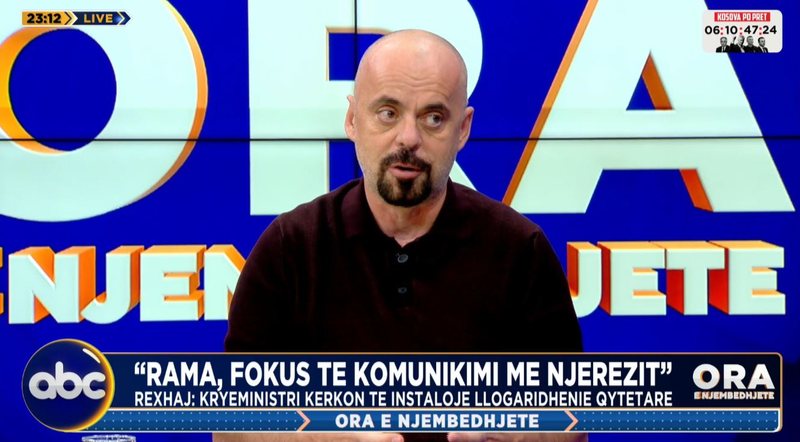
Tirana Examiner’s own political and diplomatic commentator Albatros Rexhaj was the studio guest on ABC Albania’s late-night prime-time news on the evening Prime Minister Edi Rama convened the Socialist Party leadership to review the first weeks of his “Prania Besnike” (“Loyal Presence”) initiative. What follows is the argument he made.
Accountability, not reels
Why the sudden weight on physical presence in the field? Because, Rexhaj said, the prime minister has understood something about the period when Albanian government moved almost entirely online.
“Everything was on social media: post, share, ‘stand by’. The whole of government passed into a kind of virtual communication with the public. At the time it was the trend, the networks had just exploded, and people thought it would go on like that. But times change, people change, and in the end the difference is made by contact with people.”
Rexhaj rejected the reading of Prania Besnike as a reset to zero. It sits alongside online communication, which he called unavoidable, and its test is whether it outlasts the first burst of enthusiasm: does the field presence survive three days before ministers and party officials revert to habit?
“Some of them think they’ve done the job. Go there, stand around, make a post, take a photo, film a short reel, and move on. That’s not only a Socialist Party trend. It runs across the whole political spectrum.”
What Rama is trying to build, in Rexhaj’s reading, is a mechanism, and the mechanism has a name: llogaridhënia qytetare, citizen accountability. “The idea isn’t ‘I listened to you, fine, now go.’ The idea is that someone answers.”
“Albania is not taken into Europe with beautiful photographs and reels. Citizen accountability is a European value. Europe can bring Albania in. But you also have to make Albanians European. And that starts with the people who actually hold power. They hold it because Edi Rama collects the votes for them. Now they have to become European too, and they cannot become European unless citizen accountability is installed. It’s the circuit: voter, citizen, decision-maker.”
Change the leader and nothing changes
The argument went beyond Prania Besnike. Rexhaj rejected the proposition underlying much of the opposition’s case against Rama, and much of the protest movement’s: that changing the man at the top changes the system underneath him.
“This is the point where I sometimes have to laugh, when I see the videos of Jorida Tabaku or others from the opposition, or of various activists. They behave as if, when you change the boss, remove Edi Rama and put you in his place, something changes in this country. No. Nothing changes, because Albanians are the same and the same mentality continues. The system doesn’t change when you change the leader. The system changes if you go at it from the foundations, from the roots. That is what Edi Rama is trying to do.”
He offered this as more than interpretation. “I have information from inside the process, at least from the consultations. We ask questions, and sometimes we get answers: this is the purpose, he means it, it won’t last three days.”
“There is a village somewhere in central Albania, Elbasan, Librazhd, Prrenjas, Korçë, or out near Ersekë. If it’s not election season, who goes there? A regional official comes, takes the party chairman or the mayor, and visits a village? Only when elections come. These things have to change. Villagers are Albanians too. Villagers are citizens of this country too. It’s a lovely phrase, ‘the citizens of the village of Leskovik’. But you have to treat them as such, and you have to go to them. You can’t be Europe and tell part of your citizens: he lives up on the mountain, I don’t deal with him. Have you been to Germany, to Austria? They go to the top of the mountain. At two thousand metres the road is paved to the house. That is what Edi Rama is trying to do. Let’s see whether he manages it.”
He expects Rama to manage it, eventually, and to turn considerably greyer in the attempt. “His biggest problem will be with his own people, because his own people are used to the way things are done in Albania.”
Does that make Prania Besnike a form of accountability inside the majority itself? It has to be, Rexhaj said, given a mandate he called the largest any Albanian leader has held in democratic times after Sali Berisha’s in 1992. The example he chose cuts the other way from a one-man state.
“You go to Lushnjë. The citizen’s contact is with the municipality of Lushnjë, the problems are the municipality’s problems. And the mayor there is not easy, she has tightened things considerably, nobody dares say anything. But ask where the problem is, and the answer is ‘Edi Rama’s fault’. What does Edi Rama have to do with what the municipality of Lushnjë does? You have to look at the whole system, so that accountability is installed in every link, so that citizens know exactly who is responsible for a failure. Once you know exactly who, you can prescribe the cure. You don’t say ‘it hurts somewhere’. You find exactly where it hurts and what is causing it.”
“Hostage to Sali Berisha”
On the opposition he was brief.
“The opposition is busy with itself. The opposition is hostage to Sali Berisha. As long as Sali Berisha is there, there will be no re-creation of anything. Everything is under his shadow. That is their choice, and I understand why. Edi Rama is not Sali Berisha inside the Socialist Party. The founding leader of the Socialist Party, Fatos Nano, has died, physically now, but Edi Rama retired him from politics many years ago. Sali Berisha is the founding leader, and as long as the founding leader wants to be relevant, you cannot go against him without causing a major trauma. While that situation lasts, I don’t see any movement there.”
Everyone else in the Democratic Party, he said, has one strategy: preserve the structures and the votes, and wait for a second chance.
The middle class left the street
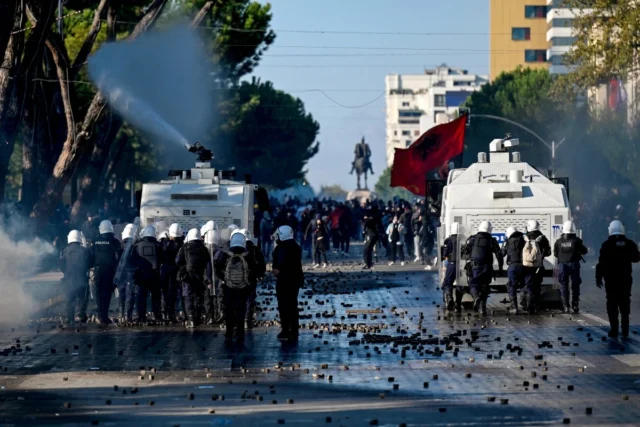
Before answering whether the Flamingo protests will matter this autumn, Rexhaj dealt with the prime minister’s vocabulary. Rama has taken to calling the protesters sorra, crows.
“I don’t like that word. He goes too far. Edi Rama likes to overdo it when he talks. It’s not good, because they are Albanian citizens. What ‘crows’? They are your citizens, and you are their prime minister.”
“The Flamingo Revolution and this protest are no longer the same thing. The Flamingo Revolution was the revolution of the middle class. Tirana came out into the streets and flooded them. Now we have groups of people who remind me of anarchist groups. They want noise, they want protest, they want media space, attention. That can go on for weeks, months, years. There’s nothing there. It produces no result. If the middle class doesn’t stay in the street, there is no result. When the middle class comes out, it makes political pressure. The middle class withdrew. For reasons they know, but it withdrew.”
Luarasi, and what counts as sexism
The previous day’s confrontation between protesters and Socialist MP Iris Luarasi drew from Rexhaj an argument about jurisprudence: democratic courts, he said, give citizens wide latitude to confront elected representatives in public, and the line runs at physical contact and physical obstruction.
“Stopping an MP in the street is not the end of the world. Let’s be clear about that. You are a public representative, not a private citizen, and a voter can come and block your way. But there are conditions. You don’t touch. You don’t physically obstruct. Yesterday there were elements that went to the edge of what democracy allows. For what people say with their mouths, it’s a free country, you can say what you like. ‘Politician, thief.’ That’s an opinion, not a crime. Thank you, we move on. But this idea of violent imposition is a problem.”
Whatever the courts might make of it, he added, it plays badly with a public that remains conservative: staying inside the democratic rules is not the same as winning anyone over.
He refused the gender frame entirely. “The fact that she is a woman is of no importance. She is an MP. MPs have no gender. She is equal to everyone else. She could be worth seven men for that job.”
The real sexism of the week, he said, was elsewhere: in the same day’s reporting that one female MP had “changed her look” before taking office. “That is not news. Why are these things news? How a woman decides to dress on her first day is not news. That is pure sexism. To me it is more sexist than the fact that, for political reasons, someone blocks Iris Luarasi’s path.”
The minefield
Rexhaj ranked the confirmation in parliament of Klodiana Spahiu as Minister of Health above the protest as the most important development of the previous two days.
He had put the question directly to the prime minister, in a professional media exchange: why this woman, why this MP? The answer came in three words: professional, humble, loyal. Had her predecessor Evis Sala not had the same qualities? “Sala left. Whether she had them or not, we don’t deal with the one who left. The news is this one.” On the second word he had made his own inquiries. “I asked up and down. They say it’s true, she is humble, a woman with her feet on the ground. And that matters. Health is the point where the citizen has the most contact with the state.”
Spahiu, in Rexhaj’s account, is walking into a minefield, and the mines have owners: pharmaceutical distributors, private hospitals and clinics with interests inside a sector that is supposed to belong to the patient.
“Health care is a minefield. The level of abuse there is sometimes quite embarrassing. With the mission the prime minister has given her, to reform the sector so that we actually reach the point where health care is for Albanians, and not for a few pharmaceutical warehouses, a few owners of private hospitals and clinics, she is going to have a great many problems. Expectations of her are very high. If she has the public’s support and the prime minister’s, and the patience to take things all the way to the end, then order and law in Albanian health care will no longer be made by the bosses of the pharmaceutical warehouses and the private hospitals. They will be made by Albanians themselves.”
Rexhaj said he intends to write on the appointment.
Albatros Rexhaj is Tirana Examiner’s political and diplomatic commentator. The views expressed in the broadcast are his own.