In the Balkans, a declared war is not needed to shift the balance: a new network of military cooperation, a few strategic signals, and a region that has never truly filed away its past are enough. Between Serbia, Kosovo, Albania and Croatia, the issue is not only what is happening today, but what it could become tomorrow.
by Filippo Sardella
Introduction – From the Yugoslav Wars to the New Grammar of Balkan Security
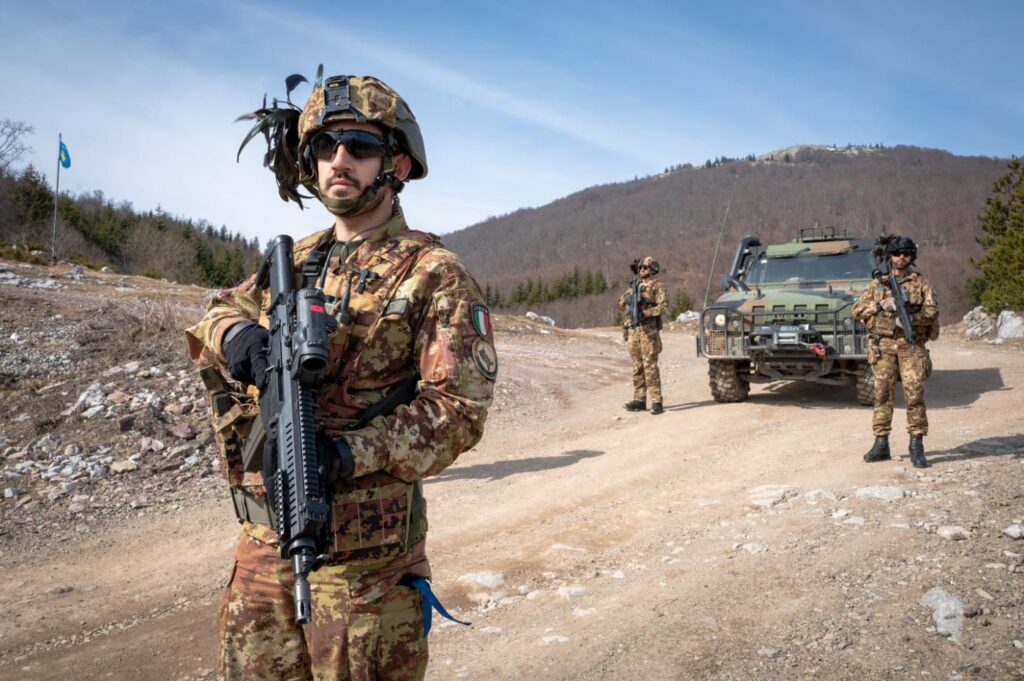
To understand why the Serbia-Balkans dossier has become so sensitive again today, one must start from a historical continuity that has never truly been closed. The former Yugoslav space is not a fully pacified area, but a region in which the wars of the 1990s left a dual legacy: formally stabilised borders on one hand, and strategically live memories on the other — especially among Serbia, Croatia and Kosovo. The central knot remains Kosovo, whose independence proclaimed in 2008 is not recognised by Belgrade, while on the ground security continues to rest in part on the presence of the NATO KFOR mission, active since 1999 on the basis of Resolution 1244 and tasked with maintaining a safe environment and freedom of movement. In parallel, the European Union continues to regard the Belgrade-Pristina dialogue as the pivot of regional normalisation and of both parties’ European path.
Within this historical framework, a development in March 2025 changed the region’s strategic perception: Albania, Croatia and Kosovo signed a joint declaration on defence cooperation. The official text speaks of strengthening defensive capabilities, interoperability, training, exercises, countering hybrid threats, industrial cooperation and support for Kosovo’s Euro-Atlantic integration, including the prospect of Partnership for Peace. At the same time, the document specifies that it creates no new international or intergovernmental legal obligations among the signatory states. This means that, formally speaking, we are not dealing with a military alliance in the classical sense; politically, however, the declaration has nonetheless produced the effect of redefining the geography of trust and deterrence in the Balkan space.
Serbia’s reaction had been immediate as far back as 2025. Belgrade’s Foreign Ministry had described the initiative as a dangerous precedent, arguing that it risked isolating Serbia and strengthening Kosovar security structures that Belgrade’s institutional narrative considers illegitimate. This reading is important because it explains the political backdrop of the current phase: for Belgrade, the problem is not solely military but symbolic and juridical, since it touches simultaneously on sovereignty, Kosovo’s status and regional power relations. In other words, what Tirana, Zagreb and Pristina present as defensive coordination tends to be read in Belgrade as a hostile alteration of the regional balance.
Body – Why the Dossier Is Relevant Now
The current relevance stems not only from the existence of the 2025 declaration, but from the fact that in 2026 it has begun to produce more concrete political and operational effects. As evident from official Albanian communiqués, in February in Munich the Albania-Croatia-Kosovo trilateral reaffirmed its intention to deepen cooperation in collective defence, interoperability, sustainable capabilities and the defence industry, in a European context described by the actors themselves as more complex and more exposed to coordination requirements. This passage is crucial because it marks the transition from a political declaration to a platform seeking strategic continuity.
During the same period, the Balkan context was militarised through other channels as well. As reported by Reuters, Serbia confirmed the purchase of Chinese CM-400AKG air-to-surface ballistic missiles, becoming the first European operator of this system, and placed this acquisition within a broader modernisation programme that includes other Chinese systems and new French Rafales, with military spending at approximately 2.6% of GDP in 2026. In parallel, again according to Reuters, Croatia reintroduced compulsory military service after 17 years, citing the deterioration of the European and Balkan security environment. The geopolitical data point, therefore, is not only mutual fear but the fact that multiple actors in the region are translating that fear into capabilities, training and postures.
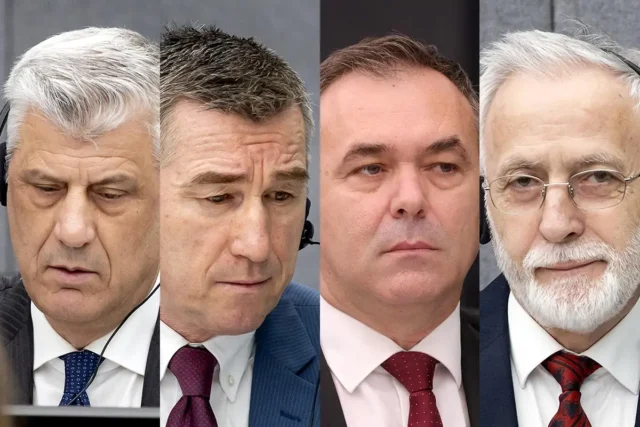
A third element must be added: Kosovo’s internal political fragility. Reuters reported first on the formation of a new government led by Albin Kurti after a prolonged period of stalemate, then on the failure to achieve institutional consolidation linked to the presidential election, and the Constitutional Court’s intervention freezing the setting of new elections until 31 March. This picture does not suggest the existence of a Kosovar political-military machine ready for imminent offensive projection; it suggests rather that security is being used also as a lever of legitimation and positioning during a phase of still-unstable institutions. It is precisely this overlap between internal fragility and external coordination that makes the current moment particularly delicate.
Finally, the role of NATO must be considered. On one hand, NATO continues to be the principal security guarantor on the ground in Kosovo through KFOR; on the other, Secretary General Mark Rutte has clarified that bilateral or trilateral agreements such as the one involving Albania, Croatia and Kosovo are not NATO agreements and do not formally concern the Alliance. This detail is essential: it reduces the likelihood of automatically reading the trilateral cooperation as a direct extension of NATO’s posture against Serbia, but it does not eliminate the fact that two of the three actors involved are Alliance members, and that any regional realignment is therefore observed by Belgrade through the lens of unfavourable deterrence.
Speculative Hypotheses
The first plausible hypothesis is that Albania, Croatia and Kosovo are building a security framework aimed not so much at preparing an offensive action as at preventing Kosovo from remaining a weak link in Balkan security. In this reading, the real objective would be twofold: to make any coercive pressure on Kosovo more costly, and to progressively insert Kosovo into regional Euro-Atlantic circuits of training, standardisation and industrial cooperation. The explicit reference in the official text to Partnership for Peace and to Kosovo’s integration into regional security initiatives reinforces this interpretation.
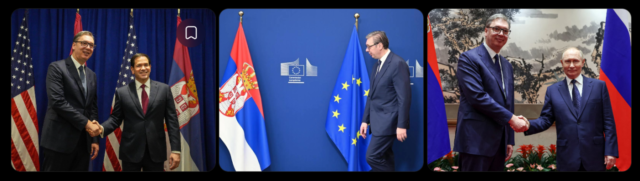
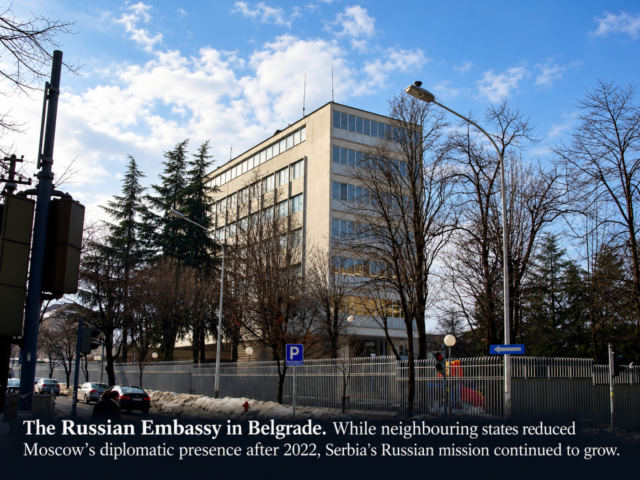
The second hypothesis is that Serbia is seeking to pre-empt the evolution of the regional framework on the narrative level. Presenting the trilateral as a potential threat allows Belgrade to do three things simultaneously: legitimise its own rearmament, consolidate internal cohesion around a perception of encirclement, and negotiate from a more assertive position with Western, Russian and Chinese interlocutors. As reported by Reuters, Serbia continues to navigate between NATO cooperation, European aspirations, relations with Russia and strategic ties with China. In this sense, the threat narrative should be read not only as a military alarm, but as an instrument for managing Serbia’s international posture.
The third hypothesis concerns the systemic level. The Balkan dossier is hardening because all of Europe is going through a phase of rearmament, industrial realignment and redefinition of security priorities. The 2025 declaration explicitly invokes the NATO Strategic Concept and the EU Strategic Compass; Croatia reintroduces conscription; Serbia accelerates its rearmament; Kosovo pledges significant defence investments. It is therefore not necessary to hypothesise an imminent war plan to explain the verbal escalation: it suffices to observe that the Western Balkans are absorbing the new European strategic culture, and doing so in a region where the conflicts of the past have never been fully neutralised at the symbolic level.
So What – Best Case Scenario
In the best-case scenario, the current phase stabilises within a logic of competitive but managed deterrence. In this case, cooperation among Albania, Croatia and Kosovo would continue to develop primarily on the training, technological and interoperability plane, without translating into postures perceived by Belgrade as immediately offensive. In parallel, Serbia would continue to strengthen its capabilities while avoiding demonstrative moves that transform every military acquisition into a political escalation signal. KFOR’s role and the EU-facilitated dialogue framework would then become the two principal buffers: the former as an on-the-ground stabiliser, the latter as a venue for diplomatic decompression.
Reaching this outcome requires very specific steps. The first is transparency regarding exercises, calendars and employment doctrine, because in the Balkans threat perception counts almost as much as the threat itself. The second is avoiding any compensation for Kosovo’s political crisis through excessive external security messaging. The third is relaunching the Belgrade-Pristina dialogue on technical and incremental dossiers, without necessarily waiting for a major final agreement immediately. Operationally, the most effective choice would be to build regular prior-notification mechanisms, indirect military deconfliction channels under the NATO-KFOR umbrella, and a European diplomacy that is more present in a preventive mode than a reactive one.
So What – Worst Case Scenario
In the worst-case scenario, the region enters a spiral of mutual securitisation in which no actor formally desires war, but all contribute to making a crisis more probable. Trilateral cooperation would be progressively read in Belgrade as evidence of encirclement; Serbian rearmament would be interpreted by neighbours as coercive preparation; Kosovo’s political crisis would increase resort to identity rhetoric; any tensions in northern Kosovo or local incidents would immediately become symbols of a broader regional challenge. In this scenario, no explicit attack order would be needed: a sequence of misread signals, rigid postures and an inability to separate the military, media and negotiating planes would suffice.
The steps leading toward this outcome would be recognisable. First would come an increase in strategic rhetoric, with accusations of offensive preparations and counter-accusations of destabilisation. Then would follow the normalisation of symbolically loaded exercises and arms acquisitions as political messages. Subsequently, a further freezing of political dialogue would occur, precisely as Kosovar institutions remain fragile and the European framework remains marked by broader military competition. Operationally, preventing this trajectory from maturing would require stricter communicative discipline, a higher threshold for public use of alarmist declarations, strengthened monitoring missions and more timely EU and NATO engagement before incidents become irreversible narrative crises.
Conclusions – A Crisis of Perception That Can Become a Crisis of System
As of today, the most prudent and analytically sound reading is this: there are no sufficient public elements to assert that a coordinated military attack against Serbia is being prepared. There are, however, clear elements to assert that the Western Balkans are entering a phase of security posture redefinition, in which the Albania-Croatia-Kosovo cooperation, Serbian rearmament, the enduring centrality of KFOR and the unresolved question of Kosovo’s status are producing a new regional competition. The real risk, therefore, is not only conventional offensive action, but the accumulation of hostile perceptions within an environment already marked by war memory, institutional fragility and European realignment.
The variables to monitor in the coming weeks are primarily five. The first concerns the concrete nature of the 2026 exercises among Albania, Croatia and Kosovo: scale, profile, transparency and political message. The second is the evolution of Serbian rearmament, especially if accompanied by new public doctrine or further demonstrative signals. The third is Kosovo’s institutional stability, because weak internal leadership tends to make external communication more volatile. The fourth is the resilience of the Belgrade-Pristina dialogue under European stewardship. The fifth, finally, is the behaviour of third-party actors — in particular NATO and the EU — whose capacity for preventive containment will be decisive in determining whether the region remains within managed deterrence or slides toward a systemic crisis.
For the original report in Italian click HERE