Three Serbian citizens were sentenced at the end of December 2025 for placing pigs’ heads in front of mosques in the Paris region. An action explicitly linked to the Kremlin.
by Jean-Baptiste Chastand (Le Monde)
Pronounced on the sly as part of a guilty plea procedure, the verdict was revealed on Friday 6 March by the Balkan branch of the Radio Free Europe news website. Found guilty of having deposited pigs’ heads in front of nine mosques in the Paris region in September 2025, three Serbian citizens were sentenced at the end of December by the high court of Smederevo, a small town 50 kilometres east of Belgrade, for espionage and racial discrimination.
The Serbian justice system also convicted them of having participated, in May 2025, in the throwing of green paint against the Shoah Memorial and three Parisian synagogues. These two actions had a considerable impact and aroused a wave of indignation in France, before being later attributed to Russia by the French services. Also consulted by Le Monde, the verdict confirms that the group “received orders and financial means from the structures of the intelligence services of the Russian Federation”.
All from the same small town of Velika Plana (15,000 inhabitants), the three men declared themselves as unemployed workers, laboratory technicians and waiters. They were recruited and then sent to France for a few thousand euros by a man designated as “Hunter” in the verdict, and who would actually be a Serbian named Aleksandar Savic, as Mediapart had revealed. While his fate remains unknown, his recruits have been sentenced to six to eighteen months of house arrest with an electronic bracelet. In addition, eight other people are still under investigation.
According to the court, the group organized other actions, which went completely unnoticed, such as the pasting of “600 to 700 stickers” calling for commemoration of the Armenian genocide near the Arc de Triomphe and in the 18th arrondissement of Paris in April 2025, or the deposit, in July 2025, of plastic skeletons in front of the Brandenburg Gate, in Berlin. “I’m still waiting for my retirement. Thank you, Merz,” said messages in German quoting Chancellor Friedrich Merz. For the Serbian judiciary, “the aim of this group was to carry out actions of political destabilisation and to incite religious and ethnic hatred in France and Germany”.
Read also | Article reserved for our subscribers Reporters Without Borders launches Svoboda, a package of a dozen channels and radio stations, to counter Russian propaganda
Little Hands Training Camp
While the use of small, often naïve and untrained hands to carry out destabilisation operations in Europe has been widely documented since the beginning of the war in Ukraine, the year 2025 will have made Serbia the main hub for Russian destabilisation actions. In September, Moldovan police arrested more than 70 Moldovans and Romanians suspected of having undergone training on Serbian territory to prepare riots in view of the general elections on 28th September, which were finally won peacefully by pro-European parties.
According to the Serbian police, this group numbered a total of more than 150 people, who were trained for several weeks in a camp near a restaurant located along the river that marks the border between Serbia and Bosnia and Herzegovina. In this case, two Serbian nationals were also arrested. The fate of the alleged organizer of the camp, a Russian citizen according to Radio Free Europe, remains unknown.
The choice of Serbia, a country of 6.5 million inhabitants, for all these operations is no coincidence. Russian President Vladimir Putin’s office favours nationals of countries known both for their low standard of living and for being crossed by a strong pro-Russian current. Thus, in the case of the “red hands” on the Shoah Memorial, in 2024, the Kremlin went through Bulgarians, convicted in the first instance by the Paris criminal court in October 2025.
Good relations between the Serbian president and Vladimir Putin
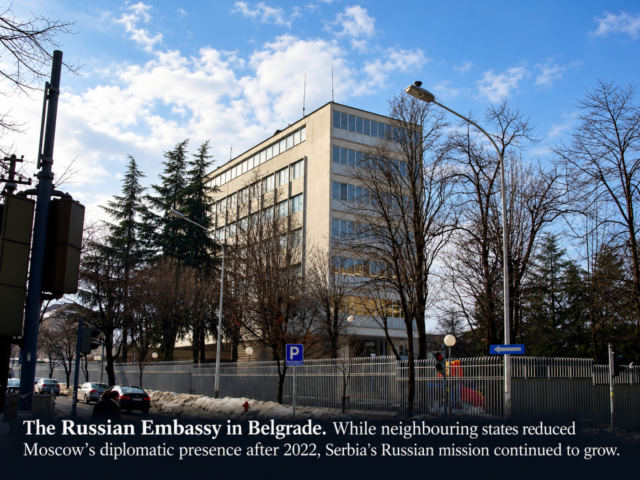
Serbia, which is a candidate for membership of the European Union (EU) while refusing to align itself with sanctions against Russia, has a more “practical” dimension. It does not require a visa for Russian nationals, nor do its citizens need a visa to travel to the EU. “It offers the best conditions for hybrid operations, because the population is mostly pro-Russian and the Russian and Serbian regimes are doing each other a favour,” notes Predrag Petrovic, a researcher at the Belgrade Centre for Security Policy, pointing to the good relations between Serbian President Aleksandar Vucic and Vladimir Putin.
The investigative website BIRN revealed that the two Serbian nationals arrested in connection with the Moldova training camps are a former collaborator and a former member of the party of Nenad Popovic, a Serbian minister who was decorated in 2010 by Putin. While US-funded news sites, such as RFE, or EU-funded websites, such as BIRN, have extensively covered these Russian operations, they have been almost completely ignored in the many Serbian media in the hands of the government, which are full of pro-Russian messages.
For Mr. Petrovic, if the Serbian justice system acted so quickly in the pig head case, “it is only because they faced irrefutable evidence” from the French police services and that “France is very important to Mr. Vucic,” he believes. President Emmanuel Macron has spared the Serbian government from any criticism since he sold twelve Rafales to the Serbian army in 2024. “But, basically, Serbia is doing nothing to really stop these influence operations, as shown by the fact that no Russians have been arrested,” Petrovic said. Known to be critical of Russia, its research center was itself the victim of a vast hack in the fall of 2025. Unsurprisingly, it was attributed by Microsoft to hacker groups linked to Russian intelligence.