Electricity for business costs a quarter less than the European Union average and less than in any EU member state in the Balkans. Few investors know it.
Bekimi Besimi (Venice, Italy)
An industrial investor weighing the Balkan countries against one another asks about wages, taxes and the distance to a port. The electricity bill usually comes last, a line item assumed to be much the same everywhere. The assumption is wrong, and Albania pays more for the error than anyone else.
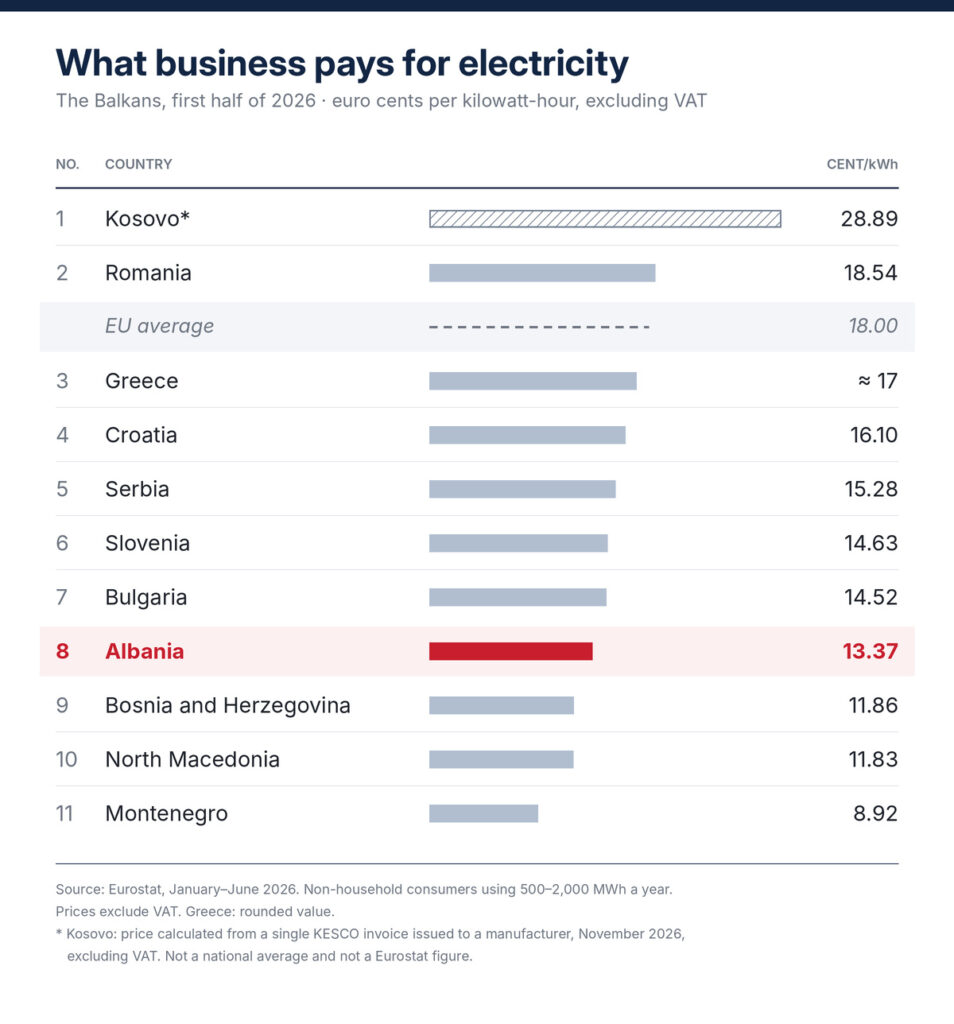
In the first half of 2026, according to Eurostat, a medium-sized business in Albania paid 13.37 euro cents per kilowatt-hour, excluding VAT. The measure covers non-household consumers using between 500 and 2,000 megawatt-hours a year, the band that takes in most of light industry, food processing and large services. The European Union average for the same band was 18 cents. Albania sits 26 per cent below it.
A factory that uses 1,000 megawatt-hours a year pays 133,700 euros in Albania and 180,000 euros in an average EU country. In Italy, Albania’s main trading partner, it pays 225,300 euros. The same machines, drawing the same power, cost 91,600 euros less a year on the eastern shore of the Adriatic.
Italian business pays 22.53 cents, the third-highest price in the Union, behind Ireland at 26.66 and Cyprus at 23.06. An Irish business pays nearly twice what an Albanian one does. Albania pays roughly what Denmark, Spain and Portugal pay, three economies Eurostat ranks among the cheapest in the EU for business electricity. Within the Union, only Sweden, at 11.77 cents, and Finland, at 9.28, come in lower.
No EU member state in the Balkans offers business cheaper electricity than Albania. Romania has moved above the Union average: its 18.54 cents is 28 per cent more than the Albanian price. Greece pays about 17 cents, roughly a fifth more. Croatia stands at 16.10 and Slovenia at 14.63. Even Bulgaria, for years the EU’s byword for cheap power, now pays 14.52 cents, more than a cent above Albania.
Albania is also cheaper than Serbia, the largest economy in the Western Balkans and its main rival for industrial investment in the region. A Serbian business pays 15.28 cents. The gap of nearly two cents costs that 1,000-megawatt-hour factory 19,100 euros a year.
Only three countries on the whole peninsula are cheaper than Albania: Bosnia and Herzegovina at 11.86 cents, North Macedonia at 11.83 and Montenegro at 8.92. Of the ten Balkan countries for which Eurostat has data, six pay more than Albania, and they include every large economy in the region.
Kosovo is missing from this half-year’s statistics. Since June 2025, Kosovo businesses with more than 50 employees or more than 10 million euros in turnover have bought their electricity on the open market. This November a manufacturer from Prizren made his factory’s bill public: 157,884 euros for 505,974 kilowatt-hours. Excluding VAT, that comes to 28.89 cents, more than double the Albanian price. The figure comes from a single invoice and not from a national average, but it is what the factory paid that month.
In Bulgaria, electricity for business rose 14.2 per cent in twelve months. In Romania it rose about 7.9 per cent in euro terms. The EU average fell 5.4 per cent and still stands 4.6 cents above Albania.
Albania generates almost all of its electricity from hydropower. For an exporter selling into Europe, where buyers increasingly ask what kind of energy went into the goods, that is a card few countries in the region hold.
Of all the costs a factory carries, energy is one of the few an investor can calculate before arriving. Today that calculation favours Albania: a quarter cheaper than Europe, cheaper than every EU member in the Balkans, cheaper than Serbia.
The advantage exists. All it lacks is the advertising.