Editorial Board
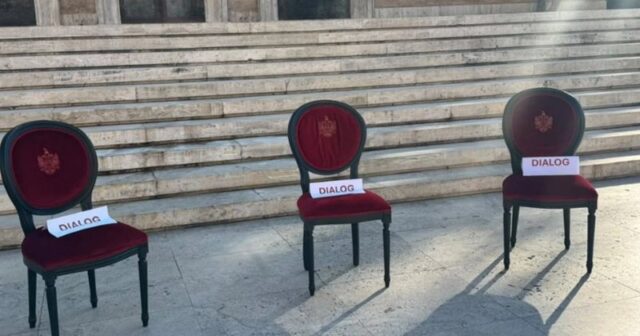
The Prime Minister spent Wednesday arguing with a party that holds ten seats in a parliament of seven hundred and twenty. Two posts, two videos, a Latin proverb from his grandmother, a challenge to Sandro Gozi to be brave and say “This is not dissent. It is violence.” One reply to last week’s poster was warranted; the accusation was in the picture. The rest is oxygen. Nothing that happens on the boulevard depends on what a small European party says about it. Something that happened in Tirana on Wednesday needed the Prime Minister’s attention instead.
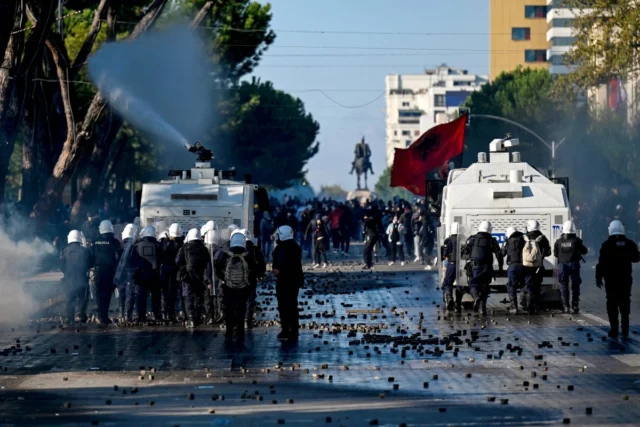
The protest, in its fifteenth week, split. One group stood where it has stood for a hundred days, in front of the Prime Minister’s office, and made speeches. Another, led by Visuar Dalipi, left the boulevard for the Lana bridge and blocked the junction. Shortly after ten, a driver asked them to let him pass. Some of them struck his car. We had a reporter at the junction. He watched protesters shouting at drivers who tried to get through, and he watched one of those drivers call the police. The police declined to come. The junction, they told him, belonged to another commissariat. No officer appeared while our reporter was there. The night before, around the opening session of Parliament, protesters had surrounded and struck deputies’ cars, Ilva Gjuzi’s in particular, while Iris Luarasi was followed and verbally abused on her way to the chamber. On Wednesday afternoon the Socialist women MPs asked for the immediate identification of those involved, an impartial investigation and an urgent review of Parliament’s security protocols.
A protest that filled the boulevard in June has become smaller, and inside it there are now small groups, with their own leaders and their own chosen ground, capable of provoking confrontations not only with the police but with citizens who have nothing to do with the protest at all. A man who wants to drive across the Lana is the public in whose name the protest speaks, and on Wednesday night a faction of that protest struck his car, while the state he pays for told him the junction belonged to somebody else’s commissariat.
A democratic state has to defend two things on the same street at the same time. People on the boulevard have the right to assemble and to denounce the government on day 102 exactly as they did on day one, without disproportionate force, without arbitrary detention, and without the attention of anyone not wearing a uniform. Last week’s questions about policing were legitimate ones and they are still open. Everyone else has the right to use the city. The right to protest has never included an unlimited right to immobilise public space, and it has never included the right to confront a citizen who is trying to pass. Marches close roads. Blockades disrupt. A junction where a car is surrounded and struck, and where the police answer the phone only to say the junction belongs to another commissariat, is a junction where the law has been left to whoever holds it. That is abdication, not restraint.
We do not pretend the position is easy. If the police move on the crowd, Wednesday becomes a story about police violence and the poster writes itself. If the police stay away, it becomes a story about the driver, and about the next driver. That is the dilemma. It is also the government’s. It belongs to the Interior Minister and the Director of State Police, who are paid to resolve it, and not to a party in Brussels that has no junction to manage.
When a group blocks a junction, the police reroute traffic before a driver reaches the crowd; a citizen is not left to negotiate with it alone, and he is not told it is someone else’s commissariat. Those who struck the car at the Lana and those who struck the deputies’ cars at Parliament are identified by name, from footage the state already holds, and charged as individuals. Nobody is charged for being on the boulevard. Both rights are guaranteed by the same institutions on the same night, and we are told how. Neither the protester nor the driver is the enemy of the state, and the state’s job is to make sure they are not the enemies of each other.
That is a week’s work for the Interior Ministry, the State Police and the Municipality of Tirana, and none of it can be done in a post. The Lana bridge is a domestic problem. Leave Gozi to his ten seats and go and solve it.