The convergence of historical revisionism, Serbian–Israeli arms ties, and diplomatic positioning is testing the credibility of genocide recognition in international politics.
Ngadhnjim Brovina (Prishtina)
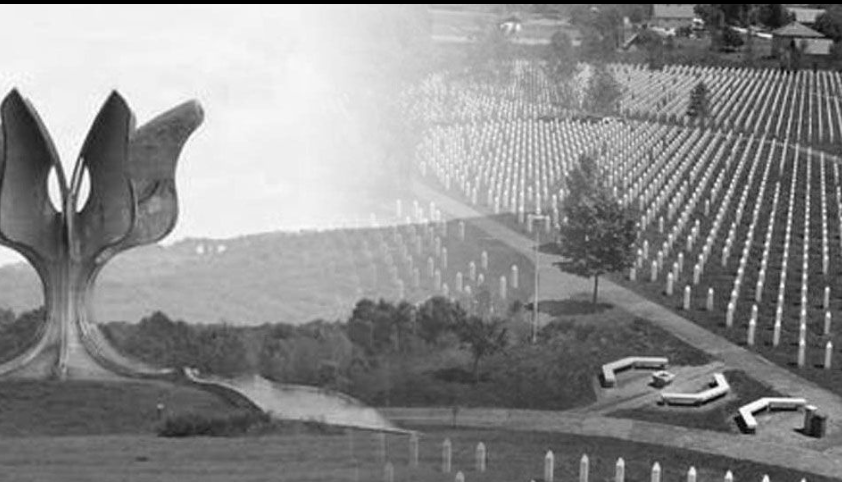
The publication this week of Milorad Dodik’s meditation on Jasenovac, in which the former president of Republika Srpska and current secessionist impresario invoked the “Auschwitz of the Balkans” and placed 700,000 Serbian, Jewish, and Roma victims at the centre of a shared unredressed trauma, fits a pattern that the scholarly literature on post-Yugoslav memory politics has documented in some detail. Jelena Subotić’s work on Holocaust appropriation in the service of nationalist projects, David Bruce MacDonald’s earlier study of Serbian and Croatian competitive victimhood, and a generation of research on denial regimes have identified the mechanism. A regime with present-day accountability problems invokes an unambiguously recognised historical genocide, positions its own national community inside that genocide’s victim set, and then uses the authority of the invoked atrocity to destabilise the international record of the atrocities it is itself responsible for.
The figure Dodik cites is not supported by contemporary historical scholarship. The Jasenovac Memorial’s List of Individual Victims, the most thoroughly documented register available, contains 83,145 named victims as of its most recent consolidation. The ethnic composition of the named list is as follows: 47,627 Serbs, 16,173 Roma, 13,116 Jews, 4,255 Croats, 1,128 Bosnian Muslims, and 266 Slovenes, with the remainder distributed across other nationalities. Of the named victims, 39,570 were men, 23,474 were women, and 20,101 were children under the age of fourteen. Current estimates from the United States Holocaust Memorial Museum, Croatian historian Ivo Goldstein, and Swedish historian Tomislav Dulić converge on a total between 80,000 and 100,000, with Goldstein allowing that a further ten to twenty percent of victims may remain unidentified due to the systematic Ustaša destruction of camp records in April 1945. The 700,000 figure Dodik repeats originated in wartime German estimates of total Serbian dead across the entire territory of the Independent State of Croatia, a number that was collapsed into a single-camp figure during the Yugoslav period and has been sustained since, in Dodik’s hands, as an instrument rather than a historical claim.
None of this diminishes the catastrophe. Jasenovac was one of the most brutal camp systems in Europe outside the German-run network, and the destruction of the Roma community in the Independent State of Croatia was very nearly total. The victim composition, including 13,116 named Jewish victims and an estimated Jewish toll at the camp between 15,000 and 20,000 once account is taken of those deported directly to the execution sites at Granik and Gradina without camp registration, establishes Jasenovac as a central site of the Holocaust in south-eastern Europe. Scholarly consensus on total Jewish deaths across the Independent State of Croatia, including deportations to Auschwitz, approaches 30,000, of which Jasenovac accounts for roughly half. It is precisely because these facts are settled that Dodik’s instrumentalisation of them is politically available to him, and precisely because the numbers he cites are inflated that the invocation functions as denial of a different, present-day record.
The more consequential question is not the Jasenovac figure. The more consequential question is the audience Dodik now expects will decline to object, and what that audience has given up in order to decline.
On 23 May 2024, the General Assembly of the United Nations adopted Resolution 78/282, designating 11 July as the International Day of Reflection and Commemoration of the 1995 Genocide in Srebrenica. The resolution passed by 84 votes in favour, 19 against, and 68 abstentions, with 22 states not present. Germany and Rwanda sponsored the text. The United States, the United Kingdom, France, and most Muslim-majority states supported it. The Israeli delegation was absent from the chamber. Its non-vote was not a procedural accident.
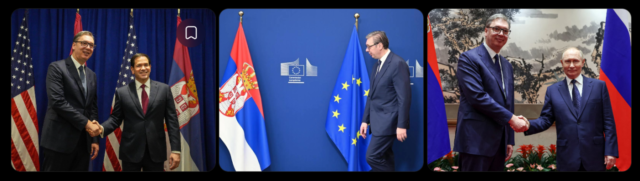
Aleksandar Vučić, President of Serbia, subsequently explained on the record, in an interview with the Jerusalem Post, the significance he attached to Israel’s absence. He thanked Israel openly for not supporting the resolution, observed that the text had drawn in many Islamic countries on Srebrenica grounds, and pledged reciprocation: in the event Israel were to face a comparable resolution at the General Assembly, Serbia would not vote for it. The statement is notable less for its substance than for its grammar. Vučić did not frame the Israeli absence as a shared principled position. He framed it as a trade.
The material side of that trade is equally on the record. According to customs data jointly examined by Balkan Insight and Haaretz, Serbian military exports to Israel reached 42.3 million euros in 2024, approximately thirty times the volume of the previous year. Vučić has described himself publicly as the only European leader trading ammunition with Israel openly, and has acknowledged that his European counterparts criticise him for it. He has also disclosed that in the days following 7 October 2023, Israeli procurement orders arrived with urgency and Belgrade cleared them within four days. The ammunition relationship between Belgrade and Jerusalem is substantial, central to Israel’s current supply situation, and politically asymmetric. Serbia is the country with the surplus capacity and the willingness. Israel is the country with the demand.
Against this commercial background, the shape of Israeli engagement with the Srebrenica denial project becomes legible as policy rather than as drift.
Since 2019, Dodik’s government has operated two commissions constituted to undo the 2004 Republika Srpska Srebrenica report, which had acknowledged the mass killings and offered an apology to the victims’ families. The first, officially styled as the Independent International Commission of Inquiry on the Suffering of All Peoples in the Srebrenica Region, was chaired by the Israeli historian Gideon Greif, formerly affiliated with Yad Vashem. Its 1,106-page report, issued in 2021 and subsequently adopted by the Republika Srpska parliament, concluded that neither the individual crime of genocide nor genocide in general occurred at Srebrenica. The second commission, on Sarajevo, was chaired by the Israeli academic Raphael Israeli. Its parallel report declared that the three-year Serbian siege of the Bosnian capital had been mischaracterised and that the Bosniak narrative of Serbian aggression had been, in its own phrasing, definitively dispelled.
The selection of Israeli academics for these commissions is not incidental to the project. It is the project’s animating logic. Dodik’s advisors identified, correctly, that the most effective instrument for laundering denial of a genocide committed against a Muslim community is the authority of scholars associated with Holocaust memory institutions. Menachem Rosensaft, former general counsel of the World Jewish Congress and a scholar of genocide law at Cornell, characterised the Greif undertaking as following the playbook of the most egregious Holocaust deniers, and identified the willingness of Israeli academics to accept such commissions as a serious ethical failure.
This posture has been reinforced in adjacent Israeli public positions. Efraim Zuroff, director of the Simon Wiesenthal Center’s Israel office, opposed the UN Srebrenica resolution in a Jerusalem Post op-ed arguing the crime did not satisfy the definition of genocide. Yehuda Bauer, one of Israel’s most senior Holocaust historians, has characterised Srebrenica as mass murder but not genocide. The Israeli ambassador in Belgrade stated on the record that what happened at Srebrenica was not genocide. Each of these positions contradicts the settled findings of the International Criminal Tribunal for the former Yugoslavia, the International Court of Justice in the Bosnia v. Serbia judgment of 2007, and the International Residual Mechanism for Criminal Tribunals. The judicial record comprises eighteen convictions for genocide and associated crimes at Srebrenica, including the life sentences of Radovan Karadžić and Ratko Mladić, both currently incarcerated at The Hague.
The consequential asymmetry this generates lies in Israel’s own normative architecture.
Israel’s moral inheritance in the international system is, in no small part, the architecture of genocide recognition itself. Raphael Lemkin coined the term in 1944, in the course of documenting the Nazi extermination of European Jewry. The Genocide Convention was drafted in the shadow of the Holocaust and adopted in December 1948, seven months after Israel’s declaration of statehood. Never Again is not a diplomatic slogan; it is the constitutional premise of Israel’s presence in the international legal order. Yad Vashem exists, as an institution of state, to guarantee that the machinery of memory does not fail in subsequent cases. When scholars formerly associated with that machinery are enlisted to deny that the systematic killing of 8,000 Muslim men and boys at Srebrenica constituted a genocide, the degradation is not confined to their individual reputations. It reaches the credibility of the architecture itself.
This is the cost side of the Belgrade accommodation, and it is increasingly being paid at the level of Israel’s core diplomatic credibility.
The audience observing this arrangement includes every capital whose cooperation Israel’s stated regional strategy requires. Abu Dhabi, Manama, Rabat, Riyadh, Amman, Ankara, Cairo, Jakarta, Kuala Lumpur, Islamabad, Dhaka. In each of these cities, Srebrenica is not a disputed historical footnote. It is observed annually, on 11 July, in mosques, embassies, and foreign ministries. The genocide of Bosniak Muslims occupies a fixed place in the shared vocabulary of the Muslim international order. The Emirati representative at the General Assembly debate on Resolution 78/282, even while announcing an abstention, opened with the story of a two-day-old Bosniak infant killed in the genocide and affirmed that Srebrenica was a settled fact. The United Arab Emirates is a founding party to the Abraham Accords.
The strategic project to which Jerusalem has committed itself is the normalisation of relations with Arab and broader Muslim states, organised around the premise that a Saudi-led realignment can durably reshape the region. That premise cannot withstand the compounding perception that Israeli state practice treats genocide against Muslims as a lesser category than genocide against Jews. The proceedings at the International Court of Justice concerning Gaza have already strained this perception beyond the breaking point of several partner relationships. The Belgrade accommodation adds a gratuitous additional strain: Israel absenting itself from a vote on a thirty-year-old genocide, accepting Serbian ammunition with the absence, and permitting its own Holocaust memory apparatus to be contracted out for Dodik’s commissions.
The arrangement does not appear to have been an unavoidable strategic necessity. It was a policy choice, made in a market where other suppliers remained available to Israel. The governments of Germany, France, and the Netherlands have sustained their post-October 2023 positions without accepting Serbian munitions as the price of coalition supply. Israel selected this supplier, and continued the relationship despite the political signal that accompanied it. That signal, articulated by Vučić himself in public, included silence on Srebrenica and a working tolerance for Dodik’s domestic project within the European order.
An Israeli policy consistent with the country’s foundational normative commitments would have recognised Srebrenica unambiguously, voted in favour of Resolution 78/282, repudiated the Greif commission by name, and understood that moral clarity on the genocide of Muslims is the indispensable precondition of any durable peace with Muslim states. That policy is available. It has not been attempted. The government of the day has made an alternative calculation, and the calculation is legible in every capital where Israel hopes to build.
Dodik’s Jasenovac post, in this light, is not an isolated provocation. It is a node in a long and now transnational operation to revise the moral ledger of the Yugoslav wars, and the operation carries, whether intended or not, a convergence between Israeli state practice and narratives that destabilise the established judicial record. Belgrade and Banja Luka understand what they have acquired. The remaining question, for Jerusalem, is whether it understands what it has sold, and whether a strategy that asks partners to overlook a legally established genocide can sustain credibility in a region where that genocide is neither abstract nor negotiable.
Ngadhnjim Brovina is Assistant Professor of Political Science at the University for Business and Technology (UBT) in Prishtina, where he has taught since 2018. He holds a PhD in Political Science from South East European University. His research focuses on international relations, international law, public diplomacy, intelligence and counterintelligence, and peacebuilding in the Western Balkans, with particular attention to Kosovo’s post-independence institutional and foreign policy development.