Three boats crossed the Adriatic carrying Gaza to Sazan. The catastrophe they borrowed is real. The emergency they invented is not.
the Newsroom (Tirana)
On Friday afternoon the port of Vlora received an expedition. It had been announced on Instagram with the solemnity of a rescue mission, carried in advance by ANSA, and framed by its organizers as a voyage to save the island of Sazan. Three sailing boats had left Brindisi the night before. What stepped ashore, in the account of Jola Hysaj, the director general of the National Tourism Agency who met them at the quay alongside deputy minister of culture and tourism Marinela Prifti, was “a dozen visibly disoriented people.” Hysaj says she offered them the one thing a rescue mission presumably wants: passage to the island itself, with full access and the freedom to ask any question.
By her account, they declined. They declined the visit, declined the briefing prepared for them, accepted the informational document, and announced they were leaving for Tirana “to join the Revolution.” The expedition that crossed the sea to save Sazan ended, on the record as it stands, without any of its members setting foot on Sazan.
That refusal is the event. Everything else that happened in Vlora on 21 August is commentary on it. And it makes urgent a question that should have been asked before the boats left Puglia, because the comparison this mission carried across the Adriatic was not implied. It was stated, printed, and illustrated.
The comparison, in their own words
At the launch press conference in Brindisi on 20 August, Tony La Piccirella of the Global Sumud Flotilla told ANSA that the dynamics of coastal dispossession in Puglia and Albania resemble Gaza: the interests that erode rights here, he said, become violence and genocide there. The mission’s launch material described the voyage as support for the protest against “the cession of the protected island of Sazan” to a fund linked to Jared Kushner. The imagery published before arrival, as described by Hysaj, included a flamingo wrapped in a Palestinian keffiyeh above the slogan “they called, we answered,” and a second card reading “from Gaza to Sazan island, our land is not for sale.”
Even the boats carried the metaphor. The vessels that sailed for Vlora are, by the organizers’ own account, boats recovered after being damaged in earlier missions toward Gaza. The transfer of symbolism from one shore to the other was not a flourish appended to the mission. It was the mission.
It is worth pausing on what the organizers chose not to lead with, because they held a true symbol in their hands. The departure was timed to the thirty-fifth anniversary of the Vlora, the ship that carried twenty thousand Albanians to Bari in August 1991, and aboard the boats were children of that crossing, sailing the route in reverse. That is a real inheritance and an honest frame: the descendants of one desperate voyage returning in solidarity on another sea. They buried it under a borrowed one.
The two columns
Set the columns side by side, because the comparison invites exactly that.
In Gaza, the health ministry’s count through 21 August stands at more than 73,000 killed since October 2023, by the ministry’s count some 21,500 of them children. More than 1,200 of those deaths have come since the ceasefire of October 2025, a ceasefire fragile enough that the word requires quotation marks in half the world’s press. At the war’s height, nine in ten residents had been displaced. Whatever position one holds on the war, its authors, or its end, these are the dimensions of the thing invoked.
Sazan is an uninhabited former military island of 562 hectares at the mouth of the Bay of Vlora. It has no resident civilian population. No family on Sazan is under bombardment, because no family lives on Sazan. No one has been displaced from it, no child has fled its ruins, and no community on it issued the call that the flamingo in the keffiyeh claims to be answering. The flamingos themselves, as it happens, live in the Narta lagoon on the mainland; none has been recorded on the island. What exists on Sazan is a dispute, a genuine one, about administrative acts, an investment designation, and the future of a protected landscape.
The distance between the columns is not a matter of degree. It is a matter of category. A war with tens of thousands of dead and a concession controversy on an empty island are not points on the same scale, and placing them on one scale does violence to both. If Sazan is Gaza, then Gaza is a planning dispute. The equivalency inflates the one by exactly as much as it deflates the other, and the deflation lands on the dead.
What the equivalency does
Whatever the organizers intended, the comparison functioned as a distribution strategy.
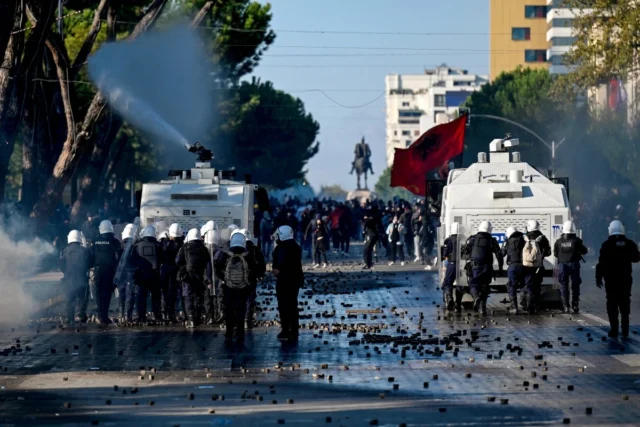
By August the Tirana protest movement, seventy days old by the organizers’ own count, had lost most of its international echo. Sazan generates a domestic argument. Gaza generates the world’s attention. Attach the first to the second and a story that had fallen out of the international press reenters it through the largest and most emotional conflict of the age. The flotilla was the splice. Mero Baze made essentially the same observation the day before the boats arrived, and made it harder: he called the result a use of Gaza’s victims as staging. The mechanism does not depend on his verdict, or on anyone’s reading of the organizers’ hearts. The communications architecture is visible from the outside, and it points one way.
The carriers of the comparison bring their own record. In January the US Treasury designated the Popular Conference for Palestinians Abroad a specially designated global terrorist for operating at Hamas’s behest. In April the State Department condemned the Global Sumud Flotilla as, in its words, a pro-Hamas initiative organized by that same designated entity. In May the Treasury sanctioned four of the flotilla’s organizers. The GSF rejects the allegations as propaganda and has demanded the underlying documents be examined by independent bodies. Designation, condemnation, denial: we record all three. What needs no adjudication is the choice itself. A movement that has spent the summer denying that any foreign hand touches it accepted, as its international escort, an organization whose relationship to the cause it invokes is itself an open file in Washington.
The dispute that deserved better
Here is what the equivalency actually cost, and it was not paid by the government.
The Sazan file contains real questions. The expression of interest for the island was filed four days before the strategic-investments law expired. The operative provisions of the 2024 protected-areas amendments, the ones that permit five-star tourism structures in every category of protected area, appear nowhere in the bill as deposited and entered at committee stage. The cooperation agreement that would give the designation legal life remained unfinalized at the end of 2025 and has never been ratified by the Kuvend. These are documented facts, they are serious, and they are answerable only by institutions that feel obliged to answer.
A movement that stood on those facts would be difficult to dismiss. A movement that stands on a keffiyeh-wrapped flamingo hands the state the easiest afternoon it has had all summer, and the state took it. Hysaj arrived at the port with a fact sheet: no agreement signed, no square meter sold, ownership to remain public, any development confined to a 45-hectare perimeter at an intensity capped at 0.20 percent of the island’s surface. Her numbers deserve their own scrutiny, beginning with the question of which document produces so precise a perimeter for a project said not to exist. But she did not need the numbers to win the day. The delegation won it for her the moment it refused the boat. Against visitors who would not visit, the government did not have to be right. It only had to be present.
What solidarity is not
There is a test for solidarity that never fails: it gives something to the cause it invokes. The Vlora anniversary passed the test; the descendants of 1991 gave Albania’s protest their presence and their history. The Gaza equivalency fails it completely. It takes from Gaza, takes the weight of its dead and the moral gravity of its ruin, and spends them on an Instagram campaign for an island where no one has died and no one lives. Nothing flows back. Gaza’s dead are not honored by the loan of their catastrophe to a concession dispute; they are diminished by it, reduced to a font in which other causes print their posters.
The organizers are welcome to return. The island will still be there, 562 hectares of it, Albanian and public and empty, open to anyone who finally wishes to look at what they came to save. That is precisely the point. Sazan can wait to be seen. The people of Gaza could not, and the surest sign that this mission was never about them is that it borrowed their fire without once feeling its heat.