Europe guards its protected shorelines with two different instruments. A member state that builds inside a protected zone meets the slow apparatus of the courts. A candidate that does the same meets the European Parliament, a public verdict, and its membership held as collateral. The coasts are equally protected. The difference is which country can be made to obey.
by Besart Ruka (Tirana)
Two things happened on the same sea within a fortnight. On the fourth of June, the cabinet in Rome overruled the region of Sardinia and its own Culture Ministry to clear a luxury resort on a protected stretch of coast, pushing the authorisation through the fast lane of a special economic zone. On the seventeenth, the European Parliament ordered Albania to freeze all construction in its protected areas, repeal the law that had opened them, and treat compliance as a condition of entering the Union. In both places, a luxury resort pressing onto a coast the law had set aside as protected. Two entirely different machines came down on it. In Italy, a national government quietly signing a waiver. For Albania, a continental parliament issuing a public sentence with a country’s future attached.
That gap is the argument. Europe runs one system of environmental enforcement for the states already inside it and another for the states trying to get in. For the member, a protected coast under threat becomes a legal question: a court case, a fine, an infringement file, the slow grind of administrative dispute. For the candidate, it becomes a political one: a resolution, a named project, a deadline, the leverage of accession. The shorelines are protected to the same degree. What changes is the instrument Europe reaches for, and how hard it is able to press.
What the law does, and what it does not
Follow the coastline and the pattern holds in every member state.
In Sardinia, at Cala Finanza, a Brazilian conglomerate is raising a luxury resort on a promontory that fronts the Tavolara marine protected area, declared in 1997, on land where the regional landscape plan forbids building within three hundred metres of the water. To proceed, about ten hectares of protected-landscape classification had to be converted to a tourist category. The first piece of it is already standing: the developer’s beach club opened to invited guests last summer. The region objected. The Culture Ministry objected. Rome overrode them through the single authorisation of the special economic zone, and the region is now fighting it where member states fight such things, in the administrative courts. A legal track. No resolution. No deadline. No accession on the line.
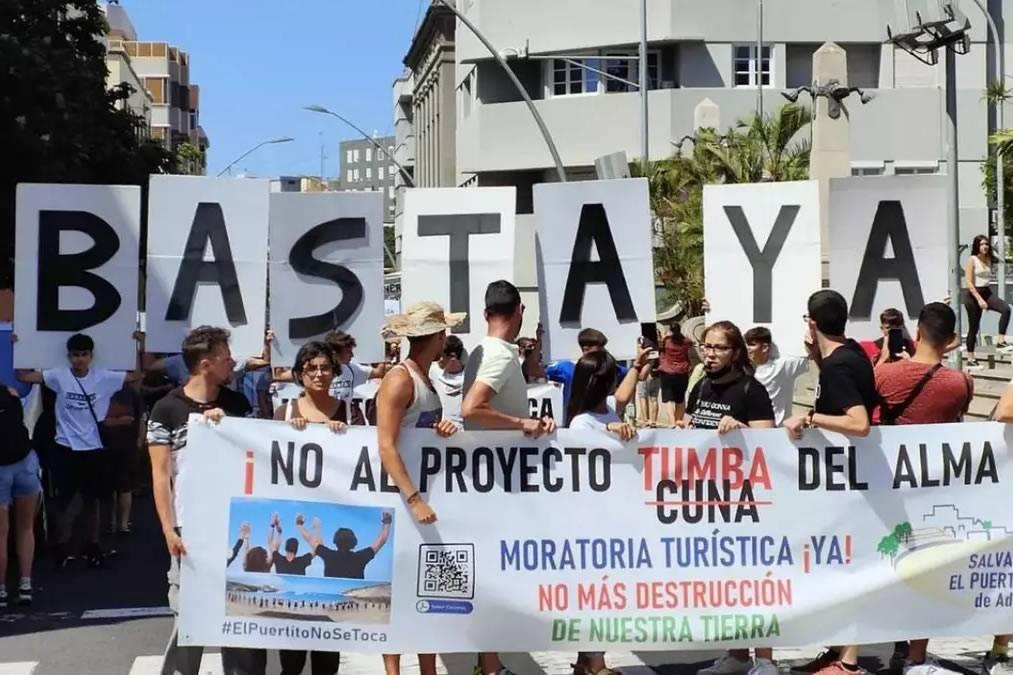
In Tenerife, at El Puertito de Adeje, a developer is building Cuna del Alma, more than four hundred luxury villas on land classed of national geological interest, set between protected natural areas and beside a marine zone of the European Natura 2000 network. Work began on a simplified environmental assessment rather than a full one, and only after a Guanche archaeological site had already been destroyed. The island council halted it. The Canary government halted it again. Fines were levied, then lifted, and the project resumed under a new regional administration. At one point a young man chained himself to a digger to stop it, and was arrested. Tens of thousands marched, under a slogan Albanians would know on sight, the Canaries are not for sale. The whole fight has run through Spanish courts and administrative orders. It has never once run through Strasbourg.
Further along the Spanish coast, in Almería, the Algarrobico hotel stands inside the Cabo de Gata-Níjar Natural Park, four hundred and eleven rooms and twenty-one storeys raised in violation of the coastal law, within the protected strip where building is forbidden. Spain’s Supreme Court ruled it illegal. More than fifty judgments have circled it. And still it stands, twenty years on, while its demolition is deferred and deferred again. The law found it unlawful and the law could not bring it down. At no point in those two decades did a protected park holding an illegal tower become a European political emergency.
And in Greece, the clearest case of all, the government this spring drafted a law to permit development inside Natura 2000 zones and to legalise structures already built without permission. This in a country the European Court of Justice has already found in breach of the Union’s Habitats Directive for failing to protect those very areas. A member under judgment for neglecting its protected nature answered by drafting a law to open it wider, and the Union’s instrument was a court ruling that can be absorbed and outlasted.
The instrument follows the leverage
None of these cases is the legal twin of Narta. The protections are written differently, the permits issued under different regimes, the damage greater on some coasts than others. That is not a hole in the argument. It is the argument. What is being measured here is not the projects. It is what each of them provoked.
Set the two columns side by side and the regimes are unmistakable. Albania receives a parliamentary resolution, a named developer, a moratorium, a benchmark welded to its accession. Italy receives an administrative lawsuit. Spain receives court files and a demolition order that waits two decades. Greece receives a judgment it can slow-walk. The candidate is handled by politics. The members are handled by law.
A Brussels official will say this is exactly as it should be, that accession conditionality is a legitimate instrument and a candidate state must expect scrutiny a member does not. That is true, and it accounts for why the Parliament may speak to Albania about its path into the Union at all. It does not account for the urgency. The ecological stakes do not change at the border. A protected coast built over in Sardinia loses the same dunes and the same water as a protected coast built over in Vlora. If the protection of nature were the operative principle, the illegal tower inside a Spanish national park would not be allowed to stand for twenty years while a candidate is handed an ultimatum to be met within the season. The intensity does not track the damage. It tracks the leverage. Europe presses hardest exactly where it can press, and the place it can press is the country waiting at the door.
That is the difference, stated without exaggeration. It is not that the member coasts go unprotected on paper and the candidate’s does not. They are protected alike. It is not that Europe is indifferent to its own shorelines; it litigates them, slowly. It is that the full weight of European pressure, the public naming and the political deadline and the threat to a national ambition, is reserved for the state that can be made to comply, and withheld from the states that cannot.
The Coastlines That Came First
There is a deeper asymmetry beneath the legal one, and it is the one Albanians feel most directly. Much of the coastline that made the Mediterranean members rich was developed before the regime now aimed at Albania existed. Port Leucate and Port Barcarès were raised from nothing on the sand cordon of a protected French lagoon in the 1960s, one of the largest marinas in the Mediterranean conjured out of a bird habitat, and they have run for half a century beside the oyster farms and the protected water. The Spanish coasts that now lecture through Madrid were poured in concrete long before anyone drew a protection line around them. The modern apparatus of habitat directives and coastal protection hardened around these places after their resorts were already built, and it meets Albania at the start of its development rather than the end. Where that same apparatus does apply in full, coexistence has proved achievable rather than fatal: Costa Navarino rose beside a Natura 2000 wetland in Greek Messinia, against the very prophecies of ruin now heard at Vlora, and became one of the most decorated sustainable destinations in the Mediterranean.
This is the part of the standard that should trouble Albania most, because it reaches past any single lagoon. The question is whether a country still outside the Union is to be allowed the route to prosperity the members took for granted. Albania has spent its post-communist decades trying to climb from the margin of the Mediterranean to its front rank, and a four billion euro commitment to its southern coast is the clearest sign yet that the climb is within reach. To be told at exactly this moment that a protected coast is inviolable in a way it was not for France or Spain when they built theirs, and is not for Italy even now, is not a lesson in conservation. It is a rationing of ambition, enforced on the applicant and waived for the club. The right to turn a coastline into national wealth is not a privilege Europe minted for itself alone. It is the thing Albania is now asked to surrender as the price of a queue whose end it has not been promised.
Once inside
None of this argues that Albania should be free to build whatever it likes on the Narta lagoon. A country serious about its coast should welcome scrutiny and turn more of it on itself than Brussels ever will. But it should read the scrutiny precisely. What is bearing down on Albania is not the even hand of a Union that holds every shoreline to one law. It is the harder of two instruments, the political one, deployed because Albania is still outside and can therefore be commanded.
There is a warning in that worth keeping past this dispute. The pressure Albania feels now is a function of its weakness, not of Europe’s consistency. The day Albania joins, it will pass from the political regime into the legal one, from the country that can be commanded into the country that can only be sued. The coast that Brussels is defending so loudly today will then be governed as Sardinia’s is, and Tenerife’s, and Almería’s: protected on paper, and enforced through the kind of procedure that can run for twenty years while the concrete sets. The protection will not have vanished. It will have slowed to the speed at which Europe enforces against its own.