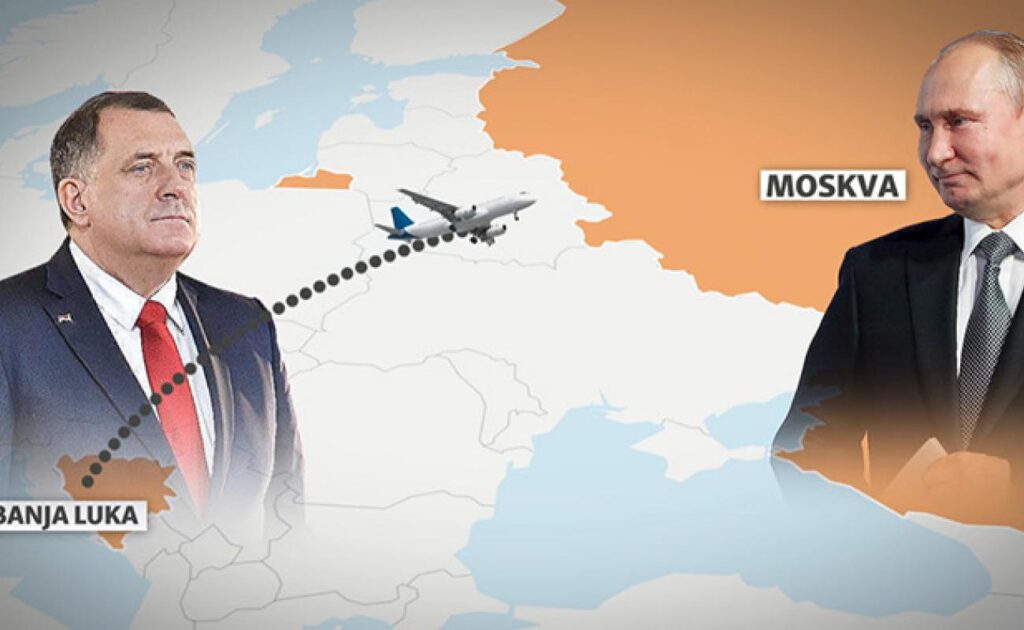
For Dodik and his allies, Albanian political agency itself remains the threat.
by Fatos Kabashi (Prishtina)
When Milorad Dodik reacted to the recent trilateral defense declaration signed by Croatia, Albania, and Kosovo, much of the Western coverage treated the episode as another routine flare-up in Balkan politics. It was reported, filed under “regional tensions,” and quickly forgotten.
That was a mistake.
Not because Dodik himself is strategically decisive — he no longer formally holds executive authority but continues to dominate political life in Republika Srpska, presiding over a secessionist project whose room for maneuver is narrowing — but because his reaction reveals something deeper than a tactical disagreement over a defense memorandum. It reveals a persistent worldview in which Albanian political agency itself is treated as the threat.
Dodik did not argue that the declaration posed a concrete military danger. He did not engage with its provisions — the language on joint exercises, NATO interoperability, counter-hybrid threats, and security coordination.
Instead, he dismissed the pact as “obviously conceived to be directed against Serbs and Serbia.”
The text of the agreement was irrelevant to his argument. What mattered was who signed it.
Croatia is a NATO member and an EU state. Albania is a NATO member and an EU accession candidate. Kosovo is recognized by more than one hundred countries and functions as a de facto Western security partner.
Three actors embedded in the Euro-Atlantic system signed a non-binding cooperation memorandum — and Dodik portrayed it as an existential threat.
The logic behind that reaction is not military.
It is political and ethnic.
The throughline is Albanians.
A posture, not a reaction
Dodik’s hostility toward Albanian political agency did not begin with this declaration. It is structural.
For years, his rhetoric has treated Albanian statehood — particularly Kosovo’s independence — not as a geopolitical fact but as a historical injustice that must remain contested.
In that worldview, Albanian assertiveness is illegitimate by definition. Albanian diplomatic activity is interpreted as expansionism. Albanian security cooperation becomes a conspiracy.
This is why Dodik’s response should not be read as a reaction to a specific agreement. It is a posture.
When he warns that “the Serbian people know how to recognize intentions and danger,” he is not analyzing the defense declaration. He is activating a familiar narrative framework in which Albanians occupy a fixed role: the permanent adversary.
The comparison he draws with Serbia’s Open Balkan initiative illustrates this logic.
Belgrade’s economic project — which Kosovo refused to join partly because of concerns about political asymmetry — is presented as evidence of Serbian goodwill and regional cooperation. In contrast, Albanian participation in a security arrangement with NATO partners is framed as aggressive bloc-building.
The inversion is deliberate.
Serbian regional primacy is portrayed as stability.
Albanian sovereignty is portrayed as provocation.
This is not an argument designed to withstand scrutiny. It is a rhetorical architecture built to make Albanian political existence itself appear destabilizing.
Albania in the crosshairs
It would be easy to interpret Dodik’s reaction as primarily directed at Kosovo. That would miss an important point.
Albania is explicitly named in his criticism — and that is not incidental.
For decades, the specter of “Greater Albania” has functioned as a convenient rhetorical device in parts of the Serbian political sphere. It appears whenever Albanian actors pursue regional influence, diplomatic coordination, or security partnerships.
The accusation is elastic enough to apply to almost anything.
A defense memorandum becomes evidence of expansionism.
A NATO partnership becomes a threat.
Advocacy for Kosovo’s Euro-Atlantic integration becomes a destabilizing project.
This framing serves a strategic purpose: it seeks to delegitimize Albania as a normal regional actor.
By any objective measure, Albania is behaving precisely as Western partners expect. It is a NATO member hosting Alliance infrastructure, an EU accession candidate pursuing institutional reform, and a country increasingly active in regional diplomacy.
Yet the moment Tirana acts — signing a security declaration with Croatia and Kosovo, advocating Kosovo’s NATO path, or strengthening defense cooperation in the Adriatic — it is cast as the author of instability.
The goal of that framing is not to respond to Albanian actions.
It is to pre-emptively disqualify them.
If every Albanian initiative is portrayed as a threat, then Albania is effectively denied the right to act as a normal sovereign state in its own region.
What a proactive response looks like
For Prishtina and Tirana, the lesson should now be clear: reacting defensively to each accusation is strategically futile.
The pattern is well established. Every Albanian diplomatic or security initiative will be framed as anti-Serb regardless of its content. Correcting those mischaracterizations after the fact rarely changes the narrative.
A more proactive approach would involve several steps.
First, reframe the discussion entirely.
The trilateral declaration is not an anti-Serb initiative. It is a pro-NATO initiative.
Croatia and Albania are Alliance members. Kosovo is pursuing membership. Interoperability, hybrid-threat response, and regional security coordination are precisely the forms of cooperation NATO encourages among partners.
The relevant audience for that message is not Belgrade — and certainly not Dodik — but Brussels and Washington.
Second, systematically document the pattern.
Each instance in which Albanian political activity is recast as aggression should be catalogued and presented to EU and NATO partners as evidence of a broader narrative strategy aimed at delegitimizing Albanian statehood and agency.
This is not grievance politics. It is strategic analysis.
Third, expand the coalition.
The declaration itself is open to other participants. Bulgaria has already been mentioned as a possible partner. Additional signatories would further weaken the claim that the initiative represents an ethnic alignment against Serbia.
The more diverse the coalition becomes, the less credible that framing will appear.
Fourth, maintain momentum toward Kosovo’s NATO integration.
This remains the strategic center of gravity. Every step toward Partnership for Peace and eventual Alliance membership reduces the space in which destabilizing narratives can operate.
Croatia and Albania — both NATO members with strong regional credibility — are uniquely positioned to advocate for that path.
They should do so more forcefully.
The stakes
Milorad Dodik will not dominate Balkan politics forever.
But the worldview he articulates — the idea that Albanian political existence itself constitutes a threat — is not unique to him.
It circulates widely in the region’s political discourse, and it will likely persist long after his political career ends.
That is why his reaction to the Croatia–Albania–Kosovo declaration should not be dismissed as rhetorical noise from a politician who, despite lacking formal executive authority, continues to shape the political direction of Republika Srpska.
It is a signal.
A signal about how Albanian political agency is still interpreted whenever Albanian actors attempt to function as normal states in their own region.
The response to that signal should not be hesitation.
It should be persistence.
Coalitions, documentation, diplomacy, and institutional integration — until the cost of portraying Albanian statehood as a threat becomes too high for the argument to survive.