Kyiv described Moscow’s foundational claim. Belgrade runs the same one toward Pristina.
Albatros Rexhaj
At the Four Freedoms Awards ceremony, Volodymyr Zelensky described what he called the core of Russia’s war against Ukraine. “At the core of Russia’s war against Ukraine is a false claim, that Ukraine does not exist, that it is allegedly a part of Russia. This is not just about history. Not just politics or ideology. It is the basis of their goal, to erase Ukraine completely.”
That sentence is doing unusual analytical work. Most Western framings still treat the existence question as rhetorical cover for underlying material interests, as ideology derived from geopolitics rather than driving it. Zelensky reverses the order. The ideology is primary. The material claims follow from it. The war, in this reading, is not a territorial dispute carrying a metaphysical wrapper. It is a metaphysical claim executed through territorial means.
That reversal matters because it brings a second theater into clearer focus.
Serbia’s claim on Kosovo is not, at its core, a legal claim. It is a mythological one, and the mythology is built over stone. Specifically over churches. The monasteries at Graçanica (Gračanica), Peja (Peć), Deçan (Dečani), and the Church of Shën Premte (Bogorodica Ljeviška) in Prizren are offered as the physical proof of a historical sequence that runs as follows: the land was the heart of the medieval Serbian kingdom, the monasteries stand as the continuous Serbian presence, therefore the land is Serbian, and whoever lives on it today lives on Serbian land by historical sufferance.
The sequence rests on a set of assertions that mainstream scholarship has examined and largely rejected, most systematically in Noel Malcolm’s Kosovo: A Short History, whose documentary reconstruction of the medieval and early modern record remains the standard anglophone reference. Every Orthodox Christian in the medieval Balkans is retroactively coded as Serb, erasing the Vlach, Greek, and Albanian Orthodox populations who shared the same ecclesiastical landscape. The Battle of Kosovo of 1389 is read as the Serbian national trauma, with the Albanian contingents on the field either absent from the narrative or recoded as Ottoman. Albanians themselves are presented not as descendants of pre-Slavic populations with documented continuity in the region, but as Ottoman-era arrivals, infiltrators of a Christian Serbian land. The churches become the proof of ownership. The living Albanian population is treated, within the framing, as an infestation of someone else’s country.
The mythology was never only an academic question. It became state doctrine. The SANU Memorandum of 1986, the semi-official manifesto that prepared the intellectual ground for Milošević’s rise, carried much of the architecture in codified form: that Albanians in Kosovo were executing a slow demographic conquest against an indigenous Serb population, that the Yugoslav state had abandoned Serbs to that encroachment, and that ancestral land was being lost to a people the Memorandum presented as having no ancestral claim on it at all.
What followed follows from that ideological base. The 1989 revocation of Kosovo’s autonomy. The wars of the 1990s. The 2006 Serbian Constitution, which still defines Kosovo under the Belgrade formulation of “Kosovo and Metohija” as an integral part of the Republic of Serbia. The refusal to recognize Kosovo after 2008. The continuous denial of Kosovo statehood today is the continuation of a position laid down in the 1980s, on foundations reaching back centuries.
Compare what Zelensky named. Russia’s claim on Ukraine rests on the same architecture. Kievan Rus is cast as the cradle of Russia. The Orthodox heritage is cast as continuous Russian identity. Ukrainian language, Ukrainian national feeling, Ukrainian statehood, these are presented as recent aberrations, inventions of Habsburg intrigue or Soviet miscalculation or Western engineering. Ukraine is not, under this framing, a separate nation that happens to share history with Russia. Ukraine is Russia interrupted. Putin’s July 2021 essay on the historical unity of Russians and Ukrainians spelled out the full claim in the form of an intellectual manifesto. The war that began in February 2022 operationalized it.
The Serbian and Russian cases are not loosely analogous. They run on the same ideological architecture, expressed in Balkan and Eurasian vocabulary. Both rest on the claim that the neighboring nation does not exist as a distinct nation, that it never properly did, and that it is therefore not entitled to separate statehood. Both treat the Orthodox civilizational heritage as ownership documentation. Both recode the neighbor’s continuous presence on its own land as a late intrusion. Both carry, as the logical endpoint of the argument, the conclusion that the neighbor’s national existence is the wrong to be corrected.
Once the architecture is named, the discrete incidents of the past year align into pattern.
The clearest recent illustration is the April 15 meeting at the Banjica 2 barracks in Belgrade. Aleksandar Vučić convened a Serbian military planning session with the Chief of the General Staff and the full military collegium present. He invited into that session the entire constitutional leadership of Republika Srpska: the RS President, the Serb member of the Bosnian Presidency, the Speaker of the RS National Assembly, the Prime Minister, and Milorad Dodik. The Dayton Peace Agreement defines Republika Srpska as a political entity inside a unified Bosnian state. No legal framework authorizes joint Serbian-RS military planning inside Serbian military infrastructure. The meeting was conducted in public, announced in advance, and narrated afterward by Vučić himself as a matter of achievement. The premise that made it possible is that Bosnia and Herzegovina is not a sovereign state whose internal entity arrangements are protected by international law. The premise is that the Serb nation is the real political unit, and the entity structures of Dayton are administrative conveniences to be superseded when the real political unit requires it.
Dodik, speaking after the briefing, named the threat. The Joint Security Declaration between Albania, Croatia, and Kosovo was, he said, an alliance against the Serbian people as a whole. He then identified the Croatian and Bosniak components within Bosnia and Herzegovina as extensions of that hostile formation. He said this inside a Serbian military planning session, under the Serbian military chain of command, with no international objection registered that day. What Dodik named as an alliance against the Serbian people is, in international legal terms, three sovereign states engaged in routine regional security cooperation. The recoding of that ordinary activity into an ethnic threat requires the premise that Kosovo, Bosnia, and the non-Serb populations of the region do not exist as legitimate political subjects. The architecture was visible in the room.
The Serbian espionage cases prosecuted in Kosovo courts run on the same architecture at a different operational level. The recruitment of Kosovo citizens by Serbian security services, the cultivation of networks in the north, and the documented information flows to Belgrade about KSF operations, all on the court record over the past two years, do not reflect the ordinary intelligence practices of one recognized state against another. The documented conduct is consistent with the posture of a power treating Pristina as an internal matter rather than an external one. The Kosovo courts have named the conduct. What is rarely named, in Pristina or in Western capitals, is the ideological premise behind it.
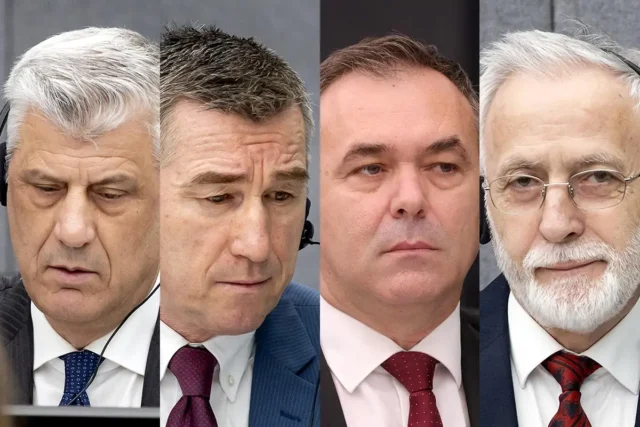
Banjska, September 2023, belongs to the same architecture. A heavily armed group, whose operational leadership Milan Radoičić has publicly acknowledged, attacked Kosovo Police in Zveçan, killing Sergeant Afrim Bunjaku. Radoičić, at the time deputy leader of the Srpska Lista party that represents Belgrade’s political structure inside Kosovo, has remained in Serbia, uncharged and unextradited. Belgrade’s handling of the attack treated it as an internal Kosovo matter rather than as a cross-border security event. That framing requires the same premise. A state that does not recognize Kosovo as sovereign cannot recognize an armed attack on Kosovo as aggression against a sovereign. The Radoičić non-extradition is the ongoing administrative expression of the doctrine.
Here the Zelensky frame clarifies what has been the Western error.
For two decades, Western diplomacy has treated the Kosovo question as a recognition dispute to be managed through dialogue. The assumption has been that normalization is possible because Belgrade’s non-recognition is a policy, and policies can be negotiated. Zelensky’s formulation exposes what this assumption misses. If the non-recognition is ideological, if it rests on the proposition that Kosovo does not exist and never did, then every round of dialogue is a round conducted by Pristina in good faith with a counterpart whose fundamental premise is that Pristina is not there. The chair on the other side of the table is occupied by a state that does not acknowledge the chair on this side.
This is not cynicism. It is structural observation. It explains why twelve years of Brussels-facilitated dialogue have produced agreements that lead nowhere. The implementation gap is not only a failure of political will. It is, at the deeper level, the logical output of a framework that cannot recognize the implementer.
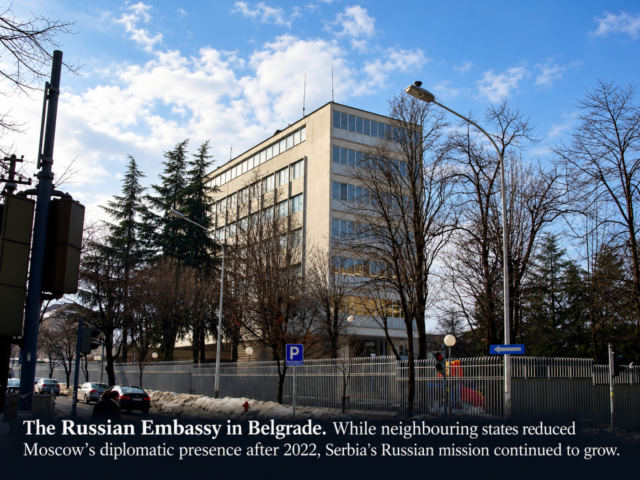
Zelensky’s contribution at the Four Freedoms ceremony was to name the framework in terms that Western audiences can hear. Russian revanchism is no longer deniable in Europe, and naming the doctrine behind it has become part of how the war is understood in Washington, Berlin, Paris, and Warsaw. What remains insufficiently named is that the same framework operates in the Western Balkans at a lower temperature, with the same ideological core, with Moscow functioning as the theoretical center and Belgrade as the closest operational relay.
It is not enough to say that Russia and Serbia are strategically aligned. The alignment is ideological. They share an architecture. The architecture holds that certain neighboring nations do not exist, that their states are fictions, and that their land is rightfully someone else’s.
Kyiv has named it. Pristina has lived it. What Brussels and Washington do next depends on whether they are prepared to name it too.
Albatros Rexhaj is a writer and analyst covering Western Balkans geopolitics and transatlantic affairs.