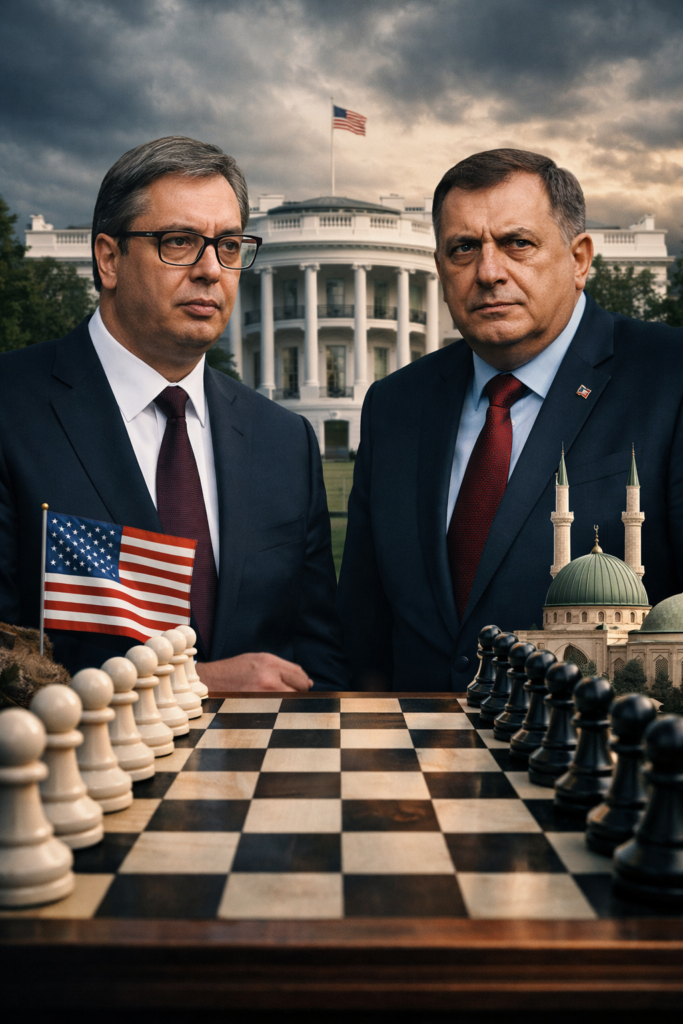
Vučić and Dodik are not defending Christians. They are running an equation — Muslim majority equals civilizational threat — that Washington is paying for with its own credibility.
by Drizan Shala (Prishtina)
On February 19, 2026, at the inaugural meeting of Donald Trump’s Board of Peace in Washington, the commander of the International Stabilization Force for Gaza announced the first five countries to formally commit troops to Trump’s own peace mission: Indonesia, Morocco, Kazakhstan, Kosovo, and Albania. Two majority-Muslim, secular democracies — Kosovo and Albania — said yes when Washington asked for soldiers in the most politically sensitive theatre on earth. They did so as U.S. partners, under U.S. command, in service of a U.S.-designed peace plan.
Twelve days earlier, Milorad Dodik had been at the National Prayer Breakfast in Washington, telling Defense Secretary Pete Hegseth about the defence of Christian values against the Muslim populations of Bosnia. The same administration that accepted Kosovo’s and Albania’s troops for Gaza had just hosted the man who calls those same societies an existential civilizational threat.
These two facts cannot occupy the same foreign policy without contradiction. This week, Serbian President Aleksandar Vučić made that contradiction explicit. Commenting on the Trump administration’s commitment to protecting Christianity, Vučić said it was “good news for the Republic of Srpska — and not bad for us either.” He added that Trump and Putin “always noted a desire to safeguard Christian values” and would understand the needs of Kosovo Serbs.
That contradiction is not accidental. It was manufactured — deliberately, methodically, and at considerable expense — by Belgrade and Banja Luka. And Washington, so far, has been paying the bill.
The Equation
What Vučić’s words reveal is not a position on religion. They reveal a strategy. What he and Dodik have constructed is a political weapon assembled from a single equation: Muslim-majority society equals civilizational threat. Applied to Bosnia, the equation justifies partition. Applied to Kosovo, it justifies permanent delegitimisation. Exported to Washington, it produces something more dangerous than either — a U.S. posture that, followed to its logical conclusion, categorises America’s own allies and partners across the Muslim world as the enemy.
The equation is not new. Serbia has promoted the Islamic extremism narrative against Kosovo since at least the late 1960s. After September 11, 2001, the framing was modernised: Serbia sought to recast its military campaign in Kosovo as a contribution to the global war on terrorism, presenting the Kosovo Liberation Army — a secular, nationalist movement — as an Islamist force. The template failed but survived. Vučić has personally sustained it, stating on multiple occasions that Kosovo is “the center of Islamic radicalism in the Balkans” and that “extremists from Kosovo endanger the security of the region and Europe.” His former foreign minister, Ivica Dačić, told the United Nations in 2018 that Kosovo had become “a base for recruiting Islamic terrorists.”
These claims have been systematically refuted — by Kosovo’s own security institutions, by European Commission assessments, and by the country’s documented cooperation with international counter-terrorism frameworks. The Kosovo Institute for Security and Resilience catalogued the full disinformation campaign in a March 2025 report. The European Parliament has formally noted that Kosovo has been subjected to coordinated disinformation from Russian and Serbian nationalist sources aimed specifically at destabilising its democratic institutions and inciting ethnic violence.
False. And durable — because they are not designed to be true. They are designed to be useful.
In Bosnia, Dodik applies the same logic with less subtlety. In a June 2024 interview with the Jerusalem Post, he stated that coexistence with Muslims in Bosnia is impossible, drawing a direct parallel to the Israeli-Palestinian conflict. At a Banja Luka rally following his ally’s election, he declared that “Muslims want harm for Serbs.” Analysts at Balkan Insight have documented a sustained pattern of rhetoric designed not merely for domestic mobilisation but to delegitimise Bosniaks as an equal political community — the necessary precondition for arguing that multiethnic Bosnia is structurally impossible and Republika Srpska’s secession therefore not aggression but self-preservation.
In June 2024, Serbia and Republika Srpska formalised the framework: a 13-page declaration signed by both Dodik and Vučić, ratified by both parliaments, establishing the political-legal architecture. The civilizational rhetoric provides the moral grammar.
How the Operation Reached Washington
The frame was not carried to Washington by chance. It was purchased. Republika Srpska retained multiple U.S. lobbying firms with Republican connections after Trump’s re-election, filing contracts under the Foreign Agents Registration Act. Among those advocating on Dodik’s behalf was Rod Blagojevich — the former Illinois governor pardoned by Trump in February 2025 after serving eight years on corruption charges, including attempting to sell Barack Obama’s vacated Senate seat. Less than two months after his pardon, Blagojevich signed a contract with the RS government to lobby U.S. officials and publish articles portraying legal actions against Dodik as a politically motivated witch hunt. He published a piece in the Washington Times claiming that Bosnia’s Muslim-Croat Federation entity is an Iranian Hezbollah base in the making — without evidence. He stated publicly that he wanted Serbia and Republika Srpska to become “bastions of Judeo-Christian values in the Balkans, just as Israel is in the Middle East.”
A pardoned felon, paid by a convicted Dayton violator, running a civilizational warfare narrative through MAGA media channels. That is the lobbying operation in one sentence.
It delivered results. In February 2026, Dodik, Cvijanović, and Acting RS President Ana Trišić Babić attended the National Prayer Breakfast in Washington — their first visit to the United States since sanctions were lifted. Dodik met with Hegseth and posted afterward that he had found a man who “deeply understands how essential strength, principled leadership, and the defence of Christian values are to preserving freedom and the dignity of nations worldwide.” The delegation also met with former National Security Advisor Michael Flynn, Speaker Mike Johnson, and White House press secretary Karoline Leavitt. A pro-RS analyst summarised the strategy without euphemism: the delegation had used the access “to highlight pressure on Christian identity, an issue to which the U.S. administration is sensitive.”
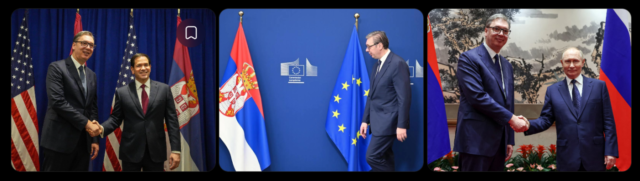
Vučić has now extended the frame to Kosovo. Patriarch Porfirije’s letter to Trump, Putin, and Pope Leo XIV — invoking Christian values to oppose Pristina’s enforcement of the foreigners registration law — was immediately endorsed by Vučić, who declared that both leaders “always noted a desire to safeguard Christian values” and would understand Kosovo-Metohija Serbs’ needs. The Patriarch writes. Vučić interprets. Trump’s religious agenda provides the geopolitical alibi. The architecture now points directly at Washington’s own standing across the Muslim world.
What the Equation Costs
Kosovo and Bosnia are secular constitutional orders. Their legal systems, elections, and foreign policies are entirely independent of religious authority. Kosovo submitted its EU membership application in December 2022 and carries a formal European perspective endorsed by the Council of the European Union; the European Parliament called on the five non-recognising member states as recently as May 2025 to grant recognition so Kosovo can advance its accession. Bosnia is an EU candidate country. Neither is an Islamic republic. Neither is governed by religious law. The Muslim identity of their majority populations is demographic, not governmental — a cultural inheritance, not a governing ideology, in precisely the same sense that Poland is Catholic or Greece is Orthodox.
Vučić and Dodik are collapsing that distinction deliberately. The collapse is the mechanism — and the mechanism, if left uncontested, costs Washington far more than a Balkans credibility problem.
The United States maintains a NATO alliance with Turkey. It runs deep defence partnerships with Jordan, the UAE, Saudi Arabia, Qatar, and Pakistan. It depends on Gulf sovereign wealth for domestic investment, on Gulf intelligence for counter-terrorism, and on Muslim-majority states across three continents as the operational backbone of its global security architecture. It has just re-engaged diplomatically with a post-Assad Syria. It makes, with care and consistency, an explicit distinction between Islam as a faith and violent extremism — a distinction that is the functional premise of every counter-terrorism partnership it holds.
Vučić and Dodik erase that distinction entirely. In their framing, Muslim majority is the threat — not radicals, not armed groups, not specific actors, but the demographic fact of a Muslim population. When this equation is performed before senior U.S. officials and validated by their presence, their handshakes, and their sanctions relief, it sends a signal to Ankara, Amman, Riyadh, Doha, Abu Dhabi, Islamabad, and Damascus that the distinction Washington has always claimed to make — between a faith and its most violent fringe — is available for purchase by the right lobbyist with the right connections.
Washington cannot hold both positions simultaneously without cost. Either the equation is wrong — in which case Dodik and Vučić are lying, and the officials who attended their prayer breakfast did so on false pretences — or it is right, in which case U.S. foreign policy toward the entire Muslim world requires fundamental revision. There is no third reading.
Brussels faces a version of the same problem, compounded by institutional stakes. The EU cannot simultaneously champion its partnerships with Muslim-majority candidate and partner states and permit two EU-adjacent governments to categorise Muslim-majority secular democracies as structurally incompatible with European civilisation. The Islamophobia embedded in this narrative has been documented as a deliberate tool to poison EU enlargement itself — promoting the idea that “Europe does not want more Muslims” to generate anti-enlargement sentiment on both sides simultaneously, among EU member state publics and Western Balkan populations alike. The civilizational frame damages the EU’s most consequential regional policy instrument from both ends at once.
The Bill
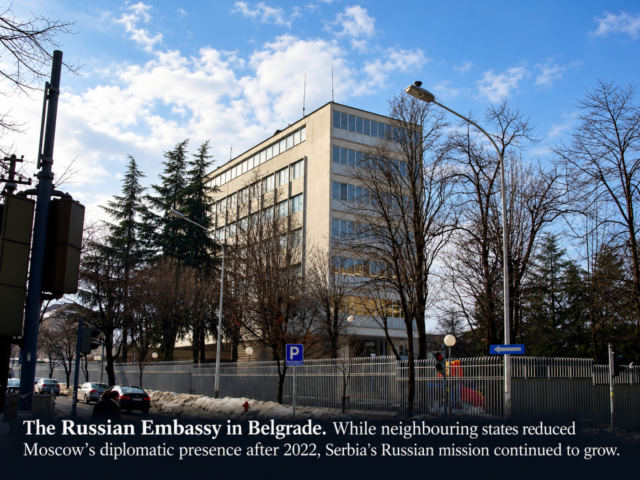
The immediate cost to Washington is Dayton credibility. The Trump administration lifted sanctions on a politician twice penalised for violating the U.S.-brokered peace agreement — and notably, first sanctioned not by Obama or Biden but by Trump himself in July 2017. Dodik thanked the administration for correcting “a grave injustice inflicted by the Obama and Biden administrations,” omitting that detail entirely. A former U.S. diplomat assessed the transaction plainly: Dodik “dropped his most significant challenges to the Dayton Accords to appease the White House, though he maintains the ability to launch another disruptive secession campaign.” Washington paid in strategic credibility and received a pause. For the first time since 1995, Washington and Moscow find themselves on the same side of the Dodik question — not by accident, but as the direct consequence of a lobbying operation that repackaged a convicted secessionist as a defender of Christian civilisation.
Russia did not need to intervene. Belgrade and Banja Luka delivered the realignment through a pardoned felon, a prayer breakfast, and a civilizational narrative — all of it aimed at countries that are, at this moment, sending troops to serve under the U.S. flag in Gaza.
The longer bill is being sent to capitals across the Muslim world that are watching what Washington chooses to validate, and drawing their own conclusions about what the distinction between Islam and extremism is worth when the equation Muslim-majority-equals-threat is performed in the Oval Office’s shadow — and no one in Washington calls it what it is.
About the author:
Drizan Shala is a Kosovo-based security expert and political analyst specializing in national security, defense policy, hybrid threats, and regional geopolitics in the Western Balkans. He is a PhD candidate in Security Studies (Homeland Security) at the University of Sarajevo’s Faculty of Criminalistics, Criminology, and Security Studies. Shala serves as Executive Director of the Association of Criminal Law, Criminologists, and Victimologists of Kosovo and as Director of the Kosovo branch of the SIRAS Academy. His work focuses on security normalization, deterrence dynamics, and the integration of Western Balkan states into Euro-Atlantic security frameworks. He regularly contributes analysis to regional and international media and has published on NATO intelligence doctrine and contemporary defense cooperation models.