When the world’s construction industry gathered in Nuremberg, Albania sent one company. The rest stayed home.
by Elis Zenelaj (Tirana)
From March 24 to 27, in the halls of the Nuremberg Exhibition Centre, something happened that Albania’s industrial press largely missed.
Everest Sh.p.k., the Kamëz-based aluminum profile manufacturer, stood on the floor of Fensterbau Frontale, the world’s leading trade fair for windows, doors, and facades. Alongside it: 1,022 exhibitors from 47 countries, 75,000 visitors from 117 nations, German engineering houses, Austrian profile system makers, Turkish extrusion giants. The kind of room where contracts are signed before lunch and reputations are built over four days of walking and talking on concrete floors.
Everest was the only Albanian company in that room.
That fact deserves more than a footnote.
When we spoke to Everest CEO Sokol Çupi last month, he was measured about what his company represents. “Potential,” he said, when asked whether Everest symbolizes Albania’s arrival as an industrial economy. “But potential is not maturity.” He was right to resist the triumphalist reading. A single company, however well-run, does not constitute an industrial base.
But the Nuremberg appearance changes the frame of that conversation, at least partially. Potential, by definition, is unproven. A stand at Fensterbau Frontale is not potential. It is presence. It is a company that manufactures aluminum profiles in Tirana’s periphery, holds ASI certification, has published Environmental Product Declarations that meet European standards, and now puts its systems in front of the buyers, architects, and procurement directors who decide which profiles go into buildings across Germany, Austria, and Scandinavia.
That is not potential. That is a company competing.
The economics matter here, and they are worth stating plainly.
Albania’s trade balance runs structurally in deficit. Exports declined 15.3 percent in 2024 while imports grew. Aluminum and aluminum articles account for roughly $139 million in annual exports, around 3 percent of total merchandise sales abroad. The broader construction materials and metals category represents just under 19 percent of what Albania sells to the world. These are not numbers that suggest a country with a commanding industrial identity.
What they suggest, instead, is a country where the manufacturing sector remains narrow, where too few firms have climbed the value chain far enough to compete on European terms, and where the ones that have are carrying disproportionate weight.
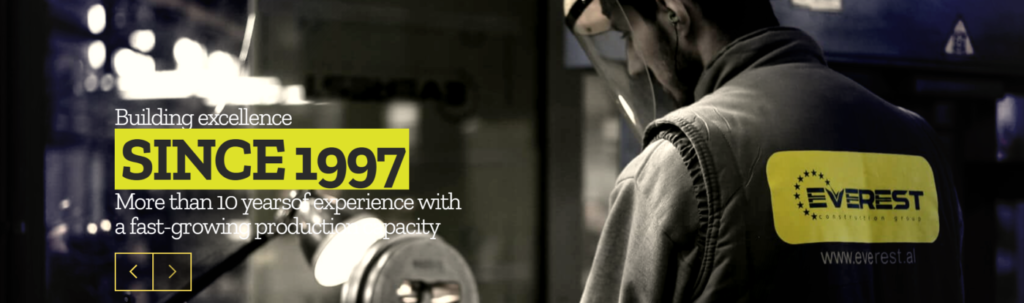
Everest is one of those firms. Seven hundred employees, turnover in the billions of lek, export flows into more than ten European countries, operational presence in the United States. Çupi told us that Albania has too few companies of that size. He was, again, correct. The Nuremberg floor confirmed it differently: Albania had one company there. Turkey had dozens. Germany filled entire halls.
The significance of Fensterbau Frontale is not merely symbolic. The fair, held from March 24 to 27 this year and returning every two years, is the place where European construction procurement decisions get shaped, where profile system manufacturers build the relationships that translate into multi-year supply contracts. Presence there is access to a pipeline that catalogues and digital outreach cannot replicate. Buyers who walk a fair floor in four days meet more suppliers, compare more systems, and make more procurement decisions than they would in six months of correspondence. Missing that floor is not a neutral choice. It is an absence that compounds.
For Everest, the question coming out of Nuremberg is whether the stand produced leads that convert, whether the company’s profile systems held their own against German and Turkish competitors in direct comparison, and whether the ASI certification and the EPD documentation that Everest has invested in did the work they were designed to do when a German architect or a Danish procurement manager stood at the booth and asked the right questions.
Those answers will not be public. But the fact of the participation is itself informative: Fensterbau Frontale does not invite companies. Companies qualify and register. To be there is already to have passed a threshold.
Çupi told us that strong institutions benefit companies like his because they create predictability, and that without predictability, industrial investment slows. The observation runs in both directions. A company that survives EU-level certification scrutiny, publishes environmental declarations, and competes on a German trade fair floor is also telling its government something: that the regulatory and infrastructural conditions that made this possible need to hold, and that the ones still missing, on energy, on workforce retention, on compliance frameworks, are costing the country companies it does not yet have.
In Nuremberg, Everest was not representing the Albanian state. It was representing itself. But in a room where country of origin is visible on every stand badge, it was also, inevitably, representing a version of what Albanian manufacturing can look like when it is given time and discipline to develop.
That version deserves to be seen clearly, without inflation and without dismissal.
One company on one floor. The only one from its country. Competing, not observing.
For an economy that still exports more shoes than engineered systems, one company on one floor is not a solution. But it is evidence that the floor is reachable. The question Albania has not yet answered is why it took so long to get there, and who else is coming.
Elis Zenelaj is a staff writer for the Tirana Examiner.