Albania’s ancient tower-houses kept blood feuds, sheltered enemies, and encoded an entire civilization. Now the state wants to turn them into hotel rooms. The question is what survives the transaction.
by Livia Brunga (Tirana)
Luli Hupi asks you to take your shoes off at the door.
It is a small gesture, the kind that could easily read as quirky guesthouse policy, except that in this particular doorway the request carries several centuries of weight behind it. The door itself is deliberately low. You bow your head to enter. Whether that was an architectural accident or an encoded lesson in humility depends on whom you ask. In northern Albania, most people will tell you it was both.
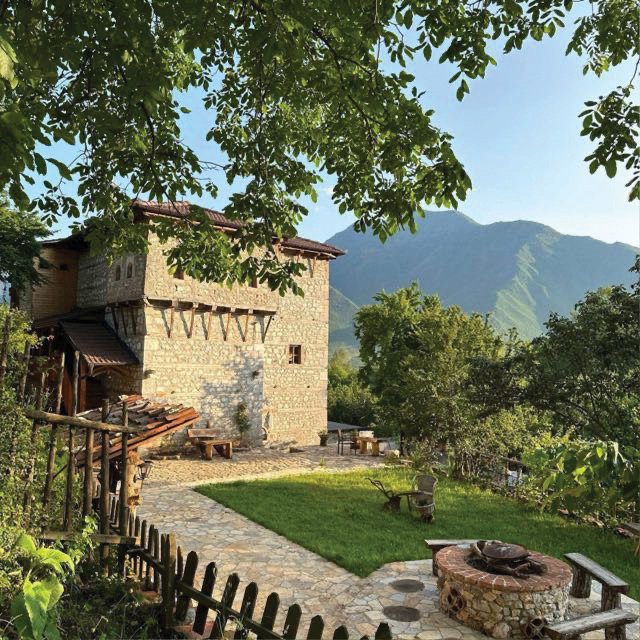
Inside, the walls are a meter thick at the base, narrowing toward the roof like a fist slowly unclenching. The wooden beams are original. The fireplace in the upper room is the same fireplace where Luli’s grandfather received guests, where his great-grandfather before him received guests, where the fire was lit not for ambiance but because a visitor had arrived and honor required it. Luli spent years abroad, working in mines, sending money home, watching the kulla his family had held for generations slowly give itself back to the mountain. Then he returned and began the restoration, stone by stone, using traditional techniques and local limestone, the same material the original builders chose because the mountain offered it.
Kulla Hupi is now a guesthouse. It is also, depending on how you look at it, either a success story or a parable. Possibly both. Albania is betting on the former.
The kullat of the Albanian highlands are among the most singular structures in the Balkans: part fortress, part courthouse, part cosmology. Built predominantly from the 17th century onward, when the Dukagjini region was locked in continuous conflict, they served as fortified residences for extended clan families and they did so with a completeness that modern architecture rarely achieves. The walls are thick because they had to stop bullets. The windows are small, narrow slits called frëngji, designed less to let light in than to let arrows out. The entrance is low so that an enemy entering could not raise his weapon before he was visible.
But the kulla was never only a defensive structure. It was a social archive, its rooms a precise map of status, obligation, and honor. The ground floor housed cattle and agricultural equipment. The family quarters sat above. At the heart of the upper level was the oda e burrave, the chamber of men, a room with no precise equivalent in any European architectural tradition.
The oda had a large fireplace, lit when guests were present. The most honored guest sat closest to it, on the section of carpet known as the big cerga. Families across northern Albania competed to have the most generous and most frequented oda e burrave. This investment in hospitality was not mere social performance. It was understood as a form of moral standing, a public declaration of who you were and how seriously you took your obligations to others. Historical events were recounted here, epic songs were sung, disputes were mediated. The room was where a community’s memory lived between one generation and the next.
Governing all of this was besa. The word is usually translated as pledge of honor or word of honor, but the translation flattens something that in Albanian carries the weight of an entire ethical architecture. Besa is sacred and inviolable. Thirty-eight articles of the Kanun of Lekë Dukagjini, the medieval customary code that governed social life across the northern highlands, defined the adequate treatment of a guest. Hospitality fell under honor’s provisions. The role of a guest was estimated so highly that he became, in the Kanun’s framing, a fundamental component of the Albanian house. Even a man in an active blood feud with his visitor was required to extend full protection under his roof for the duration of the stay.
The kulla, then, was not just the building in which hospitality happened. It was hospitality materialized in stone.
Certain kullat served one additional function, among the most striking in Balkan architectural history: the locked tower, kulla ngujimi, a refuge for men targeted by blood feuds. The most famous example still stands in Theth, in the Accursed Mountains north of Shkodër. It is still owned by the family that built it. Men spent years inside those walls, neither free nor dead, living in the gap between honor and violence, while the world outside slowly negotiated the terms of their survival.
Now Albania wants to put these buildings on the tourist circuit.
The government’s Ministry of Tourism, Culture and Sport is developing what it describes as a national revitalization program for kullat across four northern counties: Lezhë, Dibër, Kukës, and Shkodër. The program draws on a GIZ pilot project, funded by the German, Swiss, and British governments, which has linked nine kullat in northern Albania into a cultural route called the Tower Tour. Around 350 owners have already registered interest. The language from Tirana is optimistic and measured. The stakes, however, are considerably higher than the language suggests.
The program’s architects are not naive. They speak of GIS documentation, interdisciplinary expert panels covering everything from ethnography to musicology, and conservation pacts built around the principle of minimal intervention. They acknowledge the obstacles plainly: unresolved property titles stretching across communist-era appropriation and post-1991 legal chaos, poor road infrastructure, a rural labor shortage driven by decades of emigration. The fiscal incentives for private owners remain under discussion, which in Albanian policy language means they exist as intention rather than mechanism. The program proposes four typologies for revitalized kullat: museum, guesthouse, agritourism hub, artisan workshop.
Luli Hupi has, in effect, already built the template. The ground floor of his kulla, once home to sheep and poultry, now houses the family kitchen and a guesthouse restaurant. The rooms above offer accommodation. The thick stone walls, the wooden beams, the handcrafted furnishings: all of it intact. “I want every second to be authentic for my guests,” he says. The shoes still come off at the door.
This is, by any measure, a better outcome than the alternative. When communism fell and Albanians were allowed to move freely, the mountains emptied. Kullat across the north were abandoned and began surrendering to snow and time. A restored kulla receiving guests is obviously preferable to a collapsed kulla receiving no one. The tension the program cannot fully resolve, however, is not between restoration and ruin. It is between two incompatible meanings of the word host.
In the world the kulla was built to serve, hospitality was an obligation without price. The guest arrived, the fire was lit, the oda opened. To charge a man for that would have been not merely rude but a violation of something closer to sacred law. The Kanun held that hospitality was totally magnanimous and unselfish, offered through simple actions and modest materials. The transaction was moral, not commercial. Its currency was honor, not money, and this distinction was not incidental. It was the whole point.
What the revitalization program asks these buildings to do is structurally different. It asks them to perform hospitality for strangers who have paid in advance, whose stay is governed by a booking confirmation rather than besa, whose experience is curated for a particular kind of cultural tourist looking for something authentic to carry home in memory. The kulla becomes, in this model, a container for an experience of Albanian identity sold to people who are not Albanian.
This is not an accusation. It is the central paradox of heritage tourism, encountered in every corner of the world where a living culture becomes a destination. The act of preservation almost always involves transformation. The question is whether what survives retains anything essential, or whether the shell remains while the meaning quietly evacuates.
In the case of the kulla, that question is unusually sharp. These buildings did not encode aesthetic values. They encoded a relational ethics. The oda e burrave was not a men’s lounge with interesting rugs. It was the physical site of a moral obligation, a room where a man’s word was given, where a community’s memory was kept, where the logic of besa was rehearsed and reinforced across generations. When that room becomes a dining area for tourists eating trout and local cheese while a hospitality trainer explains the concept of honor in five languages, something has changed that cannot be measured in square meters.
The ministry’s own documents acknowledge the dilemma. They cite the model of the Shtëpia e Zjarrit, the House of Fire, as a way of providing modern comfort without deforming the kulla’s historical architecture. They know the problem exists. They do not claim to have solved it, which is, at minimum, honest.
Beneath the cultural language, the government’s case for the program rests on something more urgent: northern Albania is emptying.
Tourism across Albania has surged dramatically in recent years. The south has seen the most dramatic transformation: Berat and Gjirokastra, both UNESCO-recognized heritage cities, have experienced visitor growth that has measurably changed local economies, reversed some emigration patterns, and drawn private investment into communities that were stagnating. The northern interior has not experienced anything comparable. Young people continue to leave. The kullat that survive do so because someone old enough to remember their meaning still lives in them.
If the program works, the argument goes, it creates economic reasons to stay. The kulla becomes not just a monument to a vanished world but a livelihood for the people whose world it was. Agritourism, guided hiking, artisan production tied to tourist traffic: these are not replacements for the social grammar the kulla once anchored, but they are reasons for the grandchildren of that grammar to remain near it rather than disappear into Tirana or Milan.
Luli Hupi is the program’s implicit argument. He left, worked abroad, returned, and bet on the north when the north was still losing. He speaks of the region’s future as lying above the ground, in its heritage, its landscape, and its people. He is speaking as someone who made that bet with his own hands and his grandfather’s stone. His optimism is earned.
The counterargument is not that the program is wrong to try. It is that economic revitalization and cultural preservation are not the same project, and treating them as identical will eventually compromise both. A kulla turned into a boutique guesthouse generates revenue and keeps the stone standing. It does not keep alive the social grammar that the stone was built to express. Those two outcomes are worth distinguishing, even when the first is the only one currently achievable.
The program is also honest about what it cannot fix. And it cannot, finally, fix the deepest thing.
The state can inventory the kullat, document their architecture, digitize their coordinates, offer tax incentives to their owners, connect them to tour operators, and train local families in hospitality standards. What it cannot do is restore the Kanun, rebuild the clan networks that gave the oda e burrave its social function, or reconstitute a hospitality tradition whose moral weight came precisely from the fact that it was not a service but an obligation. You cannot legislate cultural meaning. You can only create conditions in which meaning might find new forms.
What the program can do, at its best, is keep the buildings standing long enough for the culture around them to discover what it still has to say. That is not a small thing. Stone lasts. Meaning is more fragile, and meaning requires a material home.
The kullat have survived blood feuds, Ottoman occupation, communist demolition orders, and the quiet violence of rural abandonment. Whether they survive authenticity as a tourism category remains, for now, genuinely open.
Luli Hupi’s fire is lit. The shoes are at the door. The question is what a guest, in this new arrangement, is actually entering.
Livia Brunga is a prominent Albanian media personality and digital creator whose work bridges storytelling, culture, and the natural world. A long-time advocate for sustainable travel and environmental awareness, she explores Albania’s landscapes through a lens that blends curiosity, visual sensibility, and a deep personal connection to nature.