From snowfields above Epirus to the Adriatic shore, the Vjosa has flowed unbroken for millennia. Now, as the rafts return and the world takes notice, the river is teaching Albania something about what it means to leave a place alone.
by Livia Brunga (Tirana)
Zamo Spathara was standing on the bank of the Vjosa when a politician told him he had no right to be there. Not physically, but argumentatively. “Who do you think you are,” the man said, “the father of the river?” Spathara, who had spent years organizing guides, petitioning ministries, and dragging international attention to a waterway most Europeans had never heard of, thought about it for a moment. Then he said: no. But someone has to act like it.
That exchange, small and sharp, contains the whole story of what the Vjosa is and what it nearly was not. Europe’s rivers have been, for the better part of two centuries, objects of engineering ambition. The Rhine is a working canal. The Danube carries barges and hydroelectric calculations. Of the large rivers that once ran free from mountain source to coastal delta, undivided by concrete, barely one remains. The Vjosa is among the last.
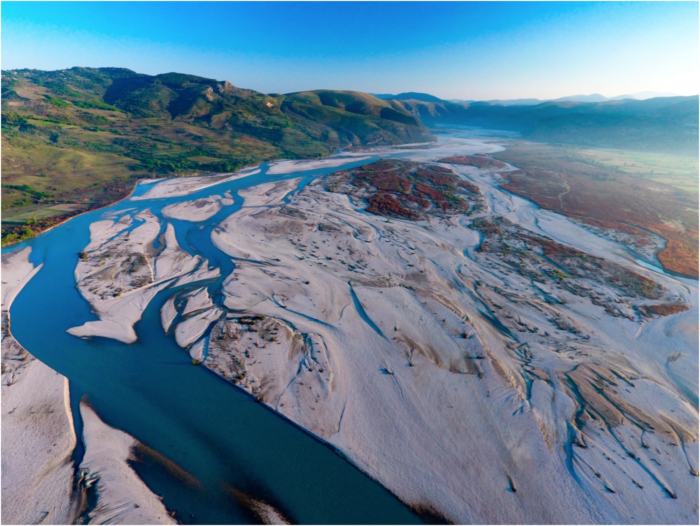
It rises in the Pindus Mountains of northern Greece, where it is known as the Aoös, a name that survives from antiquity. It descends through limestone gorges, crosses into Albania near Çarshovë, and begins its 192-kilometre passage through a landscape the twentieth century, for a mixture of poverty and politics, largely passed over. It flows through Përmet and Këlcyrë, gathers the Drino near Tepelenë, and reaches the Adriatic north of Vlorë. No dam interrupts it. No weir holds it back. It is, in the plain engineering sense, a complete river.
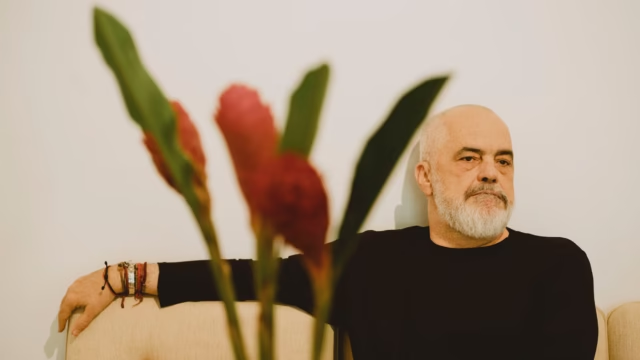
That completeness is not accidental. It is the product of a decade of organised resistance against a Turkish-Albanian energy venture that held permits to build a fifty-metre dam at Kalivaç, which would have flooded the river’s middle stretch and displaced communities that had grown along the Vjosa’s banks for centuries. The campaign gathered signatures, projected slogans onto monuments in Paris and Berlin, and made the case, repeatedly and arithmetically, that a free-flowing Vjosa was worth more to the people along its banks than the electricity revenues a dam would generate. In 2021, an Albanian administrative court ruled against the concession. On 15 March 2023, Prime Minister Edi Rama signed the Vjosa Wild River National Park into law, the first of its kind in Europe. In 2025, UNESCO designated it a biosphere reserve.
The river repays the protection. The Vjosa and its four tributaries host more than 1,100 animal species, among them thirteen classified as globally threatened. The Egyptian vulture nests in the gorge cliffs. The Balkan lynx, perhaps fifteen individuals remaining in the wild, has been recorded in the forested ridges above the valley. River otters work the shallows. The fish fauna, which includes species found nowhere else, is sustained by the river’s uninterrupted sediment flow: gravel bars shift and rebuild, islands appear and vanish, the braided middle reach rewrites itself with every flood. In a regulated river, that process stops. The Vjosa’s biodiversity is not incidental to its wildness. It is a product of it.
On 29 March 2026, the tenth edition of Albania’s National Rafting Championship was held on these waters. Teams from Hungary and the United Kingdom joined Albanian competitors. The participation of women tripled. International coach Andrea Gatti, watching the guides run the Vjosa’s currents, said the technical standards had improved significantly; rafting here, he said, is now a sustainable tourism product by any comparative benchmark. Spathara, who heads the Albanian Rafting Federation, received this carefully. The goal, as he describes it, is not to turn the river into a theme park but to make its value to the communities along its banks so legible, so concrete, so measurable in income and employment, that no future government will find it rational to dam it. The championship is, among other things, an annual demonstration that the river is worth more running than stopped.
That logic is extending. Federation officials are looking at the Drini i Zi and other Albanian rivers where the same model might take root. The Përmet region, at the centre of the park, has seen accommodation, gastronomy, and craft enterprises develop in ways that were not possible when the valley was simply remote. The river economy is real and it is growing.
There is a political argument for wild rivers, and an economic one, and an ecological one. The Vjosa’s survival required all three to be made simultaneously, in different rooms, to different audiences. What tends not to be said, because it resists quantification, is what the river also carries: a continuous thread of human presence running from the Illyrians through the Ottomans and through the long communist isolation and out the other side, all of it shaped by a waterway that was never tamed because it was never worth the cost of taming. The Vjosa is a common Albanian female name. It appears in folk songs. It appears in the memory of people who grew up on its banks and then left, the way rivers appear in memory, as a fixed point against which everything else is measured.
Europe spent two centuries straightening its rivers. The Vjosa ran while that was happening, through a country that could not afford to stop it. What was once the poverty of inaccessibility has become, in the language of the twenty-first century, a global asset. The river does not know this. It simply runs.
Vjosa Wild River National Park covers 12,727 hectares in southern Albania. The park protects 190 kilometres of the Vjosa and four tributaries. Rafting and guided expeditions operate seasonally from Përmet.