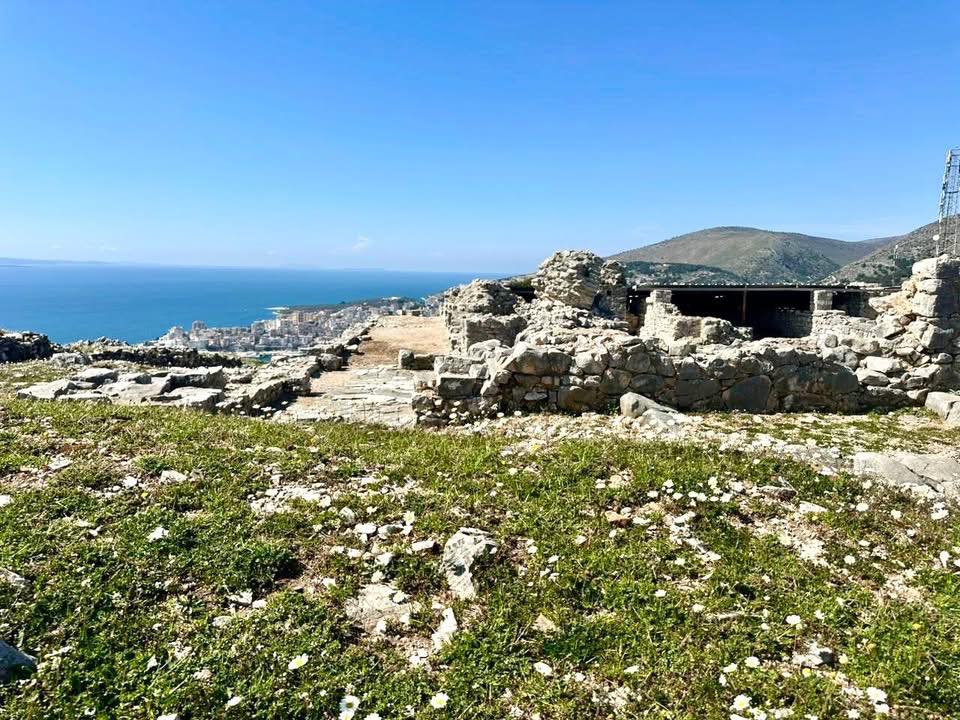
The Monastery of the 40 Saints is a designated cultural heritage monument located southeast of Saranda’s port. Annual religious observances take place on 9 March, the feast day of the Forty Martyrs.
by Rizarta Hoxha (Tirana)
From the hill above Saranda, you understand immediately why someone in the sixth century decided to build here. The Corfu Channel opens below you, that narrow band of blue that has served as the corridor between the Adriatic and the Ionian for three millennia. Corfu itself sits close enough to feel reachable on foot. To the south, the Albanian Riviera curves toward Greece. On a clear morning, which is most mornings, the light does something specific to this water that painters have been failing to capture since the ancient Greeks first gave this place a name.
The name they gave it was Onchesmos, a Chaonian settlement that grew into one of the principal ports of ancient Epirus. Bronze Age tools typical of Mycenaean Greece have been unearthed here, dating to roughly 1400 to 1100 BC, which means human settlement on this bay predates the Greeks who named it. By the classical period, Onchesmos served as port to the Chaonian capital Phoenice, and it had become one of the ordinary points of departure from Epirus to Italy. Cicero noted the winds here as favorable for the crossing. His word for those winds, onchesmites, tells you how well-known this harbor was to the Roman world. According to Dionysius of Halicarnassus, the real name of the place was the Port of Anchises, named after the father of Aeneas, and the Trojans were said to have dedicated a temple to Aphrodite on this shore. Even the myths of this coast are about passage, about crossing, about arriving from somewhere else.
The city layered identities the way this coast layers geological strata. It held one of the earliest Jewish communities in the Balkans: a synagogue built in the fourth or fifth century, constructed by descendants of Jewish captives who arrived following the First Jewish-Roman War around 70 CE. A gravestone in a Jewish cemetery in Venosa, Italy, dated 521 AD, names the daughter of a community leader from Anchiasmon, the Byzantine name for this city. The ties between this harbor and southern Italy were that old, that specific. A city has to accumulate several centuries of significance before the dead it produces start turning up in other countries’ graveyards.
The current name of the city comes from a hill to its east, and from a story that traveled much further to get here.
In the year 320 AD, near the city of Sebaste in Lesser Armenia, the territory of present-day Sivas in Turkey, forty soldiers of the Legio XII Fulminata, the Twelfth Thundering Legion, were condemned by the prefect of Emperor Licinius for refusing to renounce their Christian faith. The punishment devised for them was exposure: stripped and driven into a frozen pond in midwinter, with a heated bathhouse set on the shore as a standing offer to any man who recanted. The martyrs, on hearing their sentence, ran to the place and without waiting to be stripped, undressed themselves, encouraging one another as soldiers do in hardship, saying that one bad night would purchase them a happy eternity.
Among the confessors, one yielded and sought the warm bath. But one of the guards, watching from the shore, beheld a supernatural brilliance overshadowing the men, proclaimed himself a Christian, threw off his uniform, and stepped into the freezing water beside the remaining thirty-nine. Thus the number of forty remained complete. At daybreak, the stiffened bodies, which still showed signs of life, were burned and their ashes cast into a river so that Christians would not gather them up. Christians gathered them anyway.
Aware that their death was imminent, the martyrs had written their last thoughts in a collective testament, asking that their remains be kept together. The document survived. Their names survived: Cyrion, Claudius, Domnus, Severian, Eutychius, and thirty-five others, a roster of men from across the Roman world, preserved in the ecclesiastical record with a specificity that distinguishes this account from generic martyrology. Bishop Basil of Caesarea eulogized them only fifty or sixty years after their deaths, which means the feast day of these soldiers predates even the earliest written account. Procopius recorded how the Emperor Justinian was cured of a serious infection of the knee when brought into contact with relics of the forty. Their cult spread from Rome to Armenia, replicated in churches, ivory panels, crypt frescoes, and collective memory across the eastern Mediterranean.
How their cult arrived above this Albanian bay is unknown. What is known is that someone, almost certainly during the reign of Justinian, decided that this hill above Onchesmos was where those relics belonged, and built accordingly.
The scale of the ambition is readable even in the ruins. The basilica was forty metres long and twenty-four metres wide, with a seven-concave interior plan, three columns in each nave, and an apse protruding from the eastern facade. Two arcaded narthexes on the western and southern sides offered pilgrims a view of the bay and the Corfu Strait. The main structure shares architectural parallels with the seven-apsed banqueting hall of the palace of Lausos in Constantinople, built around 530 to 550 AD. This was not a provincial outpost of Byzantine piety. It was a metropolitan building, comparable in ambition to the episcopal architecture at Nicopolis. The underground complex beneath it consists of galleries, vaulted corridors, and seven chapels, designed to accommodate the volume of people that the relics would draw. Pilgrims accessed the relic chamber through a passage on the church’s north side.
On the outer walls, four inscriptions in red tiles name three donors: Qirjako, Theodhor, and Parigoro, with only the first letter identified for the fourth. These are Greek prayers for the protection of the donors, among the finest examples of tile inscription from this period in the region. The donors left their names in the fabric of the building itself, a form of permanence that outlasted everything else they owned.
The church gave its name to the city at least since the twelfth century, when the crusader Benedict of Peterborough mentioned it under the form Santa Quaranta. The Greek Agioi Saranta, meaning Forty Saints, gradually displaced the ancient Onchesmos. The name was later shortened by removing Agi and keeping only Saranda, meaning forty. A city renamed by a monastery, renamed by a martyrdom, renamed by a count kept whole by a guard who stripped off his uniform and stepped into freezing water in the middle of the night in a city in Lesser Armenia in 320 AD. The chain of transmission that produced the word on every Albanian map is that long, that improbable.
The monastery remained a major pilgrimage site until the fourteenth and fifteenth centuries, when Ottoman conquest brought repeated destruction. It attracted renewed attention in the eighteenth and nineteenth centuries. By the early twentieth century the basilica had lost its roof, though parts of its high walls were still standing in photographs from the 1930s. The roofless church remained a place of annual religious celebration each ninth of March, with a small number of monks still active on the site.
Then came 1944. The monument was reduced to shattered ruins, destroyed by either German artillery or Allied aircraft. In the decades that followed, the communist government of Albania completed what the war had begun. In the 1950s it was further demolished during the atheist campaign of the People’s Republic. The site was converted into a military base and remained as such until the 1997 civil unrest.
The Italian archaeologist Luigi Maria Ugolini, who published the first serious research on the basilica in the 1920s, described it as the finest of all the churches he had encountered in Albania. Archaeological excavations conducted by the Institute of Archaeology in Tirana between 2002 and 2013 uncovered architectural elements, sculptures, Byzantine-period frescoes, ecclesiastical inscriptions, coins, and ceramics. The crypt survives in better condition than the upper structure. The spread of the Forty Martyrs’ cult across Albanian territory is evidenced by icons and frescoes depicting their martyrdom found in Peshkopi, Nivica, the Kakome Monastery, and the Church of the Nativity of Saint Mary in Elbasan. The Saranda site was not an isolated outpost of this devotion. It was the center from which the cult radiated outward across the region.
Today the monastery charges two euros for entry and provides no interpretive signage. Pilgrims still leave flowers in the niches of the shattered walls. Something of the original intention survives, stripped of everything that was built to house it.
Rizarta Hoxha is a television presenter, model, and influencer based in Albania. Known to audiences across the country through her appearances on Albanian television and her presence on social media, where she has built a following of over 150,000, she writes here in her capacity as a cultural commentator on Albanian heritage and identity.