Europe’s energy supply is being held hostage. Its governments are checking the alliance rulebook.
by Klea Ukaj (Michigan, USA)
There is something almost admirable in the architecture of Europe’s response to Donald Trump’s demand for naval support in the Strait of Hormuz. Not admirable in any moral sense — but structurally admirable, the way a well-constructed alibi is admirable. Germany invoked NATO’s founding geography. Italy cited the defensive mandate of the Aspides mission. The United Kingdom offered to work with allies toward “a viable collective plan,” which is diplomatic English for nothing at all. France deliberated. Spain struck a cautious note. Each capital produced its own bespoke objection, and together they formed a perfect mosaic: the image of principled restraint, mortared entirely from self-interest.
Let us be precise about what is actually happening — and what is not.
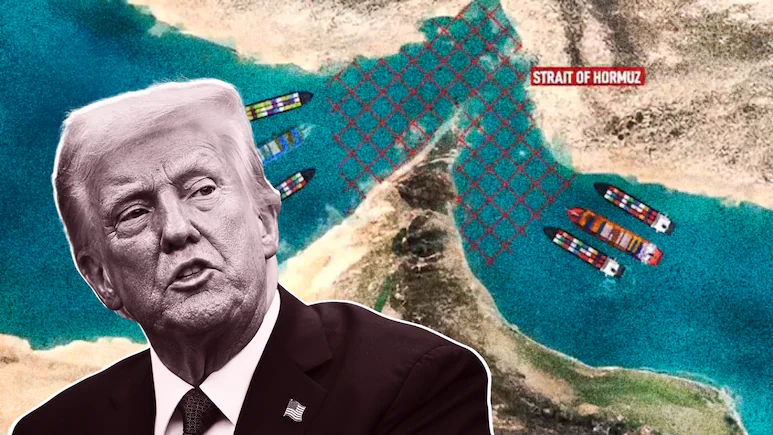
Trump is not asking Europe to fight America’s wars. He is not invoking Article 5, not demanding troops for the Levant, not calling for European F-16s over Tehran. He is asking Europe to help protect the Strait of Hormuz — the waterway through which roughly one-fifth of the world’s oil and liquefied natural gas passes, a disproportionate share of it bound for European ports, European refineries, European households. The International Energy Agency, not a Trumpian institution, has called the current disruption the largest supply disruption in the history of the global oil market. Oil is approaching $105 a barrel. European economies will bear the cost. European governments know this. The unanimous European response, nonetheless, is that America should handle it.
This is not a new response. It is the response of seventy-five years.
The architecture of postwar European security was always, at its foundation, a subsidy. The United States garrisoned the continent, extended its nuclear umbrella, and absorbed the primary cost of deterring Soviet power — freeing European governments to redirect fiscal energy toward the welfare states, supranational institutions, and elaborate cultures of soft power that became the signal achievement of the postwar order. The arrangement had genuine logic. It also had a built-in moral hazard that nobody in Brussels or Berlin was particularly eager to examine: when security is free, strategic seriousness atrophies. When deterrence is outsourced, you lose the habit — and eventually the capacity — of thinking clearly about what deterrence requires.
For decades this went politely undiscussed. American presidents grumbled; European ministers nodded; spending targets were pledged and missed; and the system reproduced itself. What Trump has done — crudely, yes, with the transactional menace of a creditor who has finally lost patience — is force the question into the open. That his methods are ugly does not make the question less legitimate. That his demands are self-serving does not make them wrong.
The German response is worth dwelling on. “This war has nothing to do with NATO,” Chancellor Merz’s spokesman told reporters. “It is not NATO’s war.” Both sentences are technically true. Both are strategically evasive to the point of dishonesty. The question was never whether the Hormuz blockade triggers Article 5. The question is whether Germany — Europe’s largest economy, a country whose industrial base runs on the energy that transits that strait — has a national interest sufficient to warrant action, and whether that interest carries any obligation beyond waiting for Washington to act first. Berlin’s answer, delivered with the confidence of a government that has never had to think too hard about consequences, was: no. America will handle it.
Italy’s objection was more elegant and no less hollow. Foreign Minister Tajani noted that the Aspides mission is “anti-piracy and defensive” and cannot be extended to the Strait of Hormuz. This is a bureaucratic argument wearing strategic clothing. Missions are reauthorized. Mandates are rewritten. What resists expansion, apparently, is not legal language but Italian appetite for risk — which is a different thing entirely, and should be called by its name.
The United Kingdom presents its own category of irony. Post-Brexit Britain has invested heavily in the conceit of Global Britain: a sovereign military power with expeditionary reach and strategic independence, too serious for the constraints of Brussels, capable of projecting force and will on its own terms. Keir Starmer has now confirmed that Britain’s strategic horizon extends precisely to the edge of American commitment, and not one nautical mile beyond. London will consult, coordinate, and plan. It will not be drawn in. Global Britain, it turns out, is a brand.
Washington might use this moment to look more carefully at the map of its actual alliances — not the ones drawn in 1949, but the ones demonstrated in practice.
Washington, for its part, might use this moment to look more carefully at the map of its actual alliances — not the ones drawn in 1949, but the ones demonstrated in practice. Kosovo and Albania possess no blue-water navy. They cannot escort a tanker through the Strait of Hormuz, project force into the Persian Gulf, or contribute meaningfully to any maritime coalition. What they can offer, and have consistently offered, is something rarer among American partners: the reflex of alignment, without calculation, without the procedural delay of a government searching for an exit. When Washington has needed political support, public solidarity, or the signal that the liberal order still has believers who act on that belief rather than merely profess it, Tirana and Pristina have not flinched. There has been no auditing of interests, no dispatching of spokesmen to explain why this particular commitment falls outside the relevant mandate.
This does not make small allies into large ones. But it does raise a question that American strategic planners would do well to sit with: what exactly is an ally? If the answer is a country that will stand with you when standing with you costs something — when there is no legal cover, no procedural escape, no cost-free abstention available — then the hierarchy of American partnerships looks rather different from the one suggested by GDP and defense budgets.
None of this should be read as an endorsement of Trump’s handling of the crisis. His position carries a contradiction so sharp it verges on self-parody: the United States Navy has reportedly refused near-daily requests from the commercial shipping industry to escort vessels through the strait, citing the risk as too high. A power that will not itself transit the waterway it is demanding its allies defend occupies uncertain rhetorical ground. And Trump’s style — the threats, the ledger-keeping, the promise to remember — hands European governments the aesthetic cover to perform principled restraint while practicing strategic abdication. This is a gift they have accepted with both hands.
But aesthetics are not arguments. Trump’s contradictions do not dissolve Europe’s. The Hormuz moment is clarifying precisely because the stakes are so direct: this is not a geopolitical abstraction, not a distant war with tenuous connections to European interests. It is Europe’s energy supply. The blockade is costing European consumers money today, this week, at a rate that 400 million barrels of emergency reserves — the largest IEA release in history — cannot meaningfully offset. And Europe’s answer to the question of what it will do about this is to point, with exquisite procedural precision, at the country it has been pointing at for three-quarters of a century.
The free ride is ending. Not because Trump says so, but because the conditions that made it possible — an America confident in its global role, willing to bear asymmetric costs, persuaded that the stability of the liberal order was worth the price — are dissolving regardless of who sits in the White House. Europe has known this for years. It has chosen, with characteristic sophistication, to treat the knowledge as a planning problem rather than a reckoning.
The invoice has arrived. Europe is disputing the line items.
Klea Ukaj is a writer and civic commentator based in Michigan. Originally from Tirana, she holds a degree in Banking and is a prominent voice in the Albanian-American community. Her work focuses on Western Balkan and transatlantic affairs.