SPAK’s chief says the law already allows his investigators to make arrests. He is right. That is not the question.
Renada Bici, Legal Desk
When officers of the National Bureau of Investigation arrested Adi Çobo Bazholi in Durrës earlier this month, the operation was noted less for the man in handcuffs than for who was missing from the picture. The State Police, which for three decades has carried out the significant arrests of the Republic, appeared nowhere in the accounts of this one. The Bureau planned the operation, staffed it, and closed it, and the commentary that followed read the police’s absence as the message it appeared to be, a prosecution demonstrating that it no longer needs to knock on the ministry’s door before it knocks on anyone else’s.
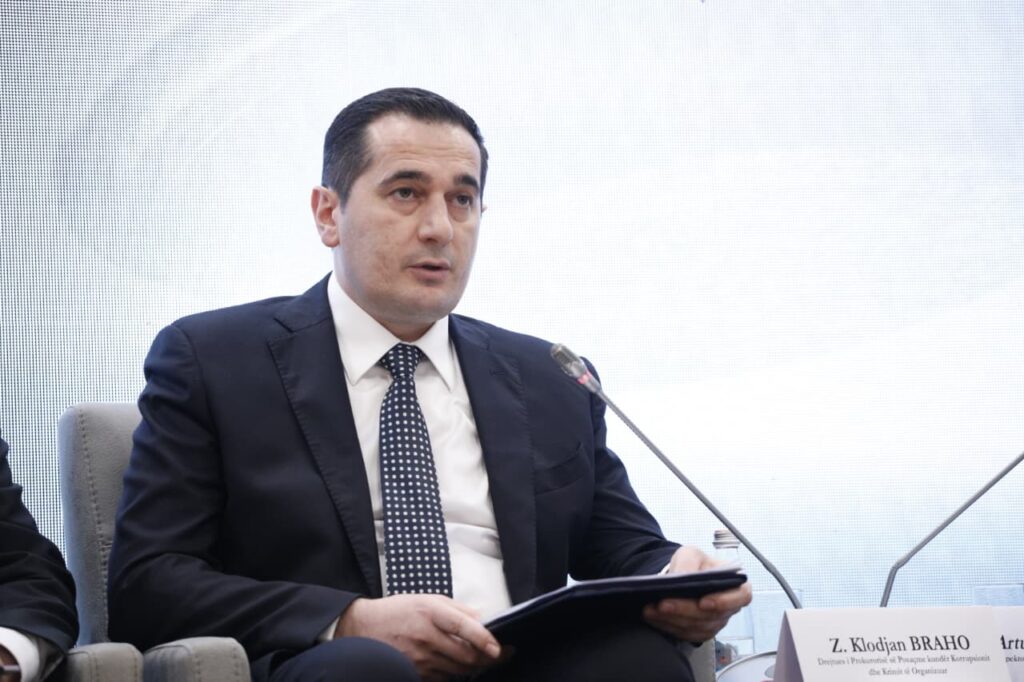
On Thursday, in an informal meeting with journalists in Tirana, the head of the Special Prosecution, Klodian Braho, converted the demonstration into a program. SPAK, he said, intends to create a special group for operational actions, with full independence in its activity. He was careful with the frame. The law does not condition arrests on the Bureau alone, he said, and the institution does not aim to replace the State Police and cannot function without cooperating with it. But the destination was stated plainly enough. The special group is coming, and it will answer to no one outside the structure that created it.
We have written before about what SPAK’s independence means and whom it runs against. In May we asked what happens when a special prosecution begins to behave as a state within the state in its dealings with foreign governments, and the question beneath that one, how anyone outside the institution verifies whom it answers to, has followed the file ever since. Thursday’s announcement belongs to the same file. An institution that investigates, intercepts, prosecutes, and seizes now proposes to add the one function it lacked, the armed execution of its own orders. Before anyone reaches for the phrase power grab, and before anyone reaches for the phrase capacity building, it is worth doing what neither camp will do, which is to read the statute.
What the law says
Begin where Braho begins, because on his narrow point he is correct. Law 95/2016 defines the National Bureau of Investigation as a specialized structure of the Judicial Police, investigating criminal offenses within the Special Prosecution’s jurisdiction according to the provisions of the Code of Criminal Procedure. That last clause does the work. The Code assigns the acts of compulsion, among them the execution of arrests and detentions, to the judicial police as such. It does not say which judicial police. An arrest warrant issued by a special prosecutor and executed by a Bureau investigator sits comfortably inside the Code’s text. Nothing in the statute reserves the physical act of arrest to the State Police, and the chief prosecutor is entitled to say so.
He is entitled to say something else, too. The distrust behind the Durrës operation is not paranoia. Operations against wanted persons have failed repeatedly in circumstances that suggest advance warning, and the suspicion inside SPAK that actions are deconspired by segments of the State Police is by now an open secret of Albanian law enforcement. The institution holds security measures and convictions in absentia that no one has executed. A prosecution that cannot produce the bodies of the people it has lawfully ordered detained is failing at something elementary, and Braho did not invent the failure. He inherited it.
So the narrow claim stands. If the question were whether a Bureau investigator may lay hands on a wanted man, the answer would be yes, and this piece would end here.
What the law does not say
The question is different, and the statute itself shows why. There is a distance, which Braho’s own formulation quietly acknowledged, between an arrest and a standing tactical unit. The first is an act the law authorizes. The second is an institution the law would have to create, with weapons, vehicles, entry equipment, use of force doctrine, selection standards, training cycles, and a command chain, maintained permanently. The Code of Criminal Procedure supplies the act. Nothing in Albanian law contemplates the institution.
Read Law 95/2016 for what it built the Bureau to be. Its investigators are recruited, by the statute’s own terms, from the State Police directorates responsible for investigating organized crime, economic crime, and narcotics trafficking, and from other institutions with judicial police functions. These are detectives. The statute vets them, secures them, polygraphs them, and subjects their families to financial monitoring, all in the service of one design idea, an investigative body that cannot be bought. Nowhere does it provide for tactical operators, because the drafters never imagined the Bureau kicking doors. They imagined it building files while the State Police kicked doors.
We know this is not an oversight, because the drafters showed us how they legislate when they intend to hand the Bureau an operational capability. The statute states expressly that the Bureau is the institution that executes interception orders requested by the Special Prosecution and authorized by the anti-corruption courts. Interception is precisely the kind of function the drafters refused to leave with structures they did not trust, so they said so, in text, with the capability named and assigned. When the legislature of 2016 wanted the Bureau to own an operational function, it wrote a sentence. There is no sentence for a tactical intervention group.
Braho has an available answer, and it deserves to be met rather than avoided. The Bureau already contains capabilities the statute never names, an analysis function, digital forensics, financial investigation cells, and nobody argues that each required an act of parliament. The answer fails at one word, and the word is force. What separates a tactical unit from an analysis sector is the authority to apply physical coercion to persons, and in the Albanian constitutional order coercion is never an administrative detail. The Constitution declares law the basis and the boundary of the activity of the state, and permits the limitation of rights and freedoms only by law. That is why the State Police carries its weapons under a statute, why its use of force is graduated in legal text rather than in internal circulars, and why every armed formation of the Republic, army, police, Republican Guard, exists by a law that names it. An analysis sector organizes labor. A tactical unit organizes violence. The first can live in an internal order. The second cannot, and the silence of Law 95/2016 is therefore not a gap the institution may fill for itself. It is a boundary.
Which gives the phrase Braho chose its proper weight. Full independence in its activity, resting on what? The Bureau’s independence is not a mood. It is a set of enumerated guarantees written into Law 95/2016, each running against a named threat, ministerial interference, political appointment, financial capture. A unit with full independence in its operational activity has no statutory referent at all. The chief prosecutor has described an institution that does not exist in Albanian law and announced that he intends to operate it.
Who commands it
Suppose the group is created anyway, by internal order and budget line, the way institutions grow when no one stops them. Follow the command chain the existing statute would impose on it, because this is where the legal problem becomes a constitutional one.
Law 95/2016 provides that the Bureau’s director, its investigators, and its judicial police services are directed and controlled by the prosecutors of the Special Prosecution. Every function the Bureau performs runs up that chain. Place a tactical unit inside the Bureau and the sentence does not bend to accommodate it. The unit’s raids, its entries, its escalations of force would be directed and controlled by prosecutors. And here precision matters, because judicial police working under prosecutorial direction is ordinary from Rome to Bucharest, and SPAK’s defenders will say so. What is not ordinary, what no European democracy houses on purpose, is a standing armed intervention unit that a prosecution office owns, staffs, and commands as its own organ. The continent’s legal orders keep the prosecutorial brain and the tactical hand in separate institutions, on the theory that whoever decides which door to breach should not also employ the men holding the ram. Albania would be fusing them, and fusing them without a single deputy voting on the question.
Now run the incident that every armed unit eventually produces. A raid goes wrong. A man is shot on a staircase in Durrës and the family says he was unarmed. Who investigates? The jurisdiction of the Special Prosecution covers, among other things, criminal offenses committed by high officials and by the structures within its own perimeter. The institution whose unit fired the shot is the institution with jurisdiction over the shooting. The State Police answers for its operations to a ministry, to a parliament that can summon the minister on a Tuesday, and to a prosecution that sits outside it. The special group would answer to the prosecutors who sent it, and then, if it erred, to the same prosecutors again. A closed loop is not accountability. It is the absence of accountability wearing its uniform.
None of this is an accusation against the men and women of the Bureau, whose vetting is the most severe applied to any public servants in the country. It is an observation about design. The severity of the vetting was the substitute for external control, and it was calibrated for detectives holding files. It was never calibrated for a formation holding rifles, because the drafters never put rifles in the design.
What other countries did
Braho told the Law Committee that the full investigative cycle within one structure is a practice seen in homologous institutions abroad. The comparison deserves to be taken seriously, which means taken precisely.
Italy’s Direzione Investigativa Antimafia is the comparison SPAK’s defenders reach for. But the DIA sits inside the Interior Ministry, staffed by seconded members of the ordinary police forces, answerable up a ministerial chain to a government that parliament can dismiss. It works for the anti-mafia prosecutors. It does not belong to them. Italy separated the prosecutorial brain from the operational hand deliberately, having learned what concentrations of both look like.
Romania is the comparison SPAK’s defenders avoid. The National Anticorruption Directorate solved its own capability gap by leaning on the intelligence service through cooperation arrangements the public was never shown, prosecutors and covert operators fused into what critics called the parallel state. When the Constitutional Court dismantled the arrangement, ruling that intelligence structures could not serve as organs of criminal investigation and pulling the secret protocols into the light, the damage was not contained to the arrangements themselves. It contaminated years of convictions and handed every corrupt defendant in the country a legitimacy argument that Romanian anticorruption has still not outrun. The lesson of Bucharest is not that special prosecutions must never acquire operational reach. It is that operational reach acquired outside statute eventually destroys the institution it was meant to serve.
And the European Public Prosecutor’s Office, the newest homologous institution of them all and the one Albania’s accession path actually points toward, owns no operational capability whatsoever. It investigates and prosecutes across more than twenty member states and executes nothing itself, relying entirely on national enforcement authorities. The most modern prosecution structure in Europe was built, on purpose, without the very organ SPAK now proposes to grow. The full cycle is not the European practice. It is the exception European designers keep declining to make.
The honest problem and the honest answer
We do not dismiss the problem Braho is solving. A prosecution that must route its most sensitive operations through a police force it has concrete reasons to distrust will keep losing fugitives. The status quo is measured in failed operations and unexecuted warrants, and every escaped defendant is a small amnesty granted by leak. The people demanding that SPAK simply trust the State Police harder are demanding that it keep paying for that trust in fugitives.
But the answer to an institution that cannot be trusted is not an institution that cannot be checked. It is a rule. If the special group is to exist, and there is a serious case that some version of it should, then it must be built the way the Bureau itself was built in 2016, in public, by statute, with its limits written before its weapons are issued.
That means, first, a law and not an internal order. An amendment to Law 95/2016 that names the unit, fixes its maximum strength, defines its mission in a closed list, and states what remains exclusively with the State Police, so that cooperation is a legal boundary rather than a monthly negotiation. The Kuvend created the Bureau’s interception capability in text. It can create this one the same way, or the capability should not exist.
Second, a use of force regime enacted, not improvised. The State Police carries its weapons under a statutory framework that took years to refine. A prosecutorial tactical unit operating on the general judicial police provisions, with no dedicated rules of engagement, would make every operation a legal experiment conducted on live subjects.
Third, an accountability mechanism that breaks the closed loop. Any use of force by the unit investigated outside SPAK’s own perimeter, by designation in the statute, so that the institution never sits as prosecutor of its own hand. And a standing reporting duty, operation by operation, to the High Prosecutorial Council and in aggregate to the Kuvend, in the annual report that is currently the only window the public has into the Bureau at all.
Fourth, a sunset. Extraordinary powers granted on an extraordinary rationale should lapse when the rationale is no longer proven, and this is not an imported habit. The justice reform itself was built that way. Its vetting bodies were created as transitional instruments with expiry written into the constitutional annex, on the understanding that emergency architecture must not quietly become permanent architecture, and when their mandate ran out, extending it required a fresh vote. The distrust of the State Police is the emergency that justifies this unit. Let the statute expire in five years unless renewed, so that the parliament which grants the capability on that rationale is made to ask, at least once, whether the rationale still holds.
Braho says the structure should be able to perform the entire cycle of investigative actions itself. Perhaps it should. But there are two full cycles in a state governed by law, and they are not interchangeable. One runs from surveillance to file to warrant to arrest, and it can, with care, be housed in a single institution. The other runs from proposal to debate to vote to statute to oversight, and it cannot be housed anywhere except the parliament. The chief prosecutor is asking for the first cycle. He can have it the day he submits to the second.