Twelve days of protest in Tirana have asked every question except the one that decides everything.
Tirana Examiner
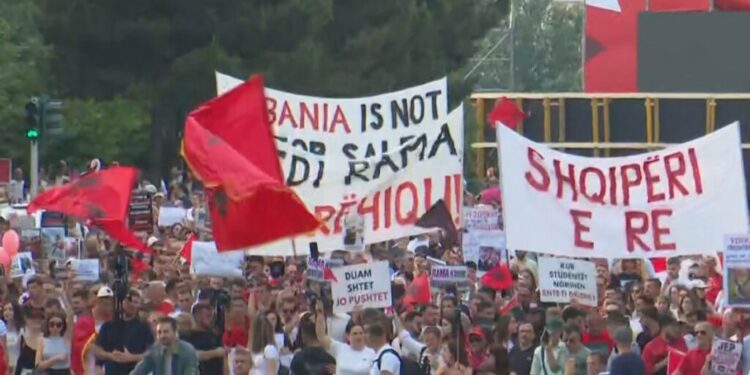
Begin with what the protest has earned, because it has earned a great deal. For twelve consecutive evenings, thousands of citizens have gathered at six o’clock in Skënderbej Square and marched down the boulevard to the Prime Minister’s office. They have stood there for hours, made speeches, sung the anthem, and gone home. The police have not intervened. No tear gas has been fired, no cordon has been charged in anger, no protester sits in a cell. A hundred meters beyond the perimeter, Tirana eats dinner, drives badly, and watches football. This is what democratic health looks like, and it deserves to be named as such, precisely because the chants describe something else. A state that tolerates nightly assembly at the door of its executive for two weeks, without panic and without batons, is behaving better than the regime of the protesters’ imagination. The square, in this narrow but important sense, is evidence against its own premise.
It is also, by now, about something larger than the lagoon that started it. Zvërnec did not stop being the subject of these protests; it stopped being the point. The five demands read from the podium make this arithmetic visible. Four of them are legislative: repeal of the strategic investor framework, withdrawal of the Mountain Package, reversal of the amendments to the law on protected areas, repeal of the changes to the cultural heritage law. The fifth is the resignation of the government, and it is the fifth that the crowd actually chants. Around it has grown a symbolic repertoire that any honest observer must record in full, the inspiring and the troubling alike. The pink flamingo, borrowed from the birds of the Narta lagoon, has become a genuinely original emblem of civic refusal. Alongside it travel slogans of a different weight: calls for an ethnic Albania, declarations that the country belongs only to Albanians, the language of treason applied liberally to opponents. A movement that is leaderless, partyless, and saturated with maximalist national feeling is exactly the vessel that outside actors find useful, and the government’s eagerness to blame Athens or Tehran for the crowds does not make the vulnerability less real. It is possible for a protest to be authentic and exploitable at the same time. This one is both.
Grant all of that, and the central question still stands untouched, because it is not a question about the protest’s sincerity. It is a question about its mechanism. Albania is a democracy, however battered, and in democracies political outcomes are decided by electoral processes. Edi Rama won his fourth mandate on 11 May 2025, thirteen months ago. It was won on a tilted field, with state resources, a largely captive media landscape and three decades of patronage all leaning one way, and the grievance this produces is legitimate. But a tilted field is answered by leveling it before the next contest, not by annulling its result from a square. The next national appointment with the ballot box is the local elections of 2027; the next parliamentary contest comes in 2029. A demand for resignation today is therefore a demand for an extra electoral outcome, and the call for a transitional government makes the demand explicit: it asks a parliamentary majority elected one year ago to dissolve itself under crowd pressure. There would be a democratic case for this if the movement argued that the 2025 mandate was itself fraudulent. Notably, it does not. The older opposition protest cycle made that claim its banner; this movement has conspicuously declined to inherit it, perhaps because doing so would mean standing closer to Sali Berisha than the square can bear. What remains is a constitutional impossibility dressed as a moral imperative. Whatever one thinks of Rama, and this publication has thought a great deal, a government removed by decibels rather than ballots would be a worse precedent than the government itself. The protesters demand more democracy through a procedure that contains less of it.
Suppose, generously, that the movement understands this and intends the square only as a staging ground for the elections to come. Then the question becomes one of translation, and here the movement has locked its own doors. The normal route by which protest energy enters parliament is the opposition, and this crowd has expelled the opposition by name. “Rama në burg, Berisha në burg” is chanted as a single sentence; “opozita e shitur” follows it like a refrain. When Democratic Party deputies demanded Rama’s resignation in parliament on 11 June, the Socialist floor leader Taulant Balla replied with an invitation of surgical cruelty: go down and join the protest that is chanting for your own leader’s imprisonment. The taunt landed because it was accurate. Berisha defended the Zvërnec investment for days before the wind changed, and the crowd remembers. The Democratic Party cannot harvest this energy; it can only stand at the edge of the square and pretend the chants are about someone else.
That leaves the new party route, and the new party route was tested under laboratory conditions twelve months ago. The 2025 election was, among other things, an experiment in whether Albanian civic energy converts into seats. Adriatik Lapaj and Arlind Qori both built formations out of authentic movements, both wrote programs, both campaigned with more integrity than the machines they challenged, and both finished at the margins. The verdict was delivered not by apathy but by architecture: two parties with three decades of clientelist infrastructure, captive media ecosystems, district arithmetic that punishes small entrants, and the patience of incumbents who have survived every previous wave. Any vehicle born from this square would face the same wall in 2027, with one additional handicap the movement has built for itself. “Shqipëri e re” is a refusal, not a program. Its power lies precisely in its emptiness: the pensioner fills it with his pension, the student with her one way ticket, the Rrjoll farmer with his fence. The moment someone writes a platform, the coalition discovers it was never one coalition but four, and the environmentalists, the nationalists, the anti corruption voters and the merely exhausted go their separate ways.
The region offers exactly one proof that the conversion is possible, and it doubles as a price list. Vetëvendosje began as street refusal and ended in government, but the journey took roughly fifteen years, a singular leader willing to absorb prison and ridicule, and an unglamorous organizational build sustained between every protest cycle. And Kosovo’s circumstances were not Albania’s: Kurti’s movement could graft itself onto an unfinished national question and the legitimacy vacuum of a young state, advantages no Tirana formation will inherit, which makes the fifteen years a floor rather than a ceiling. Serbia, meanwhile, supplies the counterexample in real time: a student movement of enormous moral authority that, more than a year on, still possesses no electoral instrument, because refusing the existing parties while declining to become one is a posture, not a strategy. Tirana’s square should study both neighbors carefully. It currently resembles Belgrade far more than Pristina.
While the movement declines to choose, the government has discovered something useful: it can pay the square in policy rather than power. The Strategic Investments Law will be allowed to lapse, a concession announced with the insistence that it has nothing to do with anything happening in the street, which is the surest sign that it has everything to do with it. Brussels made the concession cheap; the Commission’s warnings on Chapter 27 meant the law was already a liability on the accession ledger, so Rama could satisfy the protesters’ second demand while crediting the European Union and conceding the crowd nothing. Expect the same treatment for the protected areas amendments if the pressure holds. This is the standard endgame for leaderless movements everywhere: the state concedes the negotiable demands one by one, peeling away the protesters whose grievance was concrete, until the square holds only the maximalists, guarding a resignation demand that has no enforcement mechanism and no expiry date. The twelfth evening already drew visibly fewer people than the eleventh. Attrition is not defeat, but it is the medium in which this strategy works.
All of which brings the argument to the question this essay exists to ask, the question the podium has never answered because no one on it can. Who writes the program?
Take an honest inventory of who is visible. Luçiana Kokaj, a Rrjoll resident with a property grievance, careful each evening to insist she represents no party, which is exactly what makes her acceptable to the square and useless as an author of its politics. Artur Meçollari, a maritime expert lending technical credibility on a single front. The actor Mehdi Malkaj, supplying sentiment, who in one charming aside even rejected the movement’s own slogan on the grounds that Albania has always been new. And the young man who took the microphone to declare that neither government nor opposition cares for Albanians, before offering the crowd his complete theory of political action: when the Prime Minister appears in public, sabotage him. These are decent people and several are brave. They are also, collectively, the cast of a mood. None of them is the seed of an organization, and no organization is forming behind them.
Look further and the bench does not lengthen; it empties. Every plausible author of a program is disqualified before writing a sentence. Lapaj and Qori exist, but joining a small party that already lost feels to the square like a demotion from revolution to retail politics, and the square has pointedly not flowed to either. Anyone formed in the orbit of the two big parties, however genuinely reformist, carries the caste’s smell and would trigger the movement’s antibodies on contact. The diaspora fills piazzas in Milan and streets in London with red and black flags, and will not supply a single candidate willing to move to Kukës and run for its council. And the cohort that should be producing political entrepreneurs, the capable thirty year olds with organizational talent and unspent ambition, is the same cohort whose absence the protest mourns on its emigration banners. They are in Frankfurt and Vienna and Milan, which is why a boulevard can be full and a shadow cabinet impossible. The crowd and the vacancy are made of the same departure.
There is a mechanism beneath this, and it is self reinforcing. The movement’s immune system, the very ferocity that protects it from capture by Berisha, by provocateurs, by foreign hands, attacks leadership as such. The first person to step forward and say, I will turn this into a party, converts overnight from participant into suspect, accused of riding the square toward a career. Leaderlessness is therefore not a phase this movement is passing through. It is a trait the movement selects for, every evening, by applause.
So the absent WHO is not a missing person. It is a missing pipeline, and the pipeline did not erode; it was dismantled, deliberately, over three decades in which the duopoly absorbed, bought, or exiled every independent political talent the country produced. The result stands in the boulevard each night at six: an electorate capable of magnificent refusal and incapable of replacement. The full square and the empty bench are not two facts. They are one fact, observed from two angles, and together they constitute the real indictment of the thirty five years the crowd is chanting against, an indictment more damning than any slogan because it cannot be answered with a concession.
It also carries a corollary the square will not enjoy hearing. Leaderless pressure is not powerless; it has already buried a law, drawn Brussels into the argument, and produced the first audible murmurs of dissent inside the Socialist family, and it may yet change more elite calculations than anyone can see from the boulevard. But pressure without an heir reshapes an incumbent’s behavior, not his tenure. A protest that cannot produce a WHO works, by default, for the incumbent it despises. Every evening of magnificent, leaderless refusal rehearses the argument Edi Rama will make in 2029, the argument he is in truth already making between the lines of every contemptuous reply: who else? The square has spent twelve nights proving it can fill itself. The country’s future now depends on whether anyone in it is willing to do the smaller, slower, unapplauded thing, and give Albania an answer to the only question that votes can actually decide.