The Democratic Party leader accused the government of hiding “IBAR meetings” in Brussels and excluding the public from Albania’s EU accession process. But the EU institutions responsible for those proceedings describe a different reality: the meetings he referred to do not exist in the form he presented, candidate countries are not present during deliberations on their own accession files, and no comparable state issues the kind of weekly public briefings he claimed Albania was withholding.
by Ardit Rada (Tirana)
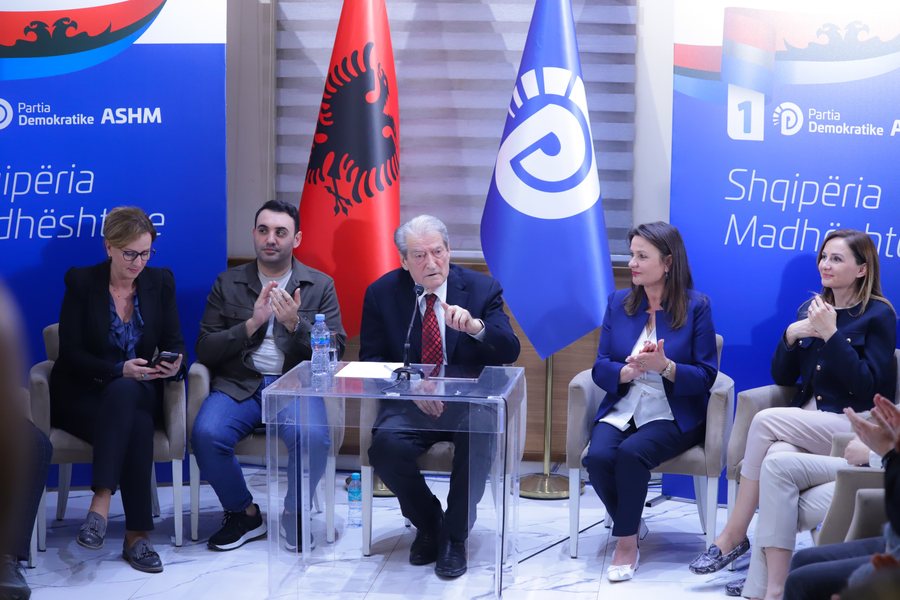
At a press conference on Tuesday in Tirana, Democratic Party leader Sali Berisha set out a dense accusation against the government: that the Interim Benchmark Assessment Report process for Albania is being concealed, that the responsible minister had appeared before the Foreign Affairs Committee on Monday only to deceive, and that the practice in comparable candidate countries is the opposite. “Qeveria mban të fshehta mbledhjet e IBAR,” Berisha told the room. “Edi Rama e ka konceptuar procesin si një proces të mbyllur në një kohë ku procesi i integrimit të vendit në BE duhet të jetë procesi më i hapur, më transparent.” The government, he said, had a representative present at those meetings and was keeping their content secret. The Prime Minister, he said, had conceived the EU integration process as a closed one when it should be the most transparent process the country runs.
The accusation was concrete. It rested on four factual claims, each capable of being checked. The Tirana Examiner did the checking. We submitted formal press inquiries to the European Commission’s spokesperson for Enlargement and to the Council of the European Union’s General Affairs Council press office, the two institutions that handle the proceedings Berisha referenced. The Commission referred the questions to the Council, on the procedural ground that the proceedings in question are Council deliberations, not Commission meetings. The Council answered substantively. What follows is what the institutional record shows, set against what was said in Tirana.
The first claim was that there are “IBAR meetings” in Brussels at which the Albanian government has a representative present. There are not. The IBAR is a document, not a meeting. It is produced by the European Commission as an assessment of a candidate country’s progress on a specific cluster of negotiating chapters, and it is submitted to the Council. The body that then deliberates on the IBAR is the Working Party on Enlargement and Countries Negotiating Accession with the EU, known by its acronym COELA. COELA is composed of representatives of the 27 member states, with the rotating Council presidency setting its agenda and driving its proceedings. According to an EU official with direct knowledge of those proceedings, the working party deliberates on the draft “interim EU Common Position” on the cluster in question, which must be agreed by all 27 member states and then upgraded to COREPER, the committee of permanent representatives, for formal adoption. Only after COREPER adopts the EU Common Position can an Intergovernmental Conference be held with the candidate country to actually open or close a cluster. The “meetings” Berisha described, by the name he gave them, do not appear in this architecture. Berisha invented the format. He offered it to the public without substantiation. This is hardly what one might expect from a former prime minister who claims familiarity with the EU, or from the team advising him.
The second claim, more pointed, was that the Albanian government has a representative physically present at these meetings. It does not. Per the Council’s own rules of procedure, COELA proceedings are reserved for the 27 member states. Candidate country representatives, the EU official confirmed, are never present during the working party’s deliberations on their own accession file. The only contact the Council framework permits is informal: the rotating presidency may, with COREPER approval, invite the candidate country’s lead negotiator to a brief informal exchange of views before the working party reverts to its formal agenda. The exchange is not a deliberation, no decision can be proposed or taken, and once it concludes the candidate’s representative leaves the room. This format applies equally to Albania, Serbia, Montenegro, and North Macedonia. None of them sits at the COELA table during a discussion of its own file. The premise that an Albanian government representative is “in the IBAR meetings” misdescribes a framework in which no candidate country is in those meetings.
The third claim was that counterparts in Serbia, Montenegro, and North Macedonia issue weekly public communiqués about these proceedings, while the Albanian side does not. The Council’s confidentiality framework forecloses this. All Council preparatory body deliberations, the official noted, are covered by the principle of confidentiality. Public Council communication on accession matters takes place at Intergovernmental Conferences, not weekly, and candidate countries themselves are bound by the broader principle of loyal cooperation, which means information they release should be factual, accurate, and tied to confirmed institutional milestones. The expectation is that candidate governments communicate when there is something institutionally confirmed to communicate: the opening or closing of a cluster, the holding of an IGC. There is no Brussels practice of weekly readouts from any candidate country about COELA deliberations on its file, because the deliberations are not public and the candidates are not present at them. The benchmark Berisha invoked does not exist as a benchmark.
The fourth claim was the comparator. Berisha presented Serbia and North Macedonia as transparent counterexamples Albania should follow. The Council’s account of its own current agenda inverts this. Albania and Montenegro, the EU official said, appear on the COELA agenda often, because both files are advancing. Serbia and North Macedonia appear very rarely, because progress on both tracks is politically blocked. What looks, from Tirana, like Serbian transparency is in fact Serbian inactivity at the level of the body in question. Belgrade is not issuing weekly readouts of COELA deliberations on Serbia’s file; there is little to read out. The same applies to Skopje. The capitals Berisha pointed to as examples of openness are the capitals at which the accession machinery has stalled. Tirana’s track is moving. The Council’s own published record reflects this: on 17 November 2025, under the Danish presidency, the EU formally opened Albania’s last accession negotiating cluster, on resources, agriculture and cohesion, a step communicated by the Council on its public press channel.
Four claims, taken together, formed the accusation. Each was checkable against the institutional record. Each fails. The “IBAR meetings” do not exist as a format. The Albanian government has no representative seated at COELA, because the Council’s rules of procedure do not permit any candidate country to sit there. No candidate country issues weekly readouts of COELA deliberations on its file, because those deliberations are confidential by Council practice. And the two states Berisha cited as transparent comparators are the two whose accession is currently stalled, while the country he accused of opacity is one of the two moving fastest.
What survives is a different question: why the leader of the parliamentary opposition, with a political team and legal counsel that know the Brussels architecture, built a public attack on a procedural map that does not match the EU institutions whose transparency he invoked. The Council cannot answer that. The Democratic Party can. Or thinks it can. Not convincingly. Not in Brussels, and not, where it matters more, in Albania.