Dhuka tells the National Council on European Integration the government is technically preparing the closure of ten chapters covering 27 of 101 benchmarks; Justice Minister Gogu flags the case backlog and the new codes as the central judicial test; the Ombudsman warns the real measure is not chapters opened but law in practice.
Aurel Cara (Tirana)
Albania has entered the most demanding stretch of its EU accession process, with Chief Negotiator Majlinda Dhuka announcing preparations for the technical closure of at least ten of the 33 chapters opened so far. The move comes as the Council Working Party on Enlargement (COELA) continues to negotiate the bloc’s common position on Albania’s Intermediate Benchmarks Assessment Report.
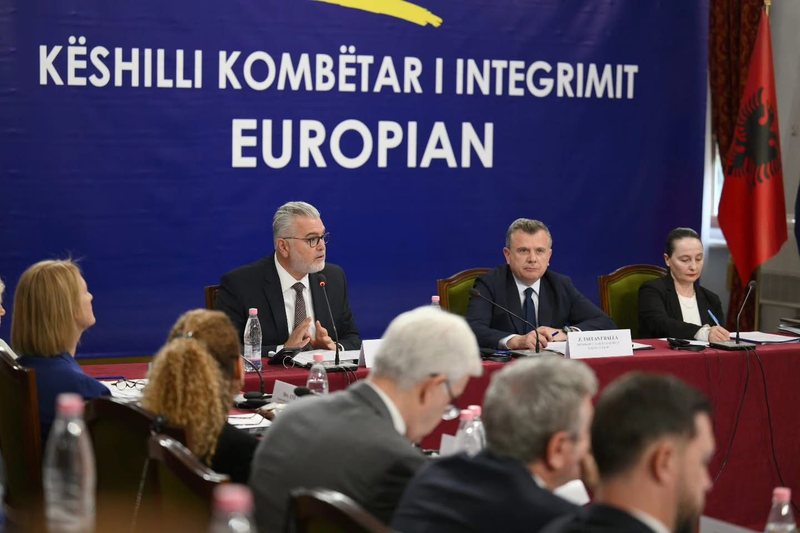
Speaking before the National Council on European Integration on Friday, Dhuka said the government considers Albania ready to close three chapters immediately and well advanced on a further seven.
The procedural state of play is more specific than the headline numbers suggest. The Commission’s positive assessment found that Albania had fulfilled the intermediate benchmarks; the process now requires political alignment among the capitals before any formal movement toward chapter closure can proceed. COELA, which brings together representatives of the 27 member states, has been working since March on the bloc’s common position on the critical issues where Tirana will be asked to push further. Without that step, no chapter can be closed, however advanced the technical preparation underneath it. The Socialist majority is meanwhile operating on the working assumption that Albania can close all open files by Christmas 2027.
“We are working intensively to technically prepare the closure of at least the first ten chapters, which cover 27 of 101 benchmarks in total, while negotiations continue across the remaining chapters,” Dhuka told the Council. “Regarding Chapter 30 on external relations, Chapter 25 on scientific research and Chapter 26 on education, we assess that Albania has generally completed all the technical preparations for their closure.”
The three chapters Dhuka named as technically ready are not arbitrary. External relations, research and education are typically among the lighter files in any accession package, requiring less structural judicial, fiscal or market overhaul than the Fundamentals cluster, which is why they routinely surface as the first candidates for closure once member state approval is secured.
That is also why the Fundamentals cluster carries the political weight Dhuka emphasized. The cluster, which gathers the rule of law, the judiciary, fundamental rights, justice and security under Chapters 23 and 24, was opened first and will close last by design. Under the revised enlargement methodology, progress on Fundamentals conditions movement across the broader negotiation framework, giving judiciary and rule of law reforms disproportionate political weight in the overall calendar.
“The Fundamentals are the political and institutional proof of Albania’s seriousness on the road to the European Union,” Dhuka said. She framed the present moment as the passage from the politics of opening to the harder task of closing, a transition that “encourages and tests the European will and capacity of all institutions and makes close cooperation imperative,” and added that the central task ahead is “closing the chapters with dignity, quality and irreversible results as an EU country.”
The Intermediate Benchmarks are tied to the Fundamentals cluster, and the central test inside that cluster is the judiciary. Justice Minister Toni Gogu, addressing the same Council, said the bottleneck is the volume of unresolved cases.
“We have serious challenges, they are still there, and I mean the necessary efficiency in the system that we must achieve,” Gogu said. “The 130,000 cases must be reduced significantly.”
The minister argued that Albania did not arrive at the Commission’s positive Intermediate Benchmarks assessment with rhetoric. “Albania has not gone before the European Commission, before the approval of the intermediate benchmarks, with words and talk, but with concrete steps and measures. I think it has been the most complex institutional exercise the government has undertaken. At the end of the day, the question is how the Albanian citizen is benefiting from this negotiation,” he said.
Gogu offered three indicators. The system, he said, “is gradually entering a more stable phase of functioning, and despite the high stock of cases there is a positive indicator that gives us hope that we can address the weak point of the system on efficiency, which passed the test of vetting, namely the reduction of the stock at the Supreme Court. From 2020 to today, the stock at the Supreme Court has been reduced by 60 percent.” He cited the closure of vetting on 17 June 2026 as “the longest running project a country has had with the EU before joining,” and pointed to the expansion of free legal aid and the digitization of the judicial system through the JURONIX platform as further markers.
On the legislative track, two flagship codes are being aligned with EU standards in parallel.
“The strengthening of procedural guarantees has already come to the fore and we are addressing it. We set up a working group some time ago that is working on the Criminal Code. We are waiting for it to arrive, and in parallel the same group of experts is working on the Code of Criminal Procedure, where they have either completed or are close to completing a draft that we will very soon make ready for public consultation,” Gogu said. He underlined that the work ahead requires “institutional cooperation,” not “spectacle,” and added that he believes “justice will be faster, more reliable and more accessible to the citizen.”
Taulant Balla, head of the Socialist Party parliamentary group, used his intervention to frame the process as one of acceleration rather than uncertainty.
“There is no talk of stagnation, no talk of loss of direction, no talk of strategic uncertainty,” Balla said. “There is only talk of advancement, of pace, credibility, extraordinary commitment, for an Albania that is seriously entering the closing phase of its European path.”
The most pointed reservations of the session came from the Ombudsman Endrit Shabani, who acknowledged the procedural achievement of opening all chapters but warned against treating that count as the substantive measure of progress.
“Albania opened all 33 negotiation chapters within thirteen months. That is a record,” Shabani said. “But it is also one of those statistics that look good on an infographic and somewhat worse at the counter where a citizen has been waiting three years for a property certificate. Because the real measure of European integration is not only the number of chapters opened, but the distance between law on paper and law in practice. That distance is exactly what IBAR will assess. Let us speak openly: IBAR sits today in Brussels, among member states that are asking, is Albania really being reformed?”
Shabani signaled that he was raising the same question, citing thousands of complaints reaching his office on the public administration and the courts. “A law that is not implemented is no longer a law, it is a document,” he said, before turning to property rights, which he called “the foundation on which the foundation of the economy rests.” He added: “We look at the problems with the aim of solving them, not using them, not hiding them.”
The Ombudsman tabled three concrete proposals for the period before IBAR.
“First, for the pre IBAR phase, the Assembly should consider a dedicated budget increase for the prison and pre trial detention system. Second, the recent amendments to Law 15/2015 strengthen the Assembly’s supervisory role in negotiations; this strengthening should be reflected in regular and structured hearings of independent institutions before every important EU assessment. Third, public institutions should be under a legal obligation to report, within specific deadlines, on the level of implementation of the recommendations issued by independent institutions,” Shabani said.
The opposition did not attend the National Council session, although on Thursday in parliament its representatives had pressed for a debate on the European Parliament Foreign Affairs Committee’s report on Albania’s accession progress, leaving the session without opposition representation on a day designed to project unified strategic direction toward closure.