An explosive drone was stopped over the Prime Minister’s Office. The man first asked to launch it refused. Someone else did not. Everything in between is the state’s to keep, and the allies’ silence is the part that should worry Tirana most.
By Drizan Shala (Security Desk)
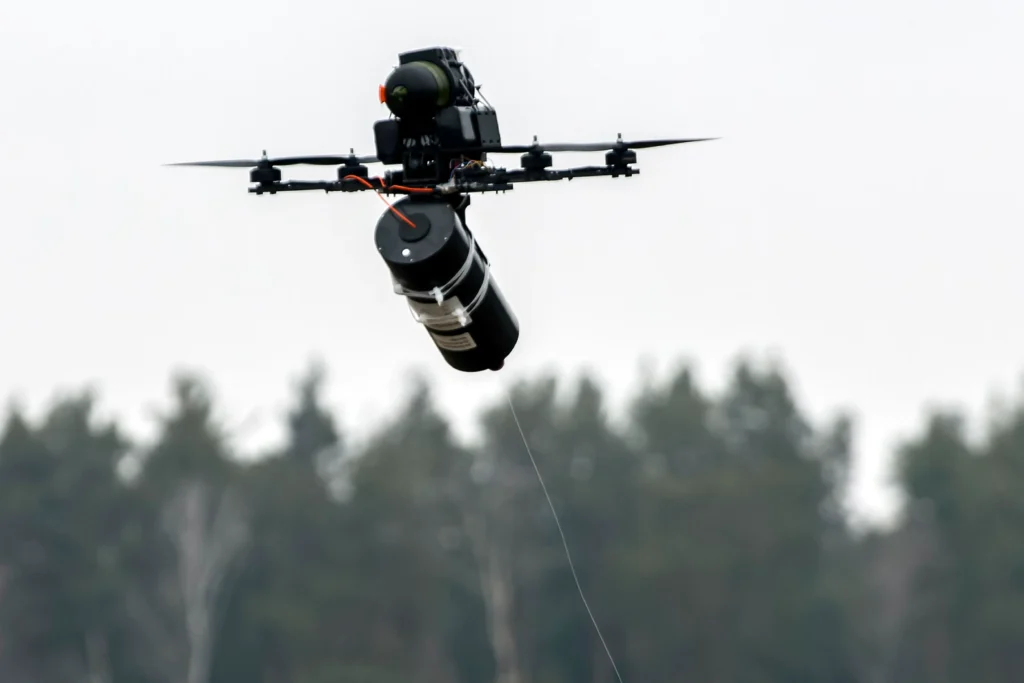
On the morning of Sunday 18 October, Edi Rama told the country from his office that a drone aimed at the Kryeministria, the Prime Minister’s Office, had been stopped. “Two days ago a drone with explosives was neutralised, meant to hit the Kryeministria and set fire to the inner courtyard, where that wooden structure is, and God knows with what consequences.” One drone, on the Friday, and a foreign hand behind it. In the same address he named Iran as a source of the disinformation around the protests and read out Aleksandr Dugin’s post of the night before on Albanians “waking up”. He gave no detail on who flew the drone, from where, or how it was brought down. He repeated the claim this week to the heads of the second-tier banks, now folded into a warning that someone had wanted a second 21 January.
Since then the Police, the Prosecution and SHISH have said nothing. Radio Free Europe asked the Police to confirm the incident and received no reply. No case number is public. The Tirana court’s filings of 22 October dealt with the lawfulness of flagrante arrests on the boulevard; none concerned a drone.
On Thursday ABC News published its own account, citing national-security sources: six drones over Tirana on the Saturday, four carrying explosives and two filming the strike for social media, all commanded from outside Albania, entering through a neighbouring country, and brought down by equipment supplied by partner states. This publication cannot confirm that account. It belongs to the part of the affair the state is holding, and the state will say.
This publication has its own sources on the drones affair. They know what happened, they have told us, and we are not printing it. They asked us not to, and they were right. The sensational angle is not this publication’s register in any case; a drone over the Prime Minister’s Office is a security matter, and security matters are built from cold facts or not at all. Ours here are the open record and one expert who agreed to be named.
Ervin Karamuço is professor of criminology at the University of Tirana’s Faculty of Law, a former head of the national torture-prevention mechanism at the People’s Advocate, and an independent security expert with no stake in the government’s account. On ABC’s own air that evening he was careful: “I cannot say whether there was a plan for explosives by drone.” Speaking to Tirana Examiner afterwards, he said he cannot confirm the ABC account. What he did confirm to this publication is narrower and worth more. Police intercepted communications between hostile players inside the riots who tried to get an individual from Kukës, a man known to the authorities, to launch kamikaze drones carrying explosives at the Prime Minister’s Office. The man refused. His quarrel with Rama, he said, was political, and he was not willing to spill Albanian blood for it.
At one end, Karamuço’s testimony: a recruitment, a payload, a target, a refusal. At the other, the Prime Minister’s announcement: a drone with explosives, aimed at that target, stopped. These are the two ends of the same story. The man from Kukës declined; someone else accepted the call; the drone that someone else launched is the drone the state neutralised on the Friday. Everything between those two ends is what remains hidden from the public: who the recruiters were, who they found, where the charge came from, how many airframes there were, where they were launched, who held the controls, and from where. That middle is the investigation.
ABC’s account is a version of that middle, and it is a version that requires military-grade technology: a drone that crosses from a neighbouring country to the centre of Tirana under control, carrying a charge, is a military system with a military control link. Per this publication’s sources, that does not appear to be the case. Our reading is of something narrower and no less dangerous: drones launched inside Tirana and potentially controlled from outside Albania. The open record is consistent with that reading. On 20 October, in an operation police named “Infrastruktura”, officers arrested a 23-year-old selling hunting slingshots to protesters on Rruga “Tre Dëshmorët” and searched his warehouse on Rruga “Kol Koçi”: 239 drones of various sizes, GPS locating devices, electronic kit, all undocumented. Nothing had to fly hundreds of kilometres. The airframes were on a shelf in the city, and so was the man the recruiters needed to launch one.
This is the lesson of the Ukrainian trenches. The airframe costs a few hundred euros. The weapon is the combination: a commercial drone, an improvised charge, a local pair of hands to launch it, and a control link that can be anywhere a signal reaches. Foreign control of that link is the gravest charge in this affair, and it is not one to make lightly. If it is true, a drone launched from a rooftop on Rruga e Durrësit and directed from a laptop in another country is an attack on the seat of government by someone outside the state’s jurisdiction, and in any country’s law that is aggression, whatever the arms-control category of the hardware.
The investigation may yet rule foreign control out. That would not make the case better. Without the foreign hand, what remains is still this: kamikaze drones carrying explosives were used against the Prime Minister’s Office of a NATO member state, inside a riot, in a European capital. That is an escalation of a kind this region has not seen. A kamikaze drone aimed at the Kryeministria, built the way they are built in Ukraine, is on its own enough to settle what kind of event this was.
That is why the middle stays hidden, why the institutions are silent, and why this publication is silent with them. An attempted explosive-drone strike on the office of the head of government of a NATO member is not a Tirana police story. Attribution of a control link runs through signals intelligence, through allied services, through the question of whether a foreign state or its proxies directed an attack on allied territory, and through what the Alliance is then asked to do about it. Every step of that is damaged by premature detail, whoever publishes it. The telemetry, the frequencies, the handsets in the intercepted communications belong in a file that is being worked, with partners, at a depth no studio panel can reach and no newsroom, ours included, should try to. The people we spoke to asked us to wait. We will.
Moscow, for its part, was not silent. On the night of 17 October, with the boulevard burning and the drone already in the state’s hands, Aleksandr Dugin posted that Albanians are “a very interesting and brave people” who “are waking up now”. Rama read the post out the next morning and called its author Putin’s ideological father. Dugin does not know about a drone over the Kryeministria; he does not need to. His job is to file the claim: whatever happens in Tirana, Moscow was watching, Moscow approves, and Moscow’s story of it is already on the record before anyone else’s. That is the other half of the method. The airframe on the shelf and the control link somewhere else take care of the street; the ideologue’s post takes care of the meaning. Both arrived in the same forty-eight hours.
Tirana’s silence is investigative discipline. Moscow has already spoken. The silence of Albania’s Western partners is something else. A week after the head of government of an ally announced an attempted explosive-drone strike on his own office, not one allied capital has said a word about it. The US Embassy spoke on the Friday about violence and restraint; the European Commission on the Sunday about arson, due process and a proportionate response; Berlin, asked, about rule of law. None of them mentioned the drone. Operational silence is one thing; the services can work the file without a word, and should. Political silence is another. A statement of concern for an ally gives away no telemetry. That is not how allies act. It is not how they acted for Germany. On 14 August an explosive drone was found at Leipzig/Halle airport; NATO declared full solidarity with Berlin against a Russian hybrid attack, and Rama posted the same day that a drone carrying explosives at Leipzig “is not a grey zone” but Russian aggression against Germany and European security, adding that hybrid war cannot be rewarded with hesitation. In September 2022 the North Atlantic Council condemned an Iranian cyberattack on Albania as an attempt to harm the security of an ally. A cyberattack earned a Council statement. A drone over Leipzig earned the Alliance’s solidarity. A kamikaze drone over the Kryeministria has earned nothing. Berlin and the other European capitals have spent two years telling their publics about Russian hybrid warfare, about sabotage, about drones over airports and arson in warehouses, and have built a whole vocabulary of vigilance around it. Either the vocabulary was never meant to cover Tirana, or the vigilance stops at the borders of the old member states. Both readings tell Moscow the same thing: that the Alliance’s commitments in the Western Balkans are a house of cards, and that a cheap drone in the right place will not bring a single ally to its feet.
The two ends are enough on their own. Inside a protest that had real grievances and real students, somebody with the intent, the means and a target went looking for a man to launch an explosive at the Prime Minister’s Office, found one who still drew a line at Albanian blood, and kept looking until they found one who did not. More than one actor was on the boulevard that week, and at least one of them was not there about tuition fees. That is what a hybrid campaign looks like at street level: a legitimate crowd as cover, a cheap airframe as the weapon, and the hand on the controls somewhere else. The state is right to keep the middle closed until it can say who held the controls. The man from Kukës has already given his answer. The one who took his place is the name the file is for. And the allies who have said nothing have given theirs too.
Read also: The Plan Was to Burn the Kryeministria to the Ground