The ancient Persian holiday that Albanian communism tried to erase — and a family that kept baking anyway.
by Livia Brunga (Tirana)
The old woman is already awake at five.
She has been awake at five on this day for as long as she can remember, and on the years when she wasn’t — when there was no day to wake for, when the tekkes were sealed and the word Nevruz had been quietly removed from the calendar — she was awake anyway, lying still in the dark, listening to the city that had been told it had no God.
Vjollca is seventy-one years old and lives in a third-floor apartment in Gjirokastër, the stone city in the Albanian south where the Ottoman grid still holds and the hills press in from every side like cupped hands. Her kitchen at this hour smells of thyme and wet dough and something underneath both of those — older, earthier — that she cannot name and has never tried to. On the table before her: twelve varieties of herbs, gathered over two days from her garden, from the market, and for one particular bitter green she won’t identify to strangers, from a slope above the city that she has visited every March since her mother first took her there as a child of seven.
That was how her mother taught her everything. Not by explanation. By going somewhere together and crouching down and picking the right leaf.
The word Nevruz is Persian, her mother told her once, stirring the filling. Nav: new. Ruz: day. It was already ancient when the Ottomans carried it west. It was already layered — spring rite underneath, the birthday of Imam Ali laid over the top like pastry over herbs — by the time the Bektashi dervishes brought it into the Albanian south in the fifteenth century. By the time it reached this kitchen it had been traveling for two thousand years and showed no signs of stopping. Her mother said this the way she said everything important: without looking up from what her hands were doing.
A coin — an old lek, worn smooth as a worry bead — waits beside the bowl.
The twelve herbs go into the dough one by one. Vjollca does not rush this. Each plant has a name, and each name carries a meaning — endurance, sweetness, the green insistence of things that return after being buried. This is the oldest argument the Bektashi make. They make it every spring without words, through pastry.
The coin goes in last.
After baking she will divide the pie into equal portions, one for each person at the table. Whoever finds the coin is considered lucky — destined for a good year, a prosperous year, the old texts say, though Vjollca has come to understand prosperity broadly, to include the luck of simply being present, of being the kind of people who still gather.
Her mother pressed the coin in during the worst years. The worst years were long. Hoxha declared Albania the world’s first atheist state in 1967 and closed every place of worship in the country — over two thousand of them, the tekkes included. The Bektashi babas were dispersed or imprisoned or, in some cases, simply gone. Sultan Nevruz was not on the calendar. Participation in religious observance could mean a labor camp. People learned to be very quiet about what they believed, and very efficient about baking.
The pie was still made. The curtains were drawn, the coin was pressed into the dough, the family gathered and divided the portions, and the child who found it held it up in the dim kitchen light, and everyone went still, and then someone laughed, and the laughter was the ceremony.
Her mother never explained the theology. She explained the herbs, the coin, the number twelve. The rest, she seemed to believe, would arrange itself.
“If you stop doing the small things,” she told Vjollca once, smoothing the pastry edge with the heel of her hand — and now Vjollca smooths the pastry edge with the heel of her hand, in this kitchen, on this morning — “the big things have nowhere to come back to.”
Ninety kilometers north, Tirana is waking up.
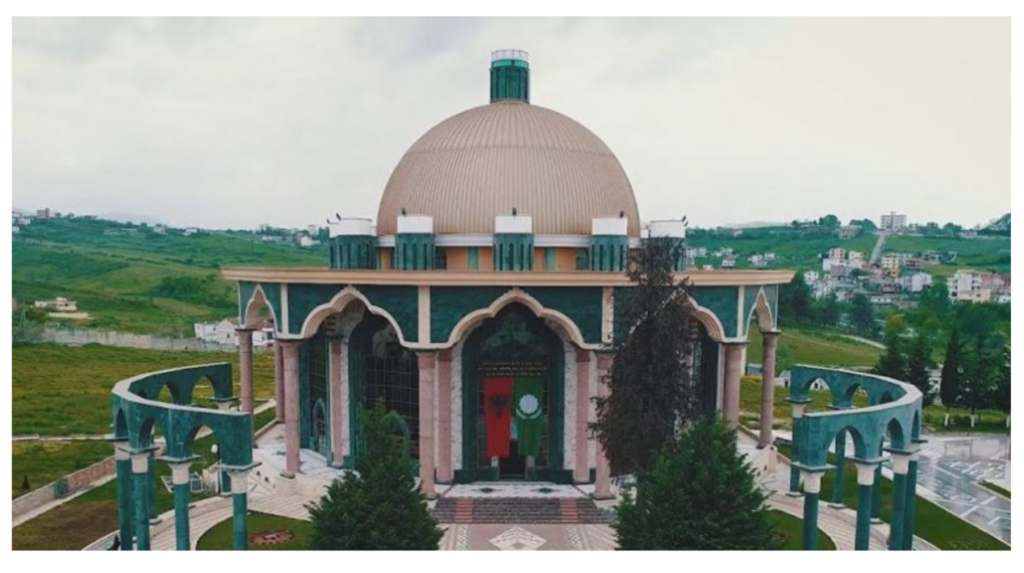
By nine the road that winds to the Kryegjyshata — the World Headquarters of the Bektashi Order, set among old trees on a wooded hill above the city — is already thick with people. Old men in dark suits who have made this climb for forty years. Young women carrying children dressed in colors that belong to a warmer month. Diplomats in overcoats moving with the careful ambiguity of people who attend religious ceremonies professionally and find, each year, that something happens to them anyway.
From inside the compound: a choir that has not agreed to blend.
The voices come from the Labëria, from the highlands, from the coast — regions that have been arguing about nearly everything for centuries and have agreed, improbably, on this. Each voice carries its own line through the others. The dissonance is not a failure of harmony. It is the whole point, and it is also, if you listen long enough, a description of the country itself: many lines running in parallel, never fully resolving, the tension between them the source of the beauty rather than its obstacle.
The Bektashi Order has always understood this. It holds women and men in the same prayer space. It reaches for wine as metaphor and, its critics charge, occasionally as fact. It venerates Ali with a devotion that carries Shia inflections while maintaining, with cheerful stubbornness, that these categories were invented by people with insufficient imagination. The League of Imams in Albania calls Nevruz a pagan festival. The Bektashis have been hearing this since the sixteenth century and have arranged their entire theology around the suspicion that the accusation is correct, and that this is not a problem.
When the Baba speaks, the crowd goes quiet. He speaks about Ali. He speaks about spring. He extends blessings outward in widening circles — to orphans, to those in difficulty, to teachers, to soldiers, to anyone trying to build something from difficult material. The president is here. So is the prime minister and the opposition leader, because Sultan Nevruz long ago became something larger than a Bektashi holiday: a claim about what kind of country Albania is, or wants to be, repeated annually until the difference between those two things narrows.
Then the polyphony again, rising without resolution into the pine trees.
In Gjirokastër the pie comes out of the oven at half past ten.
The apartment is full. Vjollca’s daughter has driven up from Tirana. Her son-in-law — raised Sunni, married into the lakror fifteen years ago, has never once complained about this arrangement — is on his second raki, leaning in the kitchen doorway with the ease of a man who has understood that belonging to a family sometimes means belonging to its rituals before you understand them. The grandchildren are on the floor. The youngest, Arta, seven years old, has positioned herself at the corner of the table where she can watch her grandmother’s hands.
Vjollca sets the pie in the center. She says something quietly — not quite a prayer and not quite not a prayer, the way things are said in Albanian households where that line has always been drawn in water. Then she cuts. Twelve pieces. She hands them out without hurrying, the way you do when you understand that the ceremony is not the finding of the coin but the sitting together while everyone looks.
The room goes quiet with eating.
Then Arta holds up the coin.
She holds it between her thumb and forefinger the way she has seen her grandmother hold it — with the gravity of a child who has been told, without being told, that this object has been in this dough every spring for longer than anyone in the room can count, that it survived things most objects do not survive, that it is older than the public holiday it now appears on. She holds it up and the table goes still.
The son-in-law laughs first. Then everyone.
It is always this laugh. Vjollca’s mother laughed it with the curtains drawn. Vjollca laughed it the year the Kryegjyshata opened its doors again and Mother Teresa stood in the courtyard in the March light, looking like someone who had been expecting something exactly this strange. The grandchildren will laugh it in rooms no one in this apartment will ever see.
The coin turns up. The big things find their way back to the small ones that kept a place for them.
This is how spring works.
Livia Brunga is a prominent Albanian media personality and digital creator whose work bridges storytelling, culture, and the natural world. A long-time advocate for sustainable travel and environmental awareness, she explores Albania’s landscapes through a lens that blends curiosity, visual sensibility, and a deep personal connection to nature.